ML & Research
A new MIT study reveals that as artificial intelligence models are trained on larger datasets, the connection between individual training images and the final generated output dissolves. This "attribution decay" makes it difficult to assign authorship or trace specific influences in AI-generated art.
Aug 19, 2026 · 3 min read
4 connections in the Atlas
ML & Research
Researchers have introduced Chain-of-Experience (CoE), a method allowing large language models to continually improve performance and reduce API costs through iterative inference-time interactions. This approach, which incorporates self-feedback and environmental signals, resulted in a 5.6% overall performance gain and 19% lower API costs across various tasks and models.
Aug 19, 2026 · 3 min read
9 connections in the Atlas
ML & Research
New research describes "model hypnosis," a phenomenon where individually weak and seemingly irrelevant cues in prompts can be systematically combined to strongly control AI model behavior. This control extends across various model families and scales, including advanced reasoning models, and the hypnotic prompts can transfer between different models.
Aug 18, 2026 · 3 min read
6 connections in the Atlas
ML & Research
A team of researchers has lowered the upper bound for the matrix multiplication exponent, denoted as $\omega$, to less than 2.371177. This improvement, achieved through a new optimization algorithm refined with Google DeepMind's AlphaEvolve, represents a theoretical advance in computational efficiency for numerous algorithms.
Aug 18, 2026 · 3 min read
4 connections in the Atlas
ML & Research
An eight-year Finnish study found that children with more screen time exhibited better cognitive processing during adolescence. Researchers suggest the type of screen activity, emphasizing learning and creativity, is more critical than duration alone.
Aug 17, 2026 · 2 min read
ML & Research
A new study reveals that large language models predominantly recommend physicians based on reputation signals like ratings, rather than demographic factors such as gender or ethnicity. This finding positions LLMs as "AI infomediaries" in healthcare, silently shaping patient choices at scale.
Aug 17, 2026 · 3 min read
3 connections in the Atlas
ML & Research
Researchers at Penn State University have developed a bio-hybrid memory device that integrates synthetic DNA with a perovskite semiconductor, achieving significantly lower power consumption than traditional storage. This new memristor technology can store and process information in the same location, potentially improving the energy efficiency of AI systems and next-generation computers.
Aug 17, 2026 · 2 min read
ML & Research
Researchers have introduced Intern-S2-Preview, a series of scientific agentic foundation models designed for multimodal understanding and long-horizon tasks. The models employ a hybrid training pipeline that includes multimodal pre-training and reinforcement learning.
Aug 16, 2026 · 2 min read
7 connections in the Atlas

ML & Research
A recent study demonstrates that coupling a single qubit to a conventional sensor can exponentially reduce the number of measurements needed to learn classical signals, achieving a 10 million-fold improvement in experimental settings. This quantum advantage, formalized by the Quantum Phase-Space Inference (Q$Ψ$) framework, promises to accelerate data acquisition and analysis in various sensing applications.
Aug 16, 2026 · 3 min read
4 connections in the Atlas
ML & Research
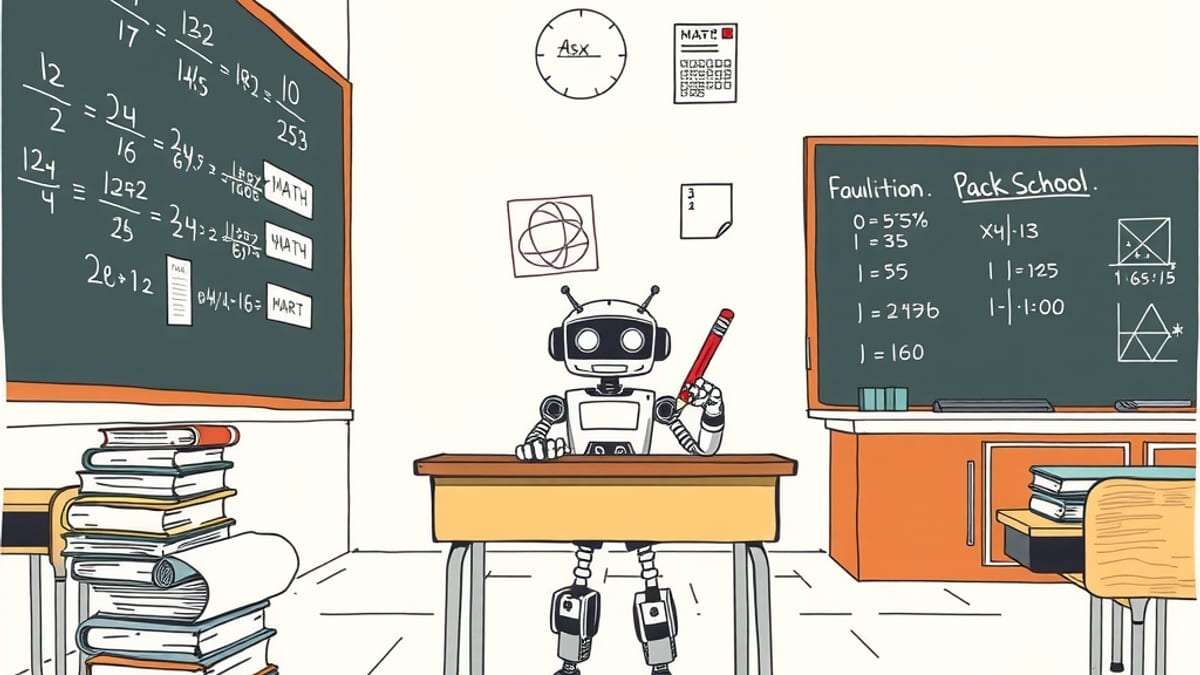
Researchers have developed LITTLECURRICULUM, an 88-billion-token pretraining corpus based on U.S. elementary school material, and LITTLELEARNER, a 5-billion-parameter language model trained exclusively on it. This initiative provides a controlled environment to study how language models acquire and represent knowledge within defined boundaries.
Aug 16, 2026 · 3 min read
3 connections in the Atlas

ML & Research
Researchers have introduced DARTree, a training-free method that accelerates autoregressive language model inference by extending a pretrained correction head from sequential chains to parallel tree structures. This approach broadens the range of candidate tokens considered, leading to faster generation without compromising output quality.
Aug 16, 2026 · 3 min read
5 connections in the Atlas
ML & Research
New findings analyzing millions of mouse cells indicate that aging is a structured, developmental process rather than a chaotic accumulation of cellular damage. This research challenges long-held theories about the nature of aging.
Aug 14, 2026 · 2 min read
1 connection in the Atlas