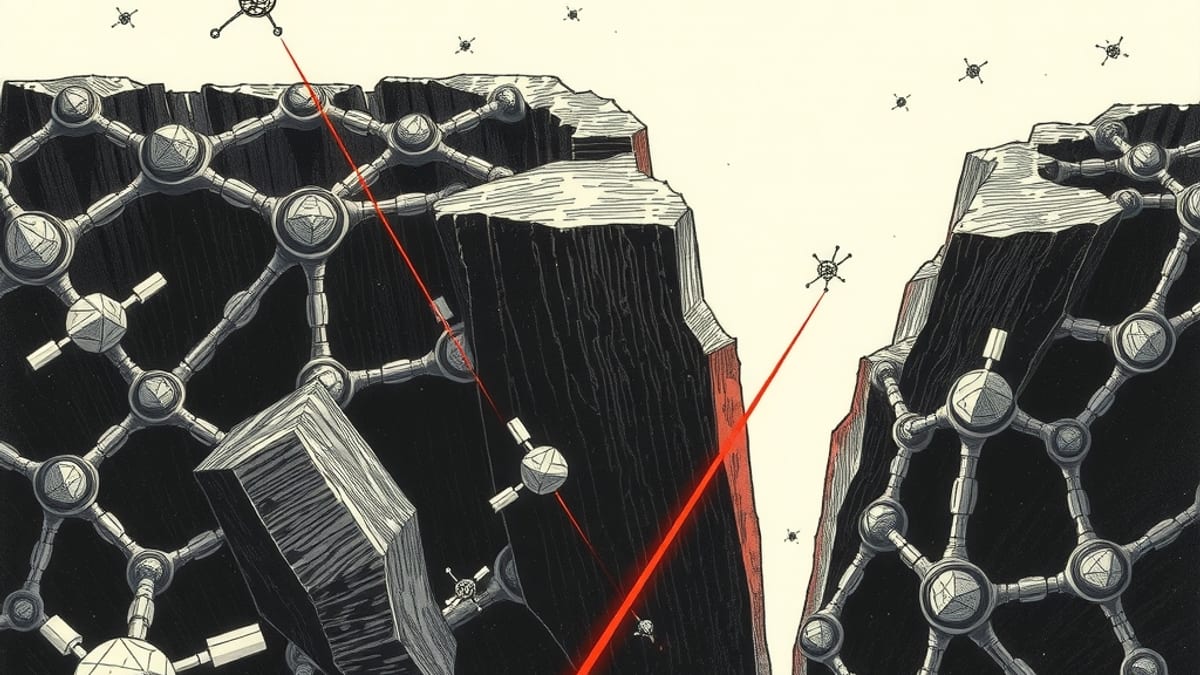
A new artificial intelligence framework named GBClaw integrates large language models (LLMs) with specialized agents and domain-specific tools to investigate the structure and deformation of general grain boundaries at the atomic level. This approach aims to overcome the complexities that have historically hindered research into these critical interfaces in polycrystalline materials.
The GBClaw framework employs a modular architecture that includes an orchestrator, distinct agents, tools tailored for specific scientific domains, interfaces for simulation software, and a hierarchical memory system. This design allows the AI to manage complex research workflows, automate simulations, and analyze results. By automating the investigation of general grain boundaries, which constitute the majority of interfaces in materials but are challenging to study due to their structural complexity and mismatch, GBClaw seeks to accelerate mechanistic discovery in materials science. The framework has already been used to simulate fourteen asymmetric nickel grain boundaries, revealing that defect layers significantly influence grain boundary sliding strength and identifying metastable structures with unusually high resistance to deformation.
The development of advanced AI frameworks for materials discovery is an active area of research. For instance, the AtomisticSkills harness framework enables AI coding agents to conduct atomistic research across materials science and chemistry by decomposing workflows into agent skills and tools, integrating over 100 human-curated skills for database access, modeling, and simulation engines. Similarly, the GATE framework learns multiple material properties simultaneously, identifying cross-property correlations to improve screening efficiency and has been applied to discover potential immersion coolants for data centers. These efforts highlight a growing trend toward using AI to automate and accelerate complex scientific investigations, aiming to bridge the gap between computational predictions and experimental validation.
General grain boundaries, the focus of GBClaw, are particularly important because they, along with other microstructural features, significantly influence material properties such as strength, conductivity, and corrosion resistance. However, their inherent structural diversity and the difficulty in characterizing them experimentally or computationally have limited a deeper understanding of their behavior. Traditional methods for studying grain boundaries often involve complex simulations or experiments that are time-consuming and resource-intensive.
GBClaw's agentic approach allows for a more dynamic and adaptive research process. The LLMs within the framework can interpret scientific literature and research goals, guiding the specialized agents to select appropriate tools and simulations. The hierarchical memory system enables the agents to retain and recall information from previous steps, facilitating complex, multi-stage investigations. This is crucial for mechanistic discovery, where understanding the step-by-step processes of material deformation or transformation is key.
The successful application of GBClaw to nickel grain boundaries suggests its potential for broader use in materials research. By automating the exploration of these complex interfaces, researchers may gain new insights into material failure mechanisms, develop novel alloys with enhanced properties, and accelerate the design of materials for demanding applications. The framework's ability to identify metastable structures with high deformation resistance could be particularly valuable for developing tougher and more durable materials.
The ongoing integration of such AI frameworks into experimental and simulation-based research projects signals a shift towards more automated and data-driven materials discovery. This trend is expected to reduce the time and cost associated with developing new materials, potentially leading to faster innovation across various industries.