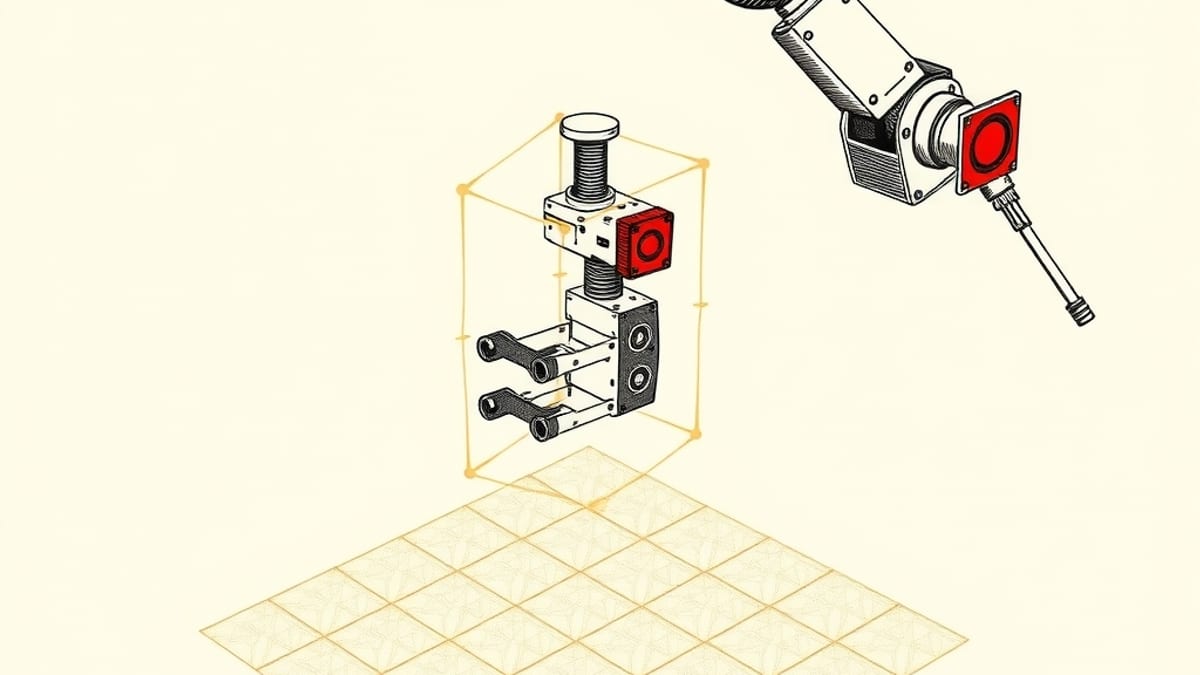
Researchers have developed a framework that allows artificial intelligence agents to create functional computer-aided design (CAD) mechanisms, overcoming a common limitation where AI-generated designs look plausible but do not work in practice. The system, named FunCAD-Harness, was detailed in a paper published on arXiv.
Current large language model (LLM) agents can produce visually appealing CAD assemblies. However, these digital creations frequently fail to meet the intended physical requirements when put to the test. This gap arises because LLMs often lack the ability to fully grasp the nuances of physical interactions and functional constraints. The new framework aims to bridge this divide by enabling AI agents to interpret underspecified design requests, construct mechanisms, and then iteratively refine them based on feedback from physical simulations.
Verifying that a CAD mechanism will function as intended is a complex task. Different designs can achieve the same outcome through varied components, control strategies, and operational sequences. FunCAD-Harness tackles this by translating abstract functional requirements into specific physical tests tailored for each candidate mechanism. The results from these simulated tests then guide the AI agent in making necessary revisions to the design.
To systematically assess the effectiveness of this approach, the researchers also introduced FunCADBench. This benchmark comprises 46 different families of mechanisms, each involving interdependent and multi-step operations. Experiments conducted using frontier LLM agents demonstrated that FunCAD-Harness can identify subtle mechanical flaws that are not apparent through visual inspection alone. This capability substantially improves the success rates of functional designs compared to standard simulation-augmented methods.
The development marks a step toward creating CAD agents that can reliably translate human intent into functional physical mechanisms. Previous work in text-to-CAD generation has focused on translating natural language into design code or generating 3D models from textual descriptions. While these efforts have shown progress in producing visually accurate models, ensuring their functional viability in a physical context has remained a significant challenge. Systems like CAD-GPT and FutureCAD have explored generating CAD construction sequences or using B-Rep primitives, but the integration of direct functional testing within the design loop is a key innovation of FunCAD-Harness. The project page for FunCAD-Harness is available at thegenlab.ai/funcad/.