ML & Research
A new study indicates the outer solar system will become dynamically unstable about one billion years after the Sun becomes a white dwarf, significantly reducing previous stability estimates. Researchers suggest the Sun's irregular mass loss, rather than external stellar encounters, will drive this instability.
Oct 4, 2026 · 2 min read

ML & Research
A new topology-aware 3D generation framework called SILSA uses sliding-window slice latents to represent shapes, improving structural fidelity and reducing generation costs. This approach preserves cross-sectional continuity and enables single-stage generation, outperforming previous methods in metrics like PSNR and Betti error.
Oct 3, 2026 · 1 min read
2 connections in the Atlas
ML & Research
Researchers have developed AutoCompact, a method that trains coding agents to decide when and how to compact their context during long-horizon tasks. This approach improves efficiency and task completion rates by intelligently summarizing and preserving essential working states, rather than relying on fixed thresholds.
Oct 3, 2026 · 2 min read
3 connections in the Atlas

ML & Research
Researchers have introduced KaliBench, a new benchmark designed to assess how accurately large language models (LLMs) generate executable command-line interface (CLI) instructions for cybersecurity tools. Initial evaluations using KaliBench indicate that no open-weight LLM achieved higher than 42% exact-command accuracy in unrestricted settings.
Oct 3, 2026 · 1 min read
1 connection in the Atlas

ML & Research
University of California, Los Angeles researchers have developed an optical-neural processor that uses light to detect deepfake videos. The system analyzes multiple video streams simultaneously, achieving nearly 98% accuracy and potentially reducing computational demands for large-scale screening.
Oct 2, 2026 · 2 min read
2 connections in the Atlas
ML & Research
A new framework called HiPhy aims to make AI-generated videos more realistic by ensuring they adhere to the laws of physics. This approach addresses a key limitation in current video generation models, which often produce visually convincing but physically impossible scenes.
Oct 2, 2026 · 2 min read
1 connection in the Atlas

ML & Research
A new benchmark, ScholarCatalyst, has been developed to evaluate artificial intelligence systems' ability to identify research papers that inspire new scientific work. The benchmark uses annotations from 184 lead authors of computer science papers who identified which prior works influenced their projects.
Oct 2, 2026 · 2 min read
2 connections in the Atlas
ML & Research
A new framework called Reconstruct, Practice, Go Real (RPG) allows robots to autonomously improve their manipulation skills without needing to retrain their underlying models. This system identifies capabilities in existing datasets, practices them in simulation, and refines skills based on performance feedback.
Oct 2, 2026 · 2 min read
3 connections in the Atlas

ML & Research
Researchers at MIT have introduced VISTA, a visual harness designed to significantly improve the reasoning capabilities of general-purpose multimodal models in interactive settings. VISTA enables models to perceive environments directly through visual observations and maintain a lossless visual memory, leading to perfect scores on the ARC-AGI-3 benchmark.
Oct 2, 2026 · 2 min read
2 connections in the Atlas

ML & Research
Researchers from MIT's Computer Science and Artificial Intelligence Laboratory, in collaboration with Google and Northeastern University, have developed InstructMesh, a new tool enabling users to repair and customize AI-generated 3D models for fabrication. This software addresses the common issue of generative AI models prioritizing visual appeal over functional accuracy, making 3D design more accessible for both experts and novices.
Oct 2, 2026 · 2 min read
2 connections in the Atlas
ML & Research
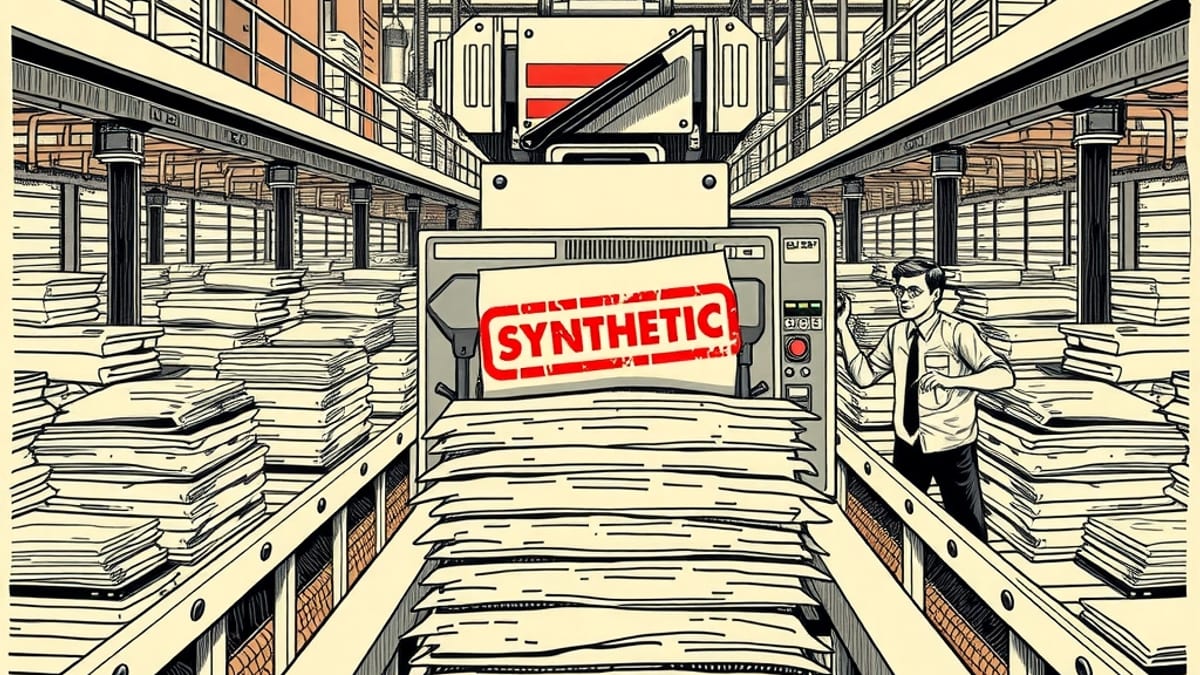
AI-generated text now makes up over 31% of web data, according to a new study. This rise in synthetic content increases the computational cost for training language models by as much as 60%.
Oct 1, 2026 · 2 min read
4 connections in the Atlas

ML & Research
The Allen Institute for AI has released Olmo-core 3, an open-source training infrastructure for large Mixture-of-Experts (MoE) models. This upgrade is designed to scale MoE training to trillion-parameter models while maintaining computational efficiency.
Oct 1, 2026 · 2 min read
4 connections in the Atlas