The estimated lifespan of the outer solar system has been significantly revised downward from hundreds of billions of years to a few billion years, according to new research published in The Astrophysical Journal Letters. The study, titled "Terminal Instability of the Solar System Triggered by Stochastic Solar Mass Loss," posits that the Sun's own death will be the primary cause of this instability, rather than distant stellar encounters.
Previous models largely assumed that the giant outer planets, Jupiter, Saturn, Uranus, and Neptune, would remain in stable orbits for up to 100 billion years after the Sun transitions into a white dwarf. Some estimates even extended this stability to a quintillion years. This longevity was predicated on the assumption that the Sun's mass loss during its red giant phase and subsequent collapse into a white dwarf would be a smooth and gradual process.
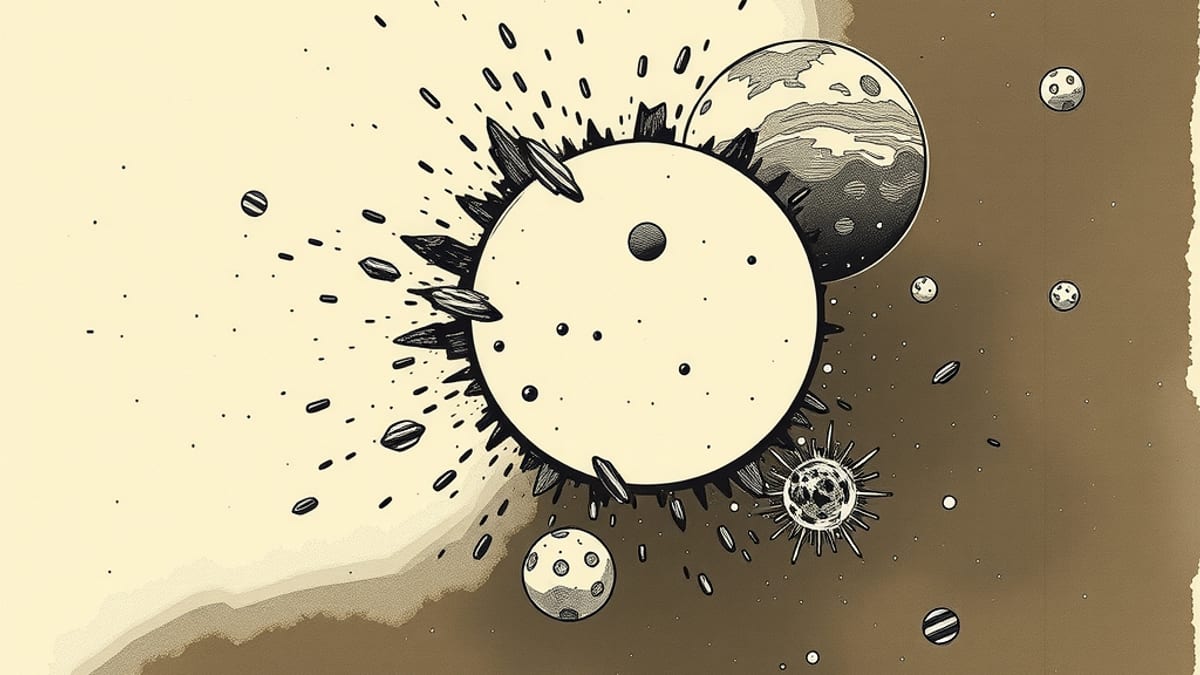
However, the new simulations by researchers, including Konstantin Batygin of the California Institute of Technology, suggest a different scenario. They propose that the Sun's mass loss will be asymmetric and involve discrete, independently directed ejections of material. These irregular ejections would impart impulsive perturbations, or "kicks," to the Sun's motion, causing the planets' orbits to "random-walk." This stochastic forcing could restructure the outer solar system concurrently with the Sun's death.
The study's numerical experiments revealed that orbital crossings among the outer planets could begin as early as the Sun's red giant phase. Approximately 40% of the simulations showed disruption or violent scattering of planets before the white dwarf even formed. Furthermore, about 90% of the simulated systems self-destructed within three billion years after the white dwarf formation. This means the dynamical lifetime of the outer solar system collapses from an estimated 10^18 years to approximately a gigayear after the white dwarf forms.
The Sun is currently about 4.57 billion years old and is expected to remain in its main-sequence phase for roughly another five billion years. After this, it will expand into a red giant, consuming Mercury, Venus, and potentially Earth. Mars might survive this initial expansion due to its distance. The instability described in the new research would occur much later, after the Sun has become a white dwarf.
This revised understanding suggests that the Sun, in its dying stages, will not merely enlarge the planetary system it built but will shake it, leading to its eventual dissolution. The findings echo concerns about the solar system's eventual breakdown that date back to Isaac Newton, who suspected the planetary order was mortal. While the timeline for this terminal instability is billions of years in the future and will not impact humanity, it fundamentally alters the theoretical endgame for the solar system.