ML & Research
Physicists have demonstrated a "quantum bath" that automatically entangles distant quantum bits, bypassing the need for constant active control. This method uses correlated microwave photons to push qubits into an entangled state, confirming a 20-year-old theory and potentially simplifying future quantum computer designs.
Aug 31, 2026 · 2 min read
1 connection in the Atlas

ML & Research
Researchers developed a new sepsis severity index using 43 routine variables over a 72-hour window, validated across two hospital systems. This novel index learns from patient mortality as a ranking signal, offering a dynamic alternative to static, decades-old scoring systems.
Aug 30, 2026 · 2 min read
2 connections in the Atlas

ML & Research
IBM and University of Chicago researchers completed a quantum computation using 70 error-corrected logical qubits, solving a problem considered intractable for classical methods in approximately 15 minutes. This demonstration also provided statistical evidence for the reliability of the quantum computer's result, addressing a key challenge in quantum advantage.
Aug 30, 2026 · 2 min read
1 connection in the Atlas
ML & Research
Researchers from Google Research and Virginia Tech have introduced WikiSkill, a new framework that enhances AI agent capabilities by compiling agent experience into a persistent knowledge base. This system allows AI agents to systematically reuse insights from past interactions, leading to improved skill evolution and performance across various tasks and models.
Aug 30, 2026 · 2 min read
3 connections in the Atlas
ML & Research
Researchers have introduced an evaluation framework for AI model security scanners that moves beyond conventional F1 metrics, distinguishing between a scanner's ability to provide a security judgment and the accuracy of that judgment. This framework provides a more comprehensive assessment of scanner performance, considering factors like analysis completion and definitive security decisions.
Aug 29, 2026 · 2 min read
5 connections in the Atlas
ML & Research
Researchers have developed a Graph Neural Network (GNN) system designed for large-scale friend recommendation on social platforms with hundreds of millions of users. The system employs multi-hash ID embeddings to manage memory for high-cardinality features and temporal neighbor sampling to capture evolving social contexts.
Aug 28, 2026 · 3 min read
ML & Research
Researchers have developed CLAP, a framework that enables action-conditioned video generation models to learn from varied internet-scale videos, including both human and robotic actions. This approach allows the models to acquire a more general understanding of physical laws, facilitating zero-shot robot manipulation in real-world scenarios.
Aug 28, 2026 · 3 min read
4 connections in the Atlas
ML & Research
Researchers have introduced Puro-2B, an open pretraining recipe that enables cost-efficient language model development on consumer-grade RTX 5090 GPUs. This initiative aims to broaden access to advanced model training, which has historically been restricted by high computational expenses.
Aug 28, 2026 · 2 min read
4 connections in the Atlas
ML & Research
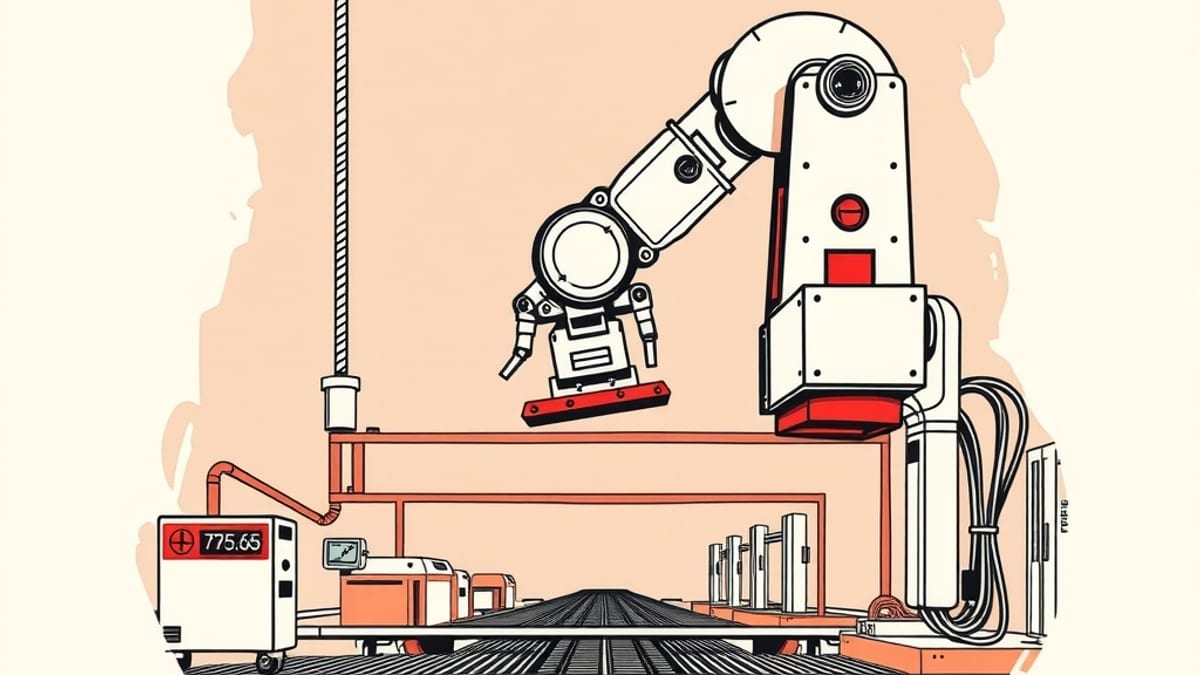
A new model called Zero-WAM allows robots to perform tasks they have not been trained on by watching human demonstration videos. This approach uses in-context learning, similar to large language models, to generalize robotic manipulation skills.
Aug 27, 2026 · 2 min read
6 connections in the Atlas

ML & Research
A new AI system called the Planetary Prediction Engine (PPE) can now perform complex geospatial modeling tasks using only natural language commands. This system automates data retrieval, fusion, and model selection, streamlining the creation of predictive planetary models.
Aug 27, 2026 · 3 min read
3 connections in the Atlas

ML & Research
Researchers have demonstrated that language model agents in a simulated environment called SwarmWorld can self-organize into technological societies without predefined roles or direct communication. This decentralized approach enabled the agents to collectively develop a broader range of resilient technologies compared to individual agents searching independently.
Aug 27, 2026 · 2 min read
3 connections in the Atlas

ML & Research
Researchers have introduced VBVR-Pro, a new closed-loop testbed designed to advance native visual reasoning by treating visual generation as the reasoning medium itself. This platform includes 300 procedurally generated tasks, offering a scalable and verifiable environment for training and evaluating models.
Aug 27, 2026 · 2 min read
5 connections in the Atlas