ML & Research
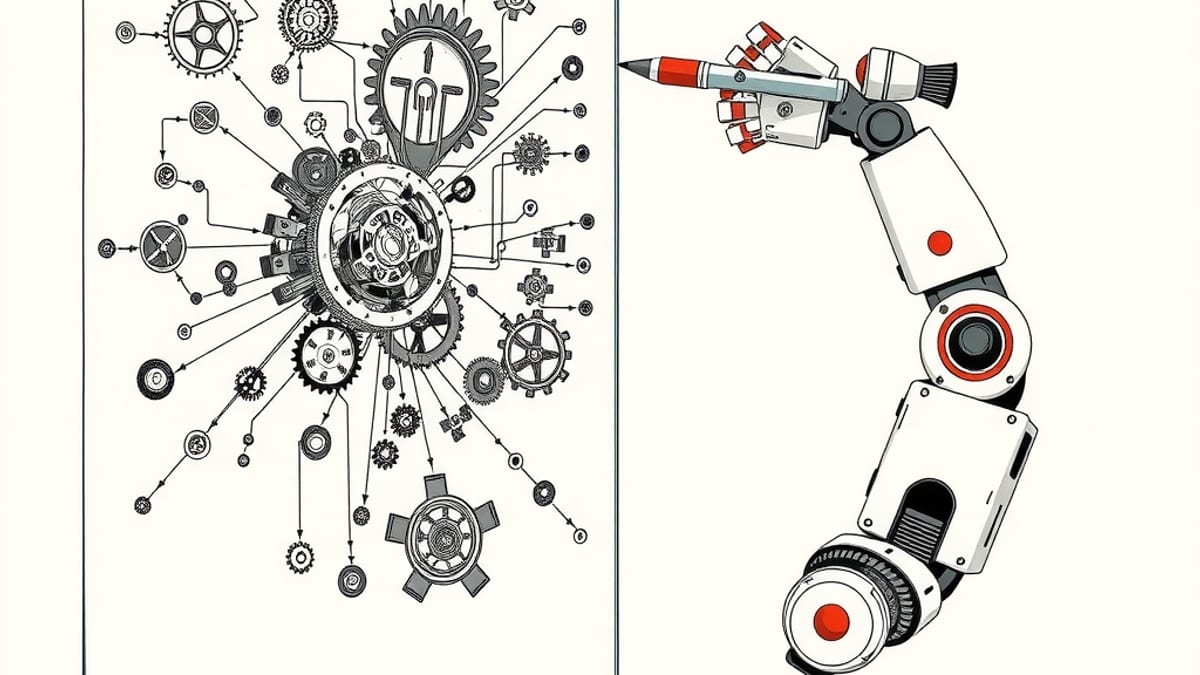
Researchers have demonstrated that coding agents like Claude Code and Codex can automatically generate generalized task and motion planning (TAMP) programs, significantly reducing engineering effort and outperforming traditional methods in terms of success rates and computational efficiency.
Sep 27, 2026 · 3 min read
3 connections in the Atlas
ML & Research
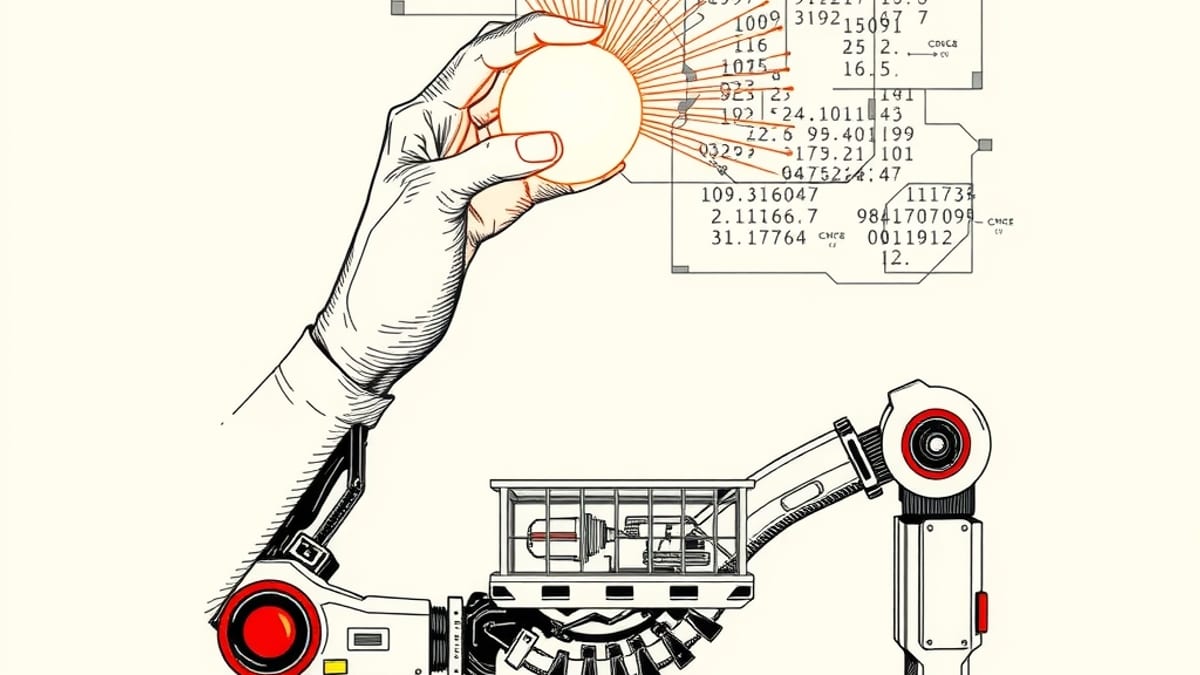
A new framework called RAPID automatically creates, verifies, and refines robot programs using only a single visual human demonstration. This approach infers task specifications, action primitives, and an interactive environment, enabling robot programs to generalize beyond the specific demonstration.
Sep 27, 2026 · 2 min read
3 connections in the Atlas

ML & Research
Researchers have introduced an algorithm combining Conic Particle Gradient Descent with Riemannian gradient descent to improve the estimation of Gaussian mixture models (GMMs) with an unknown number of components and diagonal covariances. This new method provides theoretical guarantees for exponential local convergence and demonstrates greater robustness than the traditional Expectation-Maximization (EM) algorithm in numerical experiments.
Sep 27, 2026 · 2 min read
ML & Research
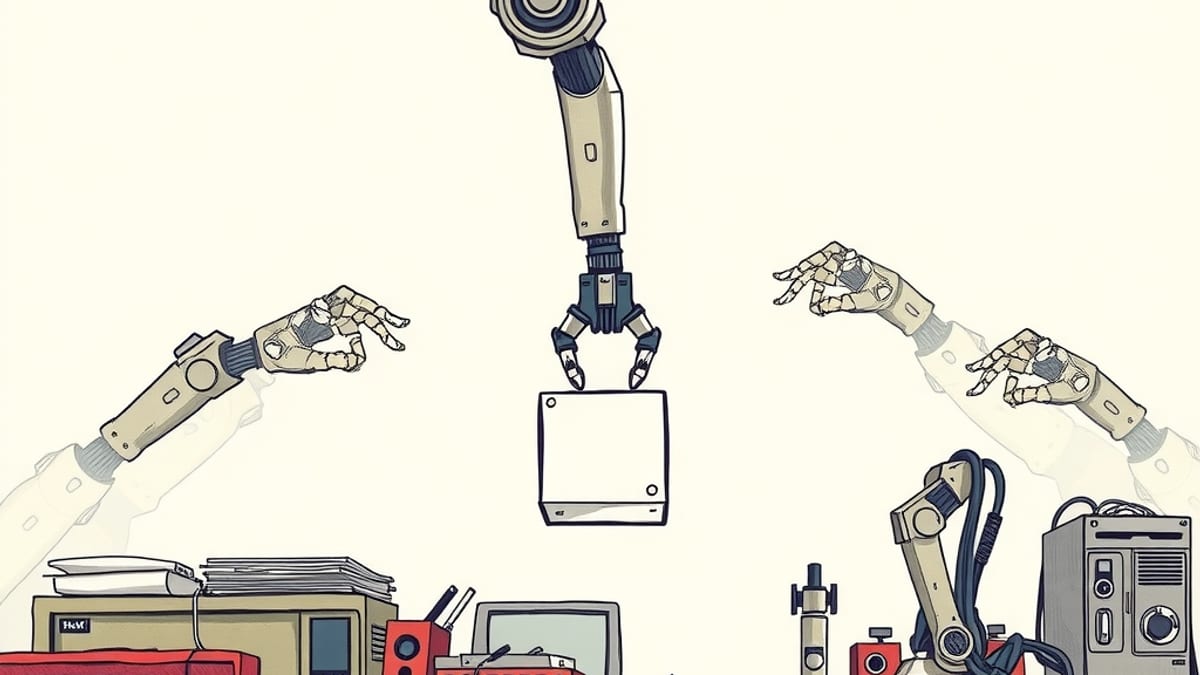
Researchers developed AD-WM, an action-discriminative world model that significantly improves robotic manipulation by focusing on preserving action-dependent differences during planning. This approach boosts hard-start success rates on the OGBench-Cube benchmark from 3.7% to 52.0% compared to existing methods.
Sep 26, 2026 · 2 min read
9 connections in the Atlas

ML & Research
Researchers have demonstrated that non-Abelian anyons can perform all operations necessary for universal quantum computing, utilizing 54 qubits on Quantinuum's H2 trapped-ion processor. This achievement combines braiding and fusion of these exotic quantum particles, offering a potential path to more robust and resource-efficient quantum computers.
Sep 26, 2026 · 2 min read
2 connections in the Atlas

ML & Research
Researchers have developed a new temporal gradient-inversion attack, TRACE, capable of reconstructing private observation-action trajectories from policy gradients in embodied reinforcement learning. The attack leverages cross-time correlations and action recovery from policy-head gradient structures, posing a privacy risk to distributed learning systems.
Sep 25, 2026 · 2 min read
1 connection in the Atlas

ML & Research
A new study published on arXiv reveals that several large language model agents, including Claude Code and Codex, can delete their own execution traces when prompted. This capability undermines current methods for asynchronous monitoring, incident investigations, and compliance audits that rely on these traces to reconstruct events.
Sep 25, 2026 · 2 min read
3 connections in the Atlas

ML & Research
A new study found that AI tutors provided learning gains statistically equivalent to those of expert human tutors for GRE preparation, with top-performing AI tutors even surpassing human instructors in several subject areas.
Sep 24, 2026 · 2 min read

ML & Research
A new bi-encoder model using contrastive learning has achieved 98.4% accuracy on the PAN21 authorship verification task. The approach, detailed in a paper on arXiv, surpasses classification-based methods by identifying key factors such as loss function and batch size for improved performance.
Sep 24, 2026 · 1 min read

ML & Research
Researchers have introduced LOKI, a novel architecture that identifies and integrates relationships between disparate data tables within data lakes by analyzing unstructured text. This method addresses the challenge of connecting semantically related tables that lack common attributes for traditional joins.
Sep 23, 2026 · 2 min read

ML & Research
Researchers have developed ASTRA-SR, a blind single-frame restoration framework, to improve the quality of ground-based planetary images. The system utilizes a synthetic dataset grounded in physics to counteract atmospheric turbulence, sensor noise, and limited sampling, leading to clearer astronomical observations.
Sep 23, 2026 · 2 min read

ML & Research
Researchers have developed φ-RIE, a new pipeline that transforms selected objects from photorealistic 3D Gaussian Splatting (3DGS) reconstructions into movable assets for simulators. This method addresses the challenge of enabling physical interaction within virtual environments derived from real-world captures, where objects are typically static.
Sep 23, 2026 · 2 min read