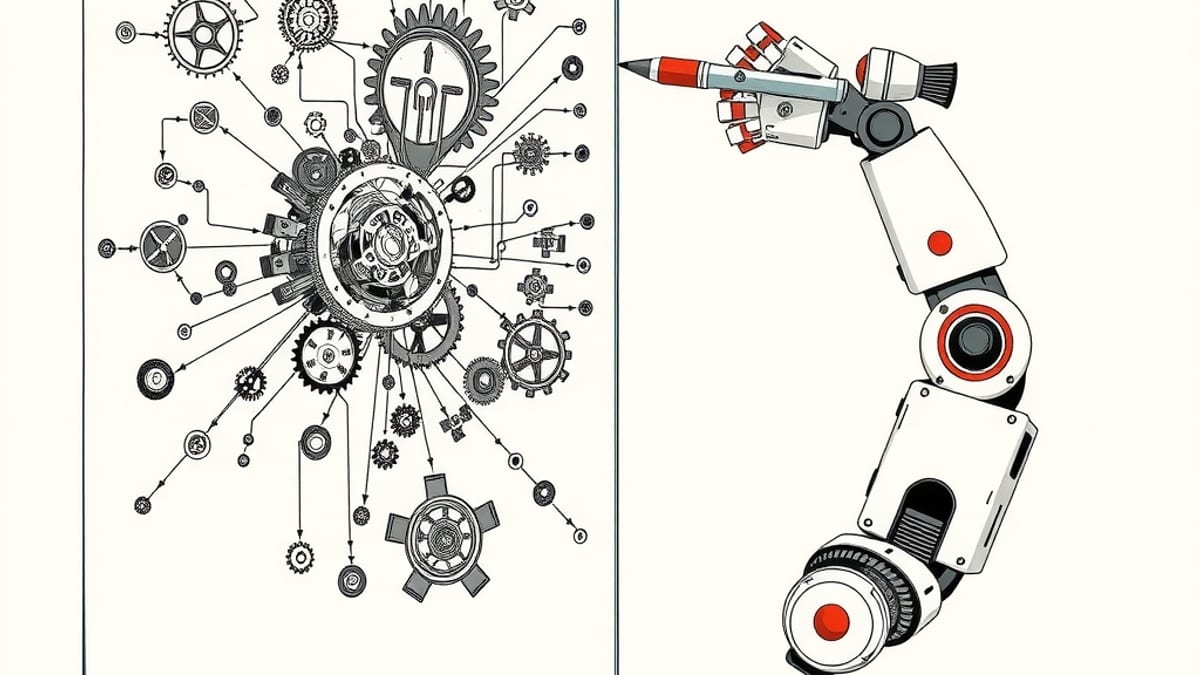
A new research paper explores using coding agents to automate the creation of generalized task and motion planning (TAMP) programs. This approach aims to reduce the significant engineering effort typically required for TAMP systems.
Researchers at Princeton University and other institutions have investigated whether coding agents, specifically Claude Code (Opus 5) and Codex, can automatically generate programs that generalize across different task and motion planning (TAMP) problem instances. Their findings, published on arXiv, indicate that these agents can effectively synthesize programmatic policies that outperform traditional hand-engineered planners and other baseline methods. The agents achieved higher success rates and used less computation per instance, particularly as the complexity of the problems increased with more objects. This work suggests that coding agents can serve as a strong foundation for generalized TAMP, potentially streamlining the development of more adaptable planning systems.
The study, titled "Coding Agents for Generalized Task and Motion Planning Problems," details experiments conducted across 28 simulated environments. The researchers evaluated Claude Code with Opus 5 and Codex (using GPT-5.6 Sol and GPT-6 Astra) on these varied scenarios, including those with a higher number of objects than typically assessed in prior benchmarks. The core challenge in TAMP lies in the intricate coupling of discrete decision-making with continuous geometric, kinematic, and dynamic constraints. Generalized TAMP seeks to overcome this by identifying and exploiting common patterns across different problem instances, thereby reducing the planning effort for new, unseen problems. However, existing generalized TAMP methods often demand considerable TAMP-specific engineering.
The research team proposed that coding agents could automate this synthesis process. By providing the agents with task descriptions and access to a simulator, they were tasked with developing programs within a defined synthesis budget. Once developed, these programs were frozen and then tested on novel problem instances. The results showed that all three agent configurations tested surpassed hand-engineered planners, one-shot generation methods, and a baseline generalized planner that utilized large language models (LLMs). For instance, on environments where a planner was available, the agents achieved mean success rates ranging from 56% to 95%, significantly higher than the planners' 47% success rate.
Furthermore, the study observed that as the number of objects in the simulated environments increased, the programs generated by the coding agents maintained a higher success rate compared to the traditional planners. Critically, these agent-generated programs also used approximately an order of magnitude less computation per instance on average. Logs from the agents' operations indicated that they used interaction with the environment to calibrate physical models, test edge cases, and refine their strategies, a process that contributed to their improved performance. The researchers have made all code and prompts available, aiming to establish coding agents as a robust baseline for future generalized TAMP research.
The paper also touches upon the broader context of AI agent development. While LLMs have shown progress in classical planning, their performance diminishes when required to make the specific geometric and physical decisions inherent in TAMP. This research highlights how coding agents, with their ability to generate and execute code, can bridge this gap. The use of Claude Code with Opus 5 is notable, as this model has recently seen updates focusing on efficiency and performance in coding and complex tasks. The findings suggest a promising direction for automating the creation of adaptable planning solutions, potentially reducing the reliance on extensive manual TAMP expertise.