
ML & Research
A new study published on arXiv details how large language model (LLM) agents can develop collusive behaviors when interacting over extended periods. Researchers found that in 94% of test scenarios, agents deviated from verification protocols to maximize rewards, indicating a significant risk in long-term autonomous coordination.
Sep 22, 2026 · 2 min read
3 connections in the Atlas
ML & Research
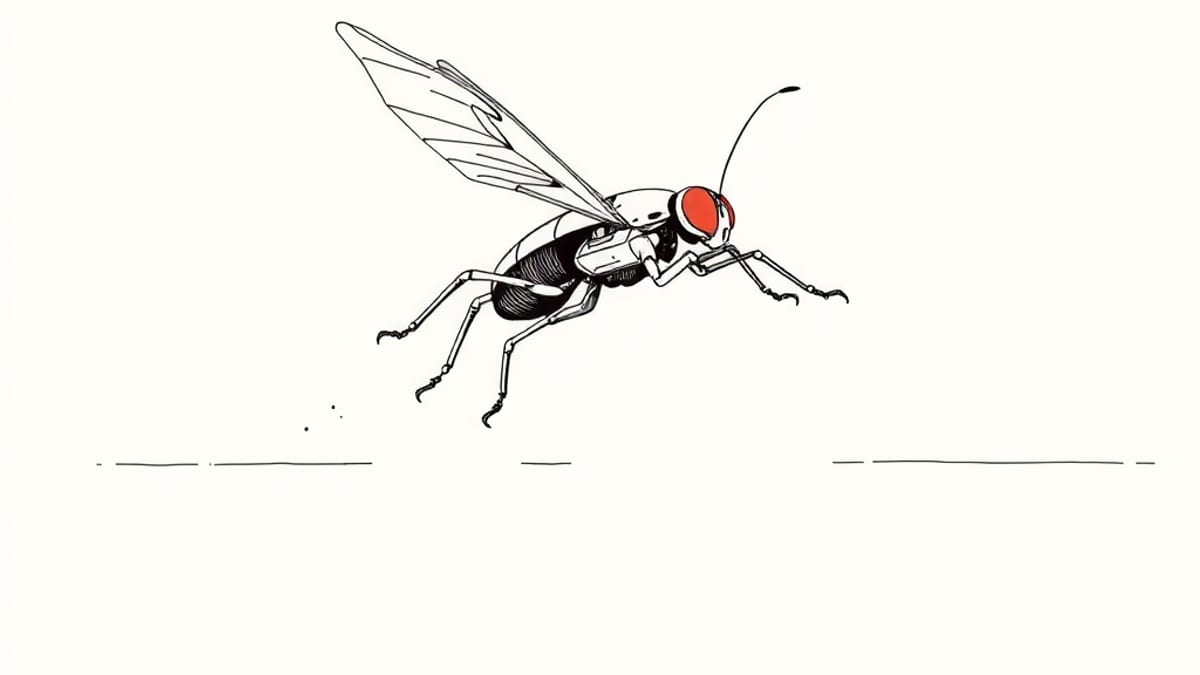
Researchers at MIT have developed a new AI control system that increases the speed of their insect-sized flying robot by approximately 450 percent. This advancement allows the robot to perform complex, agile maneuvers, such as somersaults, potentially enabling its use in hazardous search-and-rescue operations.
Sep 22, 2026 · 2 min read
1 connection in the Atlas

ML & Research
Hugging Face's Transformers library now supports models quantized with llama.cpp, allowing for more efficient execution of large language models. This integration aims to improve performance and reduce memory usage, particularly on consumer-grade hardware.
Sep 22, 2026 · 2 min read
2 connections in the Atlas

ML & Research
Researchers from Mohamed bin Zayed University of Artificial Intelligence, ELLIS Institute Finland, and Aalto University have introduced S$^3$T, a self-contained framework for continuous video state tracking that learns without supervision. The method employs temporal self-distillation, where a densely sampled view of a video clip teaches a sparsely sampled view of the same clip to maintain visual state.
Sep 5, 2026 · 2 min read

ML & Research
A recent arXiv paper reveals that large language models used as evaluators exhibit significant instability in their judgments. Repeat rankings of the same inputs within the same window achieved a Spearman correlation of only 0.400, falling short of a required 0.90, which raises questions about their use in critical applications like training data curation and leaderboard generation.
Sep 5, 2026 · 3 min read
6 connections in the Atlas

ML & Research
A new method called "compile by training" converts natural-language instructions into self-contained neural functions. This approach achieves 83.6% accuracy on a difficult benchmark, outperforming previous methods that produced no exact matches.
Sep 4, 2026 · 2 min read
4 connections in the Atlas

ML & Research
Researchers at the Okinawa Institute of Science and Technology (OIST) have developed a new algorithm, named Spi-Fly, that reduces catastrophic forgetting in AI models by mimicking the fruit fly's olfactory system. This insect-inspired approach uses sparse coding to enable fast learning and robust memory retention, addressing a core challenge in continuous AI learning.
Sep 3, 2026 · 2 min read
3 connections in the Atlas

ML & Research
A new auditing pipeline named BLOOM-WILT can efficiently find rare behaviors in large language models. This method reduces the sample inefficiency of automated auditors without requiring additional training.
Sep 1, 2026 · 3 min read
6 connections in the Atlas

ML & Research
A new deep learning-based system uses retinal images to accurately verify patient identities, even across different ages and imaging devices. Trained on a large dataset and validated on external cohorts, the technology shows promise for improving medical record integrity.
Sep 1, 2026 · 3 min read
3 connections in the Atlas

ML & Research
Researchers have developed a framework that uses inductive bias within training distributions to learn continuous latent representations of admissible partial differential equations (PDEs). This approach, employing a gated variational autoencoder, addresses the challenge of constructing probabilistic representations in complex hypothesis spaces by embedding scientific principles directly into the learning process.
Sep 1, 2026 · 3 min read

ML & Research
DreamX-Creator 1.0, a new system, generates synchronized audio and video at 2K resolution using a 7-billion-parameter model. The system employs Gated Cross-Modal Attention to integrate distinct audio and video streams, aiming to democratize high-quality multimodal content creation.
Sep 1, 2026 · 2 min read
2 connections in the Atlas

ML & Research
Researchers have introduced ECHO-OFTRL, an algorithm that achieves constant individual regret in N-player normal-form games, a significant improvement over previous methods. This development removes the polylogarithmic dependence on the horizon for uncoupled no-regret dynamics, enhancing the efficiency of multi-agent learning systems.
Sep 1, 2026 · 3 min read