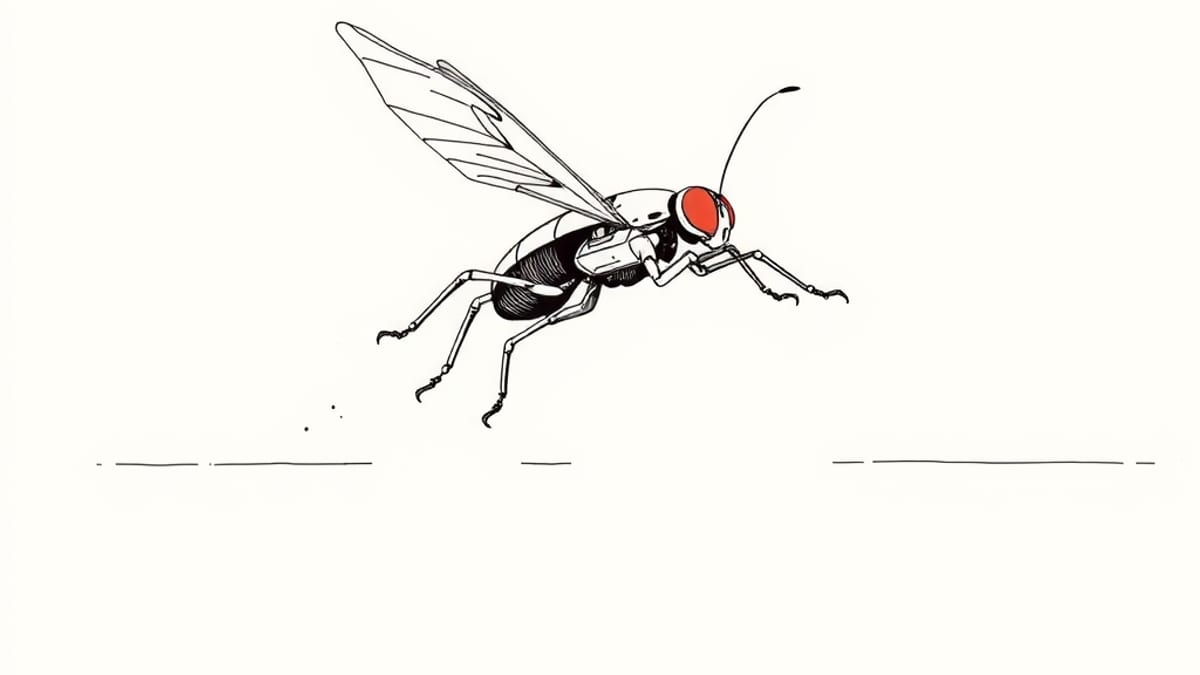
A team at the Massachusetts Institute of Technology (MIT) has significantly enhanced the flight capabilities of its insect-scale robot through an AI-based control system. The new system boosts the robot's speed by about 450 percent and its acceleration by roughly 250 percent compared to previous iterations. This improvement allows the tiny robot to execute demanding aerial maneuvers, including performing 10 consecutive somersaults in 11 seconds while maintaining its trajectory within a few centimeters.
The microrobot, which weighs less than a paperclip and spans four centimeters, utilizes flapping wings powered by soft artificial muscles. Earlier versions of the robot relied on a hand-tuned control system, which limited its speed and agility. The new AI controller addresses this limitation by balancing high performance with computational efficiency. The control system is a two-part scheme that combines a model-predictive planner with an imitation-learned policy. The model-predictive controller forecasts the robot's behavior and selects optimal actions to follow a planned route, even for complex maneuvers like somersaults and sharp turns. This planner also considers the robot's force and torque generation limits to maintain control. The second part, an imitation-learned policy, compresses these computationally intensive algorithms into an efficient real-time system.
The enhanced agility means the robot can now mimic the rapid, aggressive movements of insects, a capability previously out of reach for aerial microrobots. Experiments showed the robot could perform saccade movements, where it pitches aggressively, flies rapidly, and then pitches in the opposite direction to stop. This behavior is crucial for insects to localize themselves and maintain clear vision. The robot maintained control even when subjected to wind disturbances exceeding one meter per second.
Researchers envision these agile microrobots assisting in search-and-rescue missions, particularly in environments like earthquake rubble where their small size allows access to narrow spaces inaccessible to conventional drones. Future research will focus on integrating onboard cameras and sensors to enable autonomous outdoor flight, removing the reliance on external motion capture systems. The team also plans to investigate how onboard sensing could facilitate coordinated movements and collision avoidance among groups of these robots.