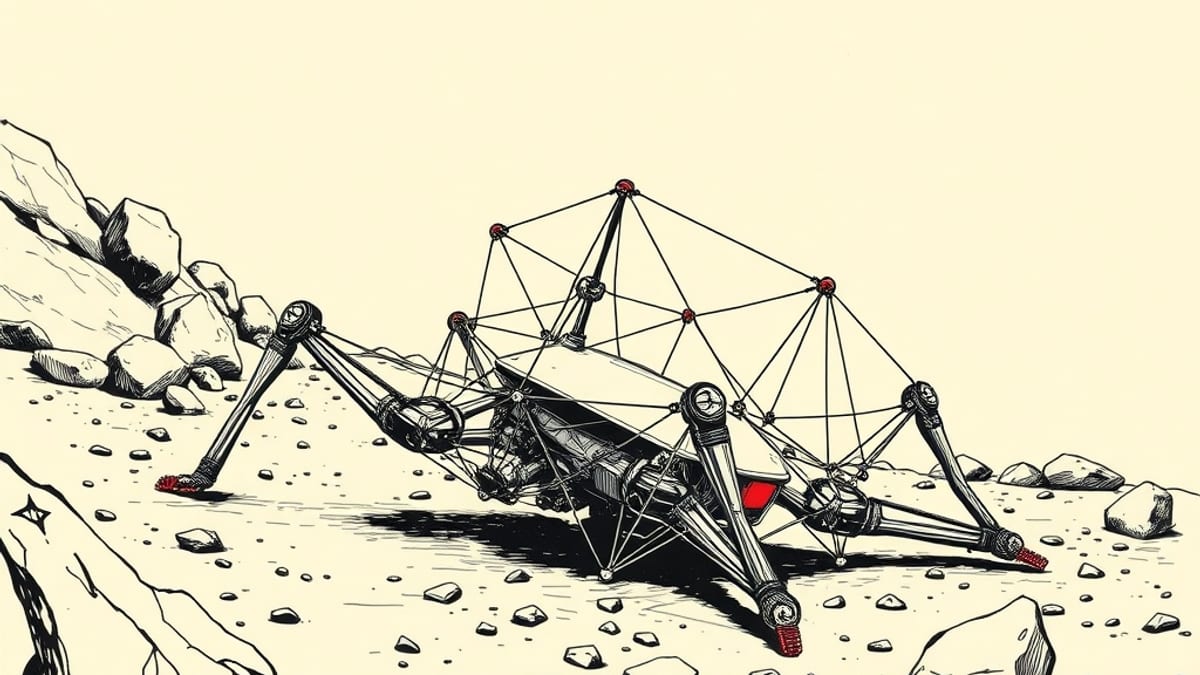
A new tensegrity robot, a hybrid structure combining rigid struts and elastic tendons, has demonstrated enhanced impact resistance and autonomous navigation in field environments. This development, detailed in Nature Machine Intelligence, addresses a long-standing challenge in robotics: creating compliant robots that maintain autonomous functionality. The robot, named Tribar, survived drops of at least 5.7 meters, accurately reconstructed its shape and orientation using onboard sensors, and achieved locomotion speeds of 18 bar lengths per minute.
Tensegrity structures, a portmanteau of "tension" and "integrity," consist of isolated rigid components held together by continuous tension elements, such as cables or springs. This architectural principle, first introduced by Buckminster Fuller in the mid-20th century, grants these structures a high strength-to-weight ratio, deployability, and inherent robustness to deformation. Researchers have explored tensegrity for robotics to create machines that can withstand impacts and adapt to unstructured terrain, properties often lacking in traditional rigid robots.
Previous tensegrity robot designs often faced limitations in speed, maneuverability, and onboard sensing, which hindered their practical application. The Tribar robot, however, integrates reliable, highly stretchable sensors for state estimation and closed-loop control, enabling it to overcome these challenges. It can estimate its shape and global orientation in real-time with these sensors, allowing for uninterrupted autonomous locomotion even after significant falls. The research team demonstrated Tribar's capabilities by rolling it off a cliff, after which it absorbed the impact and continued its movement in the same direction.
The robot's design allows for extreme deformations, a key factor in its impact resistance. This compliance, while beneficial for robustness, typically complicates control and modeling for autonomous navigation. To address this, some of Tribar's gaits were designed manually, while others were discovered through simulation. The robot's ability to climb inclines up to 28 degrees also surpasses the capabilities of other tensegrity robots.
The development of compliant robots is particularly relevant for future applications in perilous and remote environments, such as space exploration or disaster relief. NASA has actively supported research into tensegrity robotics, envisioning them as planetary rovers that can absorb strong impacts, recover from various landing orientations, and be compactly stored and deployed. The inherent resilience of tensegrity structures makes them suitable for missions where precise terrain knowledge is limited and landing conditions are unpredictable.
The research team aims for Tribar to serve as a platform and benchmark for further studies in compliant robotics. The project's approach, combining modular mechanical and electrical design with a distributed Simultaneous Localization and Mapping (SLAM) system and an efficient physics engine, is intended to enhance the robot's ability to navigate and adapt to complex terrains. Further advancements in this field could lead to robots that are not only more resilient but also more adaptable to diverse and challenging operational settings.