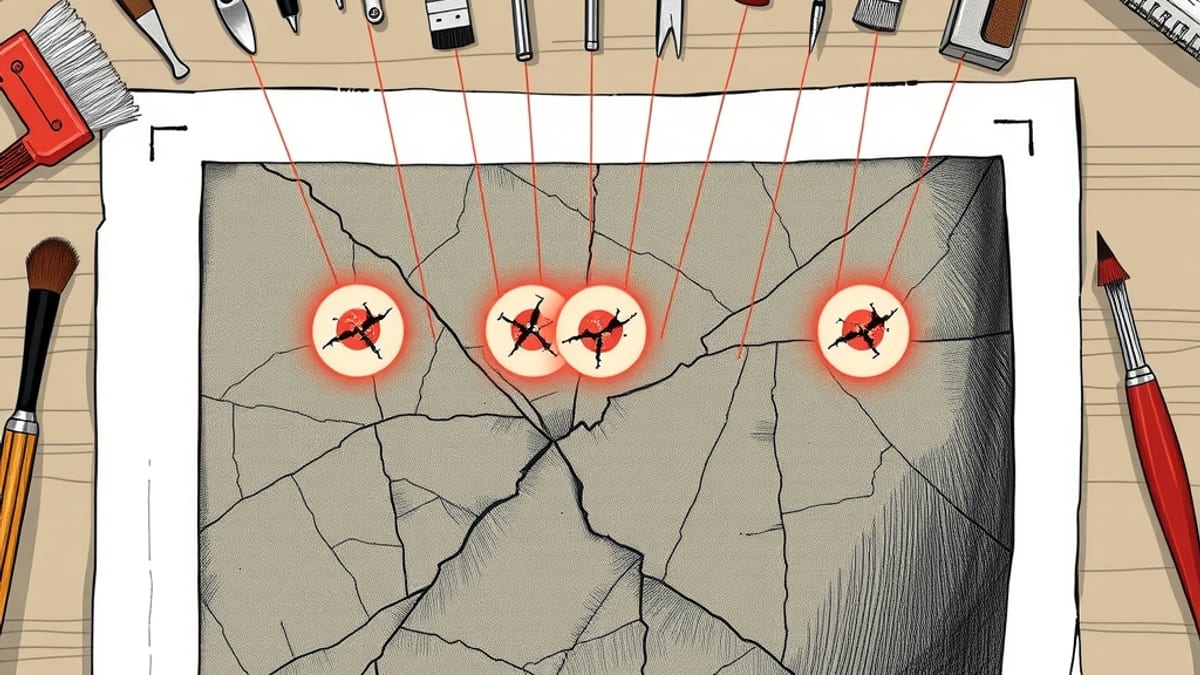
Researchers have introduced Wonder 4, a novel image quality enhancement model that utilizes a mixture-of-experts (MoE) architecture. Unlike previous models that might treat all image defects with a single approach, Wonder 4 is designed to identify and correct various imperfections, such as blurriness, graininess, compression artifacts, and scratches, in their specific locations within an image.
The core innovation of Wonder 4 lies in its MoE design. This architecture comprises 13 specialized "expert" models within each block. A trained routing mechanism within the model directs each image patch to a subset of five of these experts. This selective routing allows the model to apply corrections tailored to the particular degradation present in that image region. Crucially, the Wonder 4 model achieves this without requiring any explicit degradation classifiers, masks, prompts, or task labels.
Mixture-of-experts models, in general, consist of multiple specialized sub-models, or experts, that handle tasks more efficiently than a single, monolithic model. A gating network or router directs input data to the most appropriate experts. This approach allows models to scale in capacity by increasing the number of parameters without a proportional increase in computational cost for each input, as only a subset of experts is activated. This efficiency is particularly beneficial in computer vision tasks, including image analysis.
The development of Wonder 4 addresses a fundamental challenge in image enhancement: the conflicting nature of corrections for different types of degradation. For instance, a technique used to reduce noise might inadvertently exacerbate compression artifacts, or vice versa. By assigning different image regions to specialized experts, Wonder 4 can potentially resolve these conflicts and achieve a more effective overall enhancement. The paper detailing Wonder 4 notes that existing models often describe the entire image with a single representation, hindering their ability to apply localized and context-specific corrections.
The Wonder 4 model's approach bypasses the need for explicit classification of image degradations. This simplifies the model's architecture and training process. Typically, image enhancement models might first identify the type of degradation present and then apply a corresponding restoration technique. Wonder 4's MoE structure integrates this process, allowing the experts themselves to implicitly learn how to address various defects based on the image patch they receive.
The research behind Wonder 4 suggests that this MoE strategy can lead to improved image quality by better handling the diverse and localized nature of real-world photographic imperfections. The model's ability to process image patches with multiple specialized experts offers a more nuanced approach to image restoration.