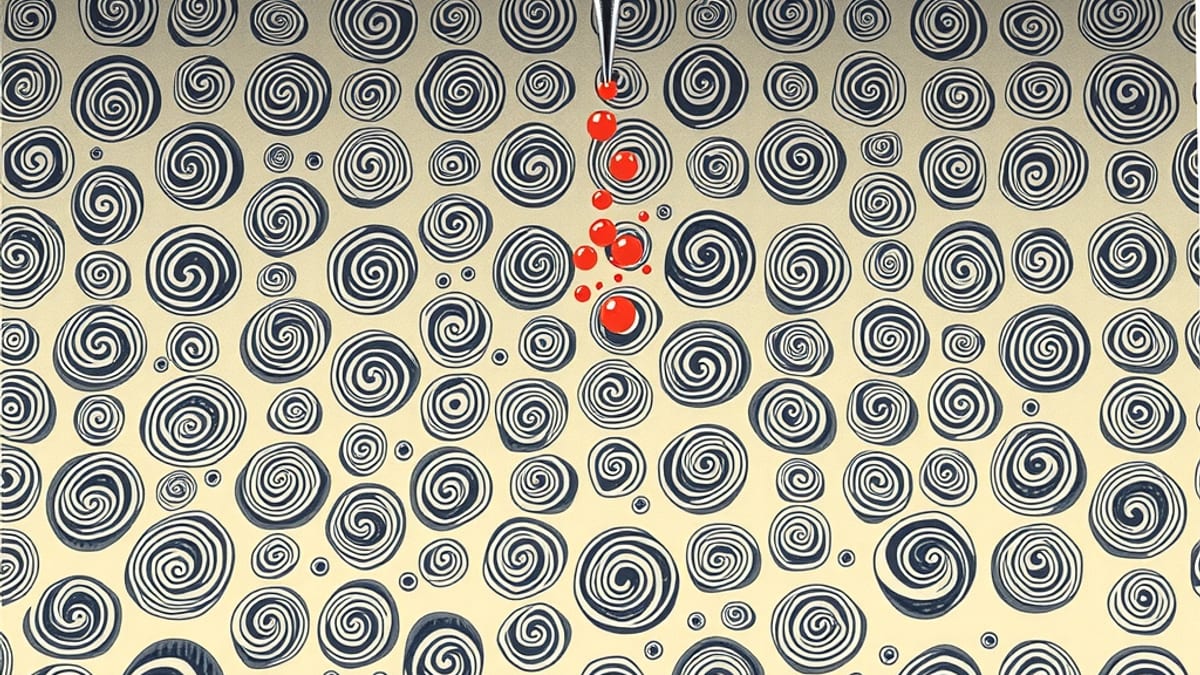
Scientists have captured the first real-time footage of a lattice of tiny magnetic vortices, known as skyrmions, melting and losing their organized structure. This breakthrough, detailed in Nature Nanotechnology, provides critical insights into how these magnetic structures behave and could pave the way for computers that operate with the efficiency of the human brain. The research team observed the skyrmion lattice transition from an ordered state to a disordered one, simultaneously manipulating individual skyrmions during the process.
Skyrmions are nanoscale magnetic whirls that can store and process information using minimal energy. Their stability, small size, and ability to be moved make them promising candidates for next-generation computing technologies, including spintronics and topological quantum computing. Unlike conventional computers that separate memory and computation, brain-inspired systems aim to process information more dynamically. Skyrmions could enable such systems by responding collectively and processing data through shifting patterns.
The observed melting process was not instantaneous. It proceeded in stages, with the lattice first losing its precise positional order while maintaining some directional alignment. This intermediate phase is key to understanding how order breaks down in two-dimensional magnetic systems. Researchers manipulated the skyrmions' size and mobility using magnetic fields, influencing the melting process. Asle Sudbø, head of the Norwegian University of Science and Technology's Centre for Quantum Spintronics (QuSpin), noted that these nanoscale vortices could be instrumental in developing computers that emulate biological brains, requiring significantly less electricity than current technologies.
This work builds upon theoretical studies of skyrmion lattice melting, which have explored phase transitions in two-dimensional systems. Previous research has indicated that two-dimensional melting can occur in stages, involving an intermediate "hexatic" phase where translational order is lost but orientational order persists. The direct observation of this phenomenon in real time offers experimental validation for these theories and provides a more detailed understanding of the underlying physics. The ability to control and observe these dynamic changes in skyrmion behavior is essential for harnessing their potential in advanced computing and data storage applications.