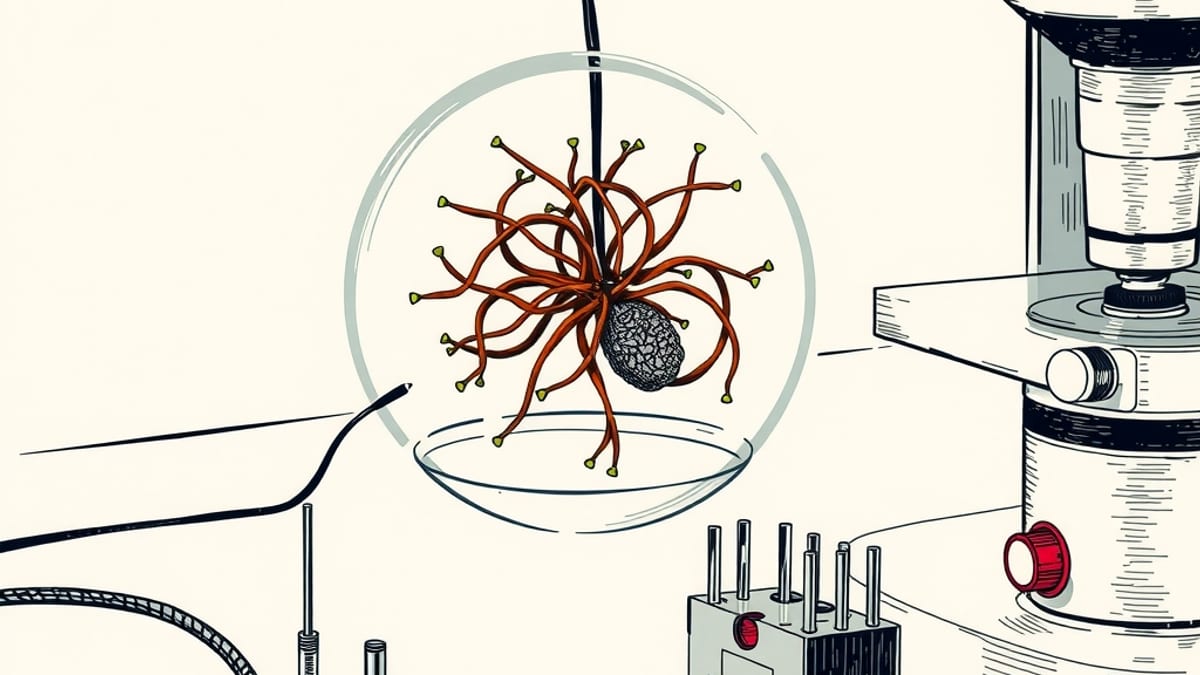
A team of scientists from the University of Bristol has shown that lab-grown human brain organoids can classify Braille letters with up to 83% accuracy. The research, published on October 16 in Frontiers in Artificial Intelligence, indicates a potential pathway for integrating biological neural networks with artificial sensors.
The study involved connecting brain organoids, which are miniature clusters of human brain cells, to a tactile sensor. Each organoid, less than a millimeter wide, contained approximately 10,000 neurons along with supporting cells. Researchers used a sensor to record patterns from the 26 letters of the Braille alphabet. This tactile data was then converted into electrical stimulation patterns and transmitted to the organoids via electrode arrays. The organoids responded with their own electrical activity, which a computer program analyzed to determine the corresponding Braille letter.
A single organoid demonstrated an accuracy of about 61% in classifying the letters. When the researchers combined the responses from three organoids, the accuracy increased to 83%. The exact reason for this improved performance with multiple organoids is not yet fully understood, though researchers hypothesize that each organoid may contribute slightly different information due to variations in their neural connections.
Tianyi Liu, a PhD candidate at Bristol University and lead author of the study, stated that the research provides a practical method to connect artificial sensors with biological neural systems. This approach could lead to more energy-efficient computing, as biological neural networks consume significantly less energy than traditional silicon-based systems. The human brain operates on roughly 20 watts, while complex silicon neuromorphic chips can require kilowatts or megawatts.
The organoids in this experiment were not "reading" Braille in a human sense, nor did they demonstrate learning or long-term plasticity. Instead, the study focused on whether the organoids could receive and relay signals reliably, and if these signals contained enough information for a computer to distinguish between different Braille letters. The team also observed that the multi-organoid system showed enhanced robustness against artificially introduced noise compared to a single organoid or direct decoding from the stimulation pattern alone.
Previous research in organoid intelligence has explored organoids recognizing Japanese vowels and handling simple tasks. This current study contributes to the broader field of biohybrid computing, where living neural tissue and silicon components work in conjunction. The Bristol team intends to investigate whether organoids can adapt to feedback and to test other types of tactile information, such as textures and edges. Future work will also explore closed-loop platforms where organoid outputs influence subsequent inputs, potentially revealing how feedback mechanisms might enhance learning and induce adaptive changes in network dynamics.