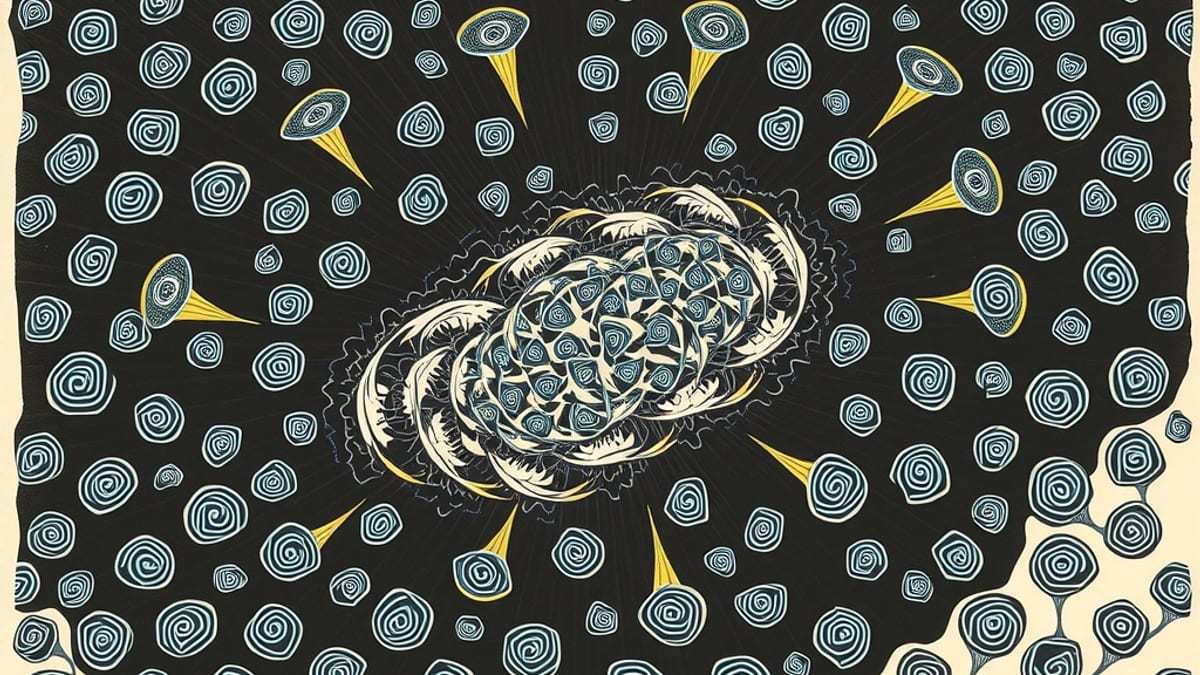
Scientists at Johannes Gutenberg University Mainz and the Norwegian University of Science and Technology (NTNU) have captured the real-time melting of magnetic skyrmion lattices. This experiment allowed researchers to directly observe the transition of an ordered two-dimensional lattice into a disordered state at a microscopic level. The findings, published in Nature Nanotechnology, offer a deeper understanding of two-dimensional melting processes and the behavior of skyrmions.Skyrmions are microscopic magnetic vortices that can store information. Under certain conditions, these structures arrange themselves into repeating patterns, forming lattices. Unlike conventional computing technologies that require increasing space and energy for data handling, skyrmions present a more efficient alternative. Asle Sudbø, who leads NTNU's Centre for Quantum Spintronics (QuSpin), explained that skyrmions could enable the construction of significantly smaller and more energy-efficient data storage systems.The research team did not induce melting by increasing temperature. Instead, they adjusted magnetic fields to reduce the size of the skyrmions, which increased their mobility within the lattice. This approach caused the lattice structure to become progressively disordered, ultimately dissolving it. This method offers insights into fundamental physics and may inform the development of future spintronic devices.The team utilized a magneto-optical Kerr microscope to observe the melting process. They found that the two-dimensional skyrmion lattice melts in a two-step process, differing from the single-step melting observed in three-dimensional structures like ice. Initially, the skyrmions lost their positional order while retaining a sense of overall orientation. In the subsequent step, the orientation itself broke down, leading to the complete dissolution of the lattice.Raphael Gruber, the first author of the study and a researcher at Professor Mathias Kläui's lab at JGU's Institute of Physics, noted that this observation provides a clearer picture of how skyrmions respond when their organized structures break apart. The ability to manipulate the shape and size of individual magnetic vortices during observation also allows for the study of how these changes affect their behavior.This research builds on earlier theoretical and experimental studies of skyrmion lattice melting. Previous work explored how magnetic field variations could tune skyrmion ensembles from a two-dimensional solid through an intermediate hexatic phase to a liquid. Other studies have investigated the role of defects in skyrmion lattices and how they influence magnetic phase transitions. The current findings could advance the development of neuromorphic, or brain-like, computers, which aim to process information with greater efficiency and in a manner similar to the human brain.
Scientists Film Magnetic Skyrmion Lattice Melting, Advancing Brain-Like Computing Research
Researchers have for the first time filmed magnetic skyrmions, tiny magnetic vortices, as they melted out of an organized lattice structure. This direct observation provides new insights into manipulating these structures, which could lead to more energy-efficient, brain-inspired computing technologies.