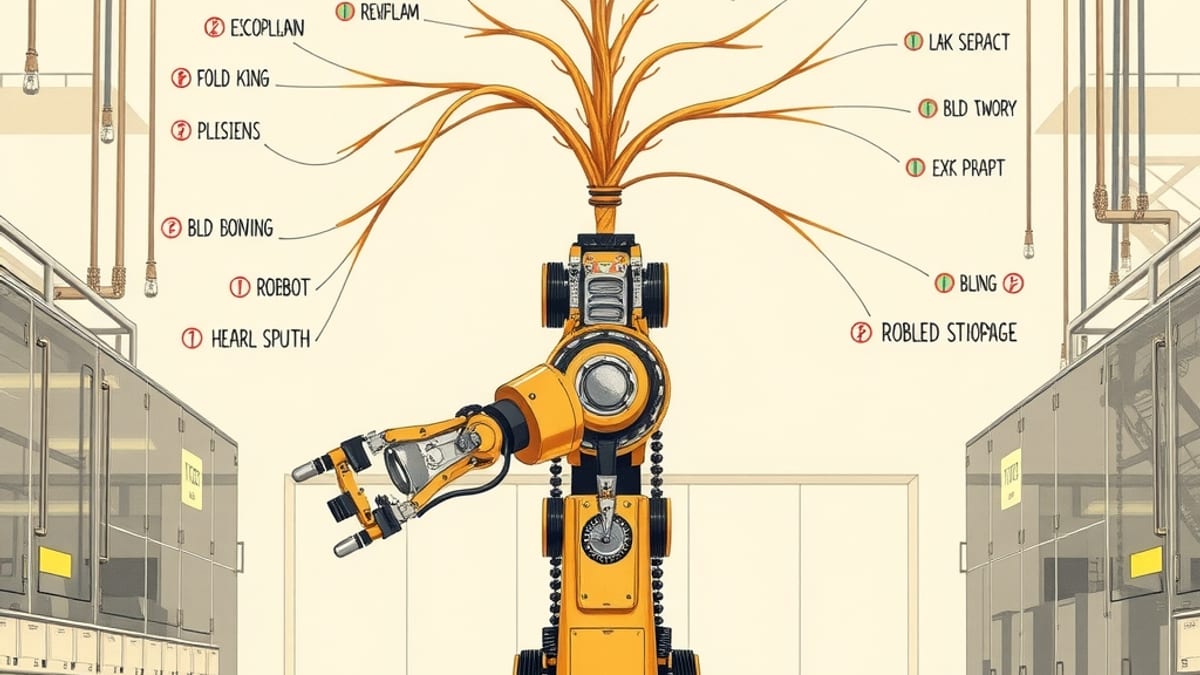
Researchers have introduced RoboRSI, a system designed to enable robots to learn and evolve their capabilities through experience in complex environments. This advancement aims to equip generalist robots with the ability to not only perform diverse tasks but also to improve their performance over time by reusing learned skills.
The RoboRSI system is built upon a methodology called Top-Down Skill Refinement (TSR). TSR works by breaking down tasks into a hierarchy of skills, including compound, atomic, and base skills. Each skill is assigned specific responsibilities and defined with explicit input-output contracts. This structured approach allows the system to attribute each execution outcome to the responsible skill branch and to confine any necessary revisions to that specific branch.
This organization of experience around task structure is a central challenge in robot learning. Previous methods have struggled to effectively attribute learning to specific capabilities or validate improvements before reuse. RoboRSI addresses this by attributing each execution outcome to the responsible capability, supported by execution evidence, and validated before it is reused.
The system's architecture includes a Manager, Planner, Engineer, and Reviewer. These components coordinate the planning, execution, diagnosis, and validated release of new skills. Human operators can guide the process by setting objectives and providing corrections. Stable skill sequences that prove effective can then be consolidated into reusable compound skills.
In evaluations, RoboRSI demonstrated its capabilities on a mobile manipulator tasked with multi-object household cleanup over 104 rounds. In simulation, the system achieved the highest success rates across four benchmark suites: LIBERO, LIBERO-PRO, LIBERO-Plus, and RoboTwin. RoboRSI surpassed the strongest baseline by margins ranging from 2.7 to 11.0 percentage points on these benchmarks.
The research also highlights that the effective reuse of experience in robots hinges on its connection to the task structure that provides meaning. This structure must support both human-directed steering and the robot's internal organization of knowledge.
The RoboRSI framework specifically implements these principles through TSR, which verifies the postconditions of each atomic task before completion and revises failures at the earliest failing node. A multi-agent execution-refinement loop further validates and releases skills across different tasks.
Previous work in robot learning has faced challenges in handling long-horizon tasks and ensuring skill reusability. For instance, the HALSI framework, while addressing temporal abstraction in reinforcement learning, focuses on learning skills of variable duration and adapting them online. Other approaches, like SKIL, have demonstrated data-efficient manipulation learning through semantic keypoints, achieving significant success rates on real-world tasks with limited demonstrations. However, RoboRSI's structured skill decomposition and validation process aim to provide a more stable and efficient path to self-evolution for generalist robots.