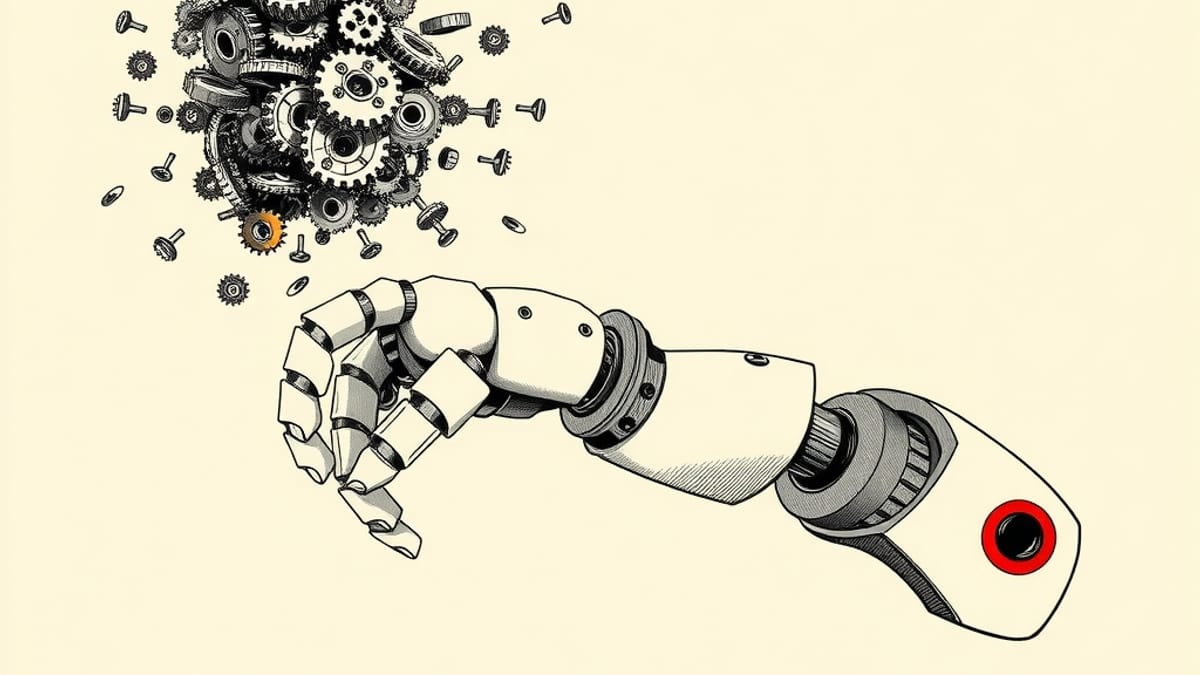
Agentic robotics, which integrates large language models (LLMs) into robot control systems, enables robots to adapt to new tasks without extensive retraining by composing perception, motion, and vision-language-action (VLA) tools. This flexibility, however, comes at the cost of efficiency. Each individual primitive action requires a separate LLM reasoning cycle, which scales with the number of primitives in a task. This leads to considerable computational overhead as the robot processes its interaction history repeatedly.
A research paper titled "ChunkAct: Action Chunking for Agentic Robotics" introduces an optimization that addresses this challenge. The paper, published on arXiv, details how ChunkAct integrates "action chunking" into agentic robotics. Action chunking, a concept borrowed from psychology and neuroscience, involves grouping a sequence of actions into a single unit. This technique has been used in robot imitation learning since 2023, notably with Action Chunking with Transformers (ACT). ACT demonstrated success in complex bimanual tasks, achieving high success rates from limited demonstration data.
With ChunkAct, a single LLM call can launch a "chunk" of chained primitives. These primitives then execute autonomously, with control returning to the LLM only if a failure occurs. This method leverages the observation that once a sub-goal is established, the subsequent primitive actions often follow a routine already present in the robot's memory, making repeated LLM reasoning for each step largely redundant.
By reducing the number of LLM calls, ChunkAct aims to decrease the computational burden and improve the overall speed of task execution in agentic systems. Traditional behavioral cloning, where a policy predicts one action at a time, suffers from compounding errors as small mistakes can lead the robot into states not covered by its training data. Action chunking mitigates this by committing to a sequence of actions, ensuring smoother and more internally consistent trajectories.
The concept of action chunking has shown benefits beyond efficiency, including better handling of non-Markovian data and improved exploration. It allows policies to capture timing information that single-step predictions cannot, such as pauses or hesitations in human demonstrations. Predicting multiple steps ahead also reduces the effective horizon of a task, making it easier for the robot to learn and execute complex sequences.
While the "unreasonable effectiveness" of LLM agent loops with tool use is acknowledged, the expense and slowness of continuous LLM interaction remain a concern for real-world robotic deployment. Ideally, LLMs would be used sparingly for novel problems, with cheaper, more efficient code taking over for routine tasks. ChunkAct moves towards this ideal by allowing the LLM to delegate sequences of actions, reducing its continuous involvement in low-level control.