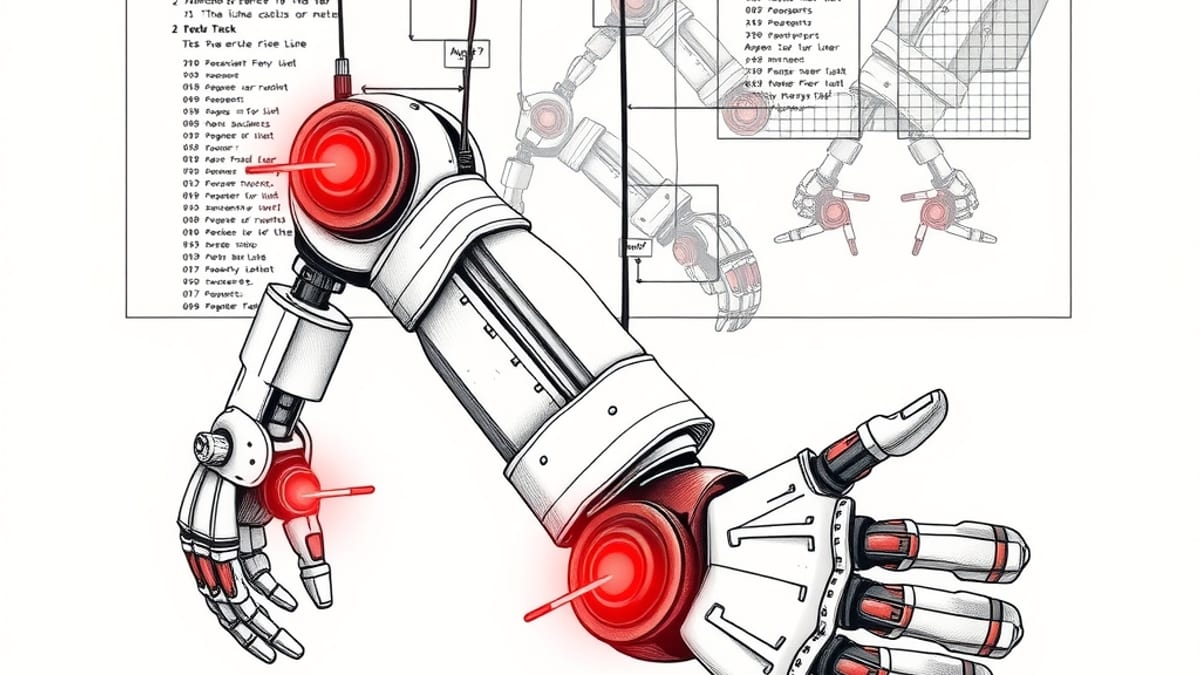
A new research paper published on arXiv, "RoboArchitect: Automating the Design of Robotic Agents with Persistent Memory," introduces a method for automatically generating the control code that dictates how a robotic agent interacts with its environment. This "harness" code determines when a robot's core policy is activated, when vision tools are consulted, or when direct arm commands are issued. Currently, these harnesses are typically crafted manually and require redesign for each new robot or task.The RoboArchitect system employs a coding model to observe a robot's performance during "rollouts" – simulated or real-world attempts at a task. When failures occur, the coding model diagnoses the issues and iteratively revises the harness code that wraps around a frozen (unchanged) robot policy. This iterative refinement process, which optimizes the harness over a series of episodes, has demonstrated substantial improvements in robot performance.The researchers evaluated RoboArchitect on various benchmarks and policies, finding that it increased the average success rate on unseen scenes from 9.7% to 43.3%, a 4.5-fold improvement. On unseen tasks, the average success rate rose from 12.7% to 40.2%, representing a 3.2-fold increase. These gains were particularly pronounced when the benchmark tasks differed significantly from the robot policy's initial training data. In such cases, a general-purpose policy, when equipped with an evolved RoboArchitect harness, often surpassed even fine-tuned versions of the same policy.The automated design process within RoboArchitect can generate intuitive control strategies. Examples include programming a robot to lift a jammed arm to clear an obstruction or to approach an object horizontally if a vertical path is blocked. Furthermore, the harness can develop its own persistent memory, allowing it to store and utilize learned experiences, such as effective grasping depths, in subsequent decisions.The findings suggest that considerable potential for enhancing robotic manipulation lies in the design of the agent harness itself. The research indicates that this design process can be effectively automated and optimized without requiring updates to the underlying model weights of the robot's core policy. This approach offers a strong alternative to the traditional method of fine-tuning a robot's policy for novel setups.
RoboArchitect Automates Robot Control Code Design, Quadrupling Success on Unseen Tasks
Researchers have developed RoboArchitect, a system that automates the creation of control code, known as a harness, for robotic agents. This method allows a coding model to observe robot actions, identify errors, and refine the harness around a pre-existing robot policy, leading to a significant increase in task success rates.