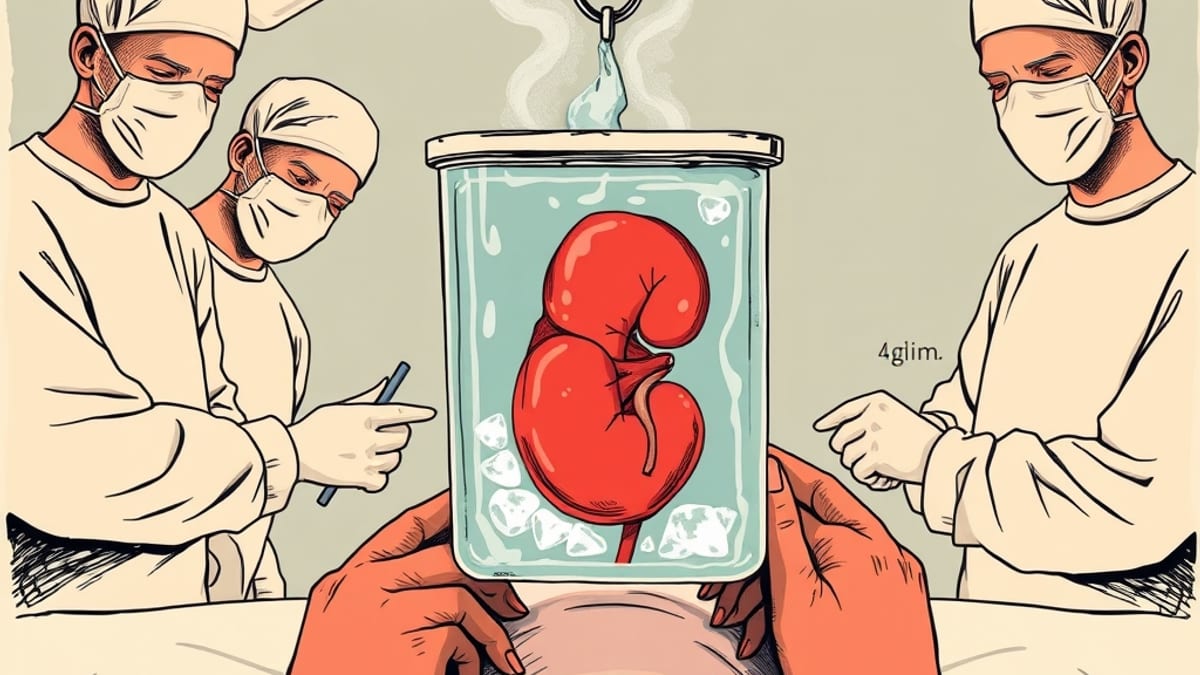
Researchers have achieved a significant milestone in organ preservation by successfully transplanting supercooled kidneys into pigs. The procedure, detailed in new research, demonstrated that kidneys cooled below freezing without ice formation could be preserved for extended periods and remain functional after transplantation. This advance offers a potential solution to the urgent problem of organ viability loss during transport.
Current methods for preserving donor organs, such as keeping them on ice at approximately 4 degrees Celsius (39 degrees Fahrenheit), limit their usable time to a matter of hours. This narrow window often results in organs being discarded because they cannot reach recipients in time. The new technique involves cooling kidneys to -4 degrees Celsius (25 degrees Fahrenheit) using a specialized device that prevents ice crystal formation. This "supercooling" method allows for preservation durations that are considerably longer than current standards.
In the experiments, pig kidneys were preserved using this supercooling technology for up to 48 hours. Following rewarming, these kidneys were transplanted into pigs. The transplanted organs began producing urine shortly after implantation, indicating immediate function. Over a 30-day observation period, the supercooled kidneys demonstrated sustained function, growing in size to accommodate the pigs' development, which suggests their long-term viability. This contrasts with organs preserved using conventional methods, which have a much shorter functional window.
The research team, led by scientists at Texas A&M University, developed a device that controls pressure to achieve supercooling without the need for cryoprotectant chemicals. The absence of these chemicals could simplify the regulatory approval process for future human applications. Preliminary findings suggest that preservation for up to 120 hours may be feasible with this method. The researchers plan to establish a company to commercialize this technology, aiming to reduce the number of donated kidneys that are currently discarded due to time constraints.
This work builds upon previous research in organ preservation. In 2023, engineers and medical researchers at the University of Minnesota Twin Cities successfully transplanted a cryopreserved rat kidney after storing it for up to 100 days, using a nanowarming approach. More recently, in May 2025, researchers from the University of Minnesota's NSF Engineering Research Center for Advanced Technologies for the Preservation of Biological Systems (NSF ATP-Bio) reported the first successful transplant of a cryopreserved large mammal kidney stored for over a week. These earlier achievements demonstrated the potential of ultra-low temperature preservation, but the Texas A&M approach focuses on supercooling rather than deep freezing.
The challenge of organ shortage remains acute. In the United States alone, over 100,000 people are on waiting lists for organ transplants, with kidneys being among the most needed. Many donated organs are never used, partly because the time between procurement and transplantation is too short. Extending this preservation window through technologies like supercooling could dramatically increase the number of viable organs available for transplantation, potentially saving thousands of lives annually.
Further research will focus on refining the supercooling process and demonstrating its efficacy and safety in larger animal models before human trials can be considered. The ultimate goal is to create a preservation system that allows organs to be to be stored for days or even weeks, providing surgeons and patients with greater flexibility in scheduling transplants and increasing the chances of successful outcomes.