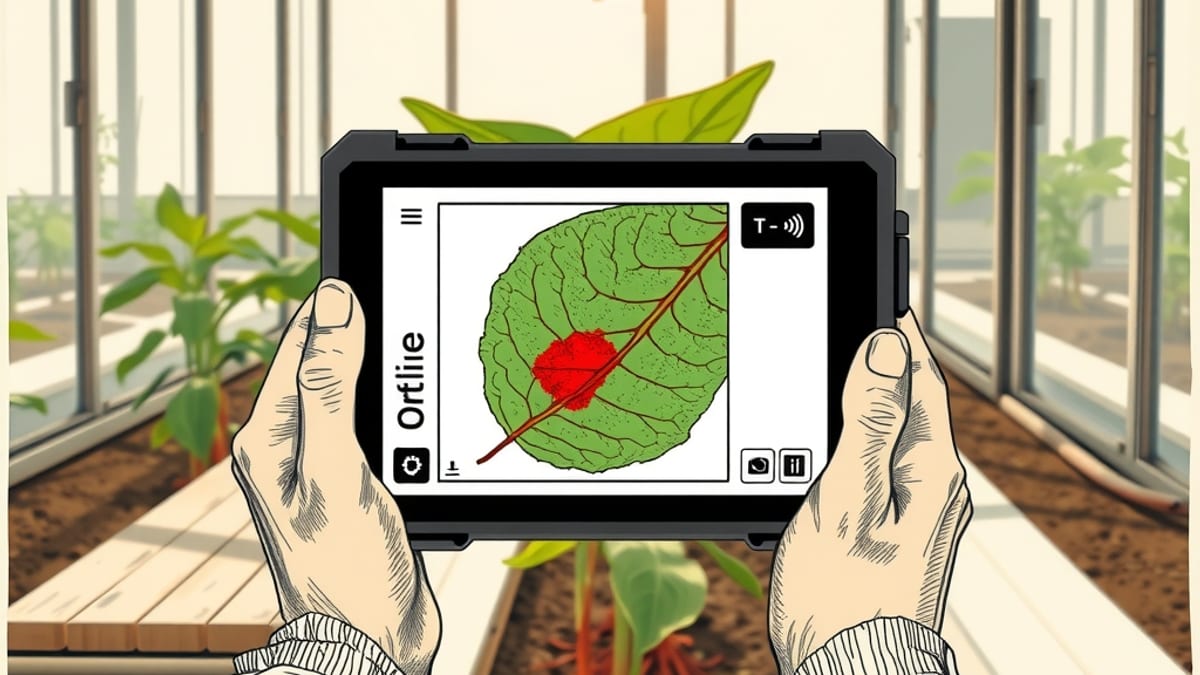
Researchers have introduced PlantVLM-Edge, a framework designed to bring advanced crop health diagnosis capabilities directly to edge devices, such as smartphones or tablets, used by farmers. This system employs quantized vision-language models, a technique that reduces the computational and memory demands of artificial intelligence models, making them suitable for deployment on hardware with limited resources. The goal is to provide timely and accurate crop health assessments without requiring constant connection to powerful cloud servers.
The development addresses a key challenge in modern agriculture: the scarcity of readily available expert knowledge for diagnosing plant diseases and health issues. While sophisticated vision-language models (VLMs) have shown promise in understanding and reasoning about visual information, their size and processing requirements have historically prevented their use on edge devices. PlantVLM-Edge integrates agricultural domain adaptation, a process that tailors the model to understand specific farming terminology and visual cues, with post-training quantization. This combination allows the models to function effectively on devices with less processing power and memory.
The framework is built to support conversational crop health diagnosis. This means farmers can interact with the system using natural language, describing symptoms or asking questions about their crops, and receive diagnostic information and advice in return. This interactive approach aims to democratize access to agricultural expertise, enabling farmers to make informed decisions for better crop management and potentially reducing crop losses and the need for excessive pesticide use.
Previous research has explored various AI applications in agriculture, including deep learning models for disease classification with high accuracy on large datasets. Systems utilizing IoT sensors for environmental monitoring alongside AI for disease detection have also been developed, achieving notable accuracy rates. However, the deployment of these advanced models on edge devices has remained a significant hurdle. Efforts to create lightweight vision models for agricultural tasks on resource-limited settings have shown promise, with some achieving substantial reductions in model size while maintaining high accuracy. The PlantVLM-Edge framework builds upon these advancements by specifically focusing on quantized vision-language models for on-device conversational diagnosis.
The application of such technologies is seen as essential for sustainable agriculture. By enabling early and accurate diagnosis of crop health issues, farmers can implement targeted interventions, optimize resource management, and improve overall yield and quality. This not only contributes to food security but also supports more environmentally sound farming practices. The research behind PlantVLM-Edge suggests a path toward making advanced AI tools more accessible and practical for farmers worldwide, particularly those operating in regions with limited digital infrastructure.