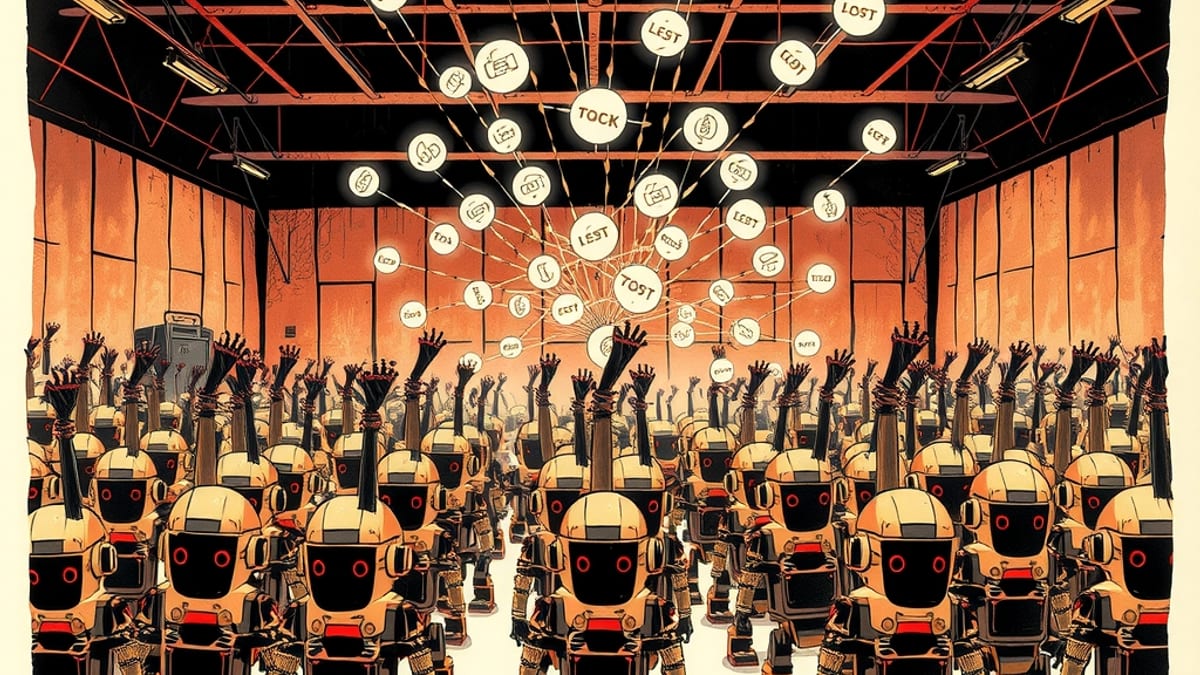
Researchers have introduced a new framework, market-based post-training (MPT), that enables decentralized swarms of AI agents to learn both their individual action policies and how to coordinate their collective behavior simultaneously. This new method allows swarms to self-orchestrate without the need for pre-defined coordination structures or a central controlling agent.
Existing multi-agent systems often train agents within fixed organizational structures, which separates the learning of individual agent capabilities from the development of collective behavior. MPT addresses this by allowing agents to express their willingness to participate in a task through bids. These bids determine which agents act and how their collective outcomes contribute to local training credit. By learning both their actions and bidding behaviors, individual capabilities and patterns of participation can adapt together.
The MPT framework was evaluated on several tasks, including embodied crafting, robot navigation, and deep research. Results demonstrated performance gains compared to monolithic post-training methods. The research confirmed that agent participation evolves as the agents learn. When using the same post-trained action policies, MPT's learned self-orchestration outperformed alternative coordination strategies.
Further analysis, known as ablations, showed that both the action policies and the bidding behaviors benefit from this joint learning process. The learned bids provide more effective signals for training actions. Beyond their original training objectives, swarms trained with MPT adapted more quickly to related tasks. They also achieved better performance with larger populations during inference. Additionally, larger populations showed smaller performance losses when individual agents were removed, indicating that the learned self-orchestration supports reuse, scaling, and robustness in decentralized agent swarms. The researchers have made the code and trained models available for public use.