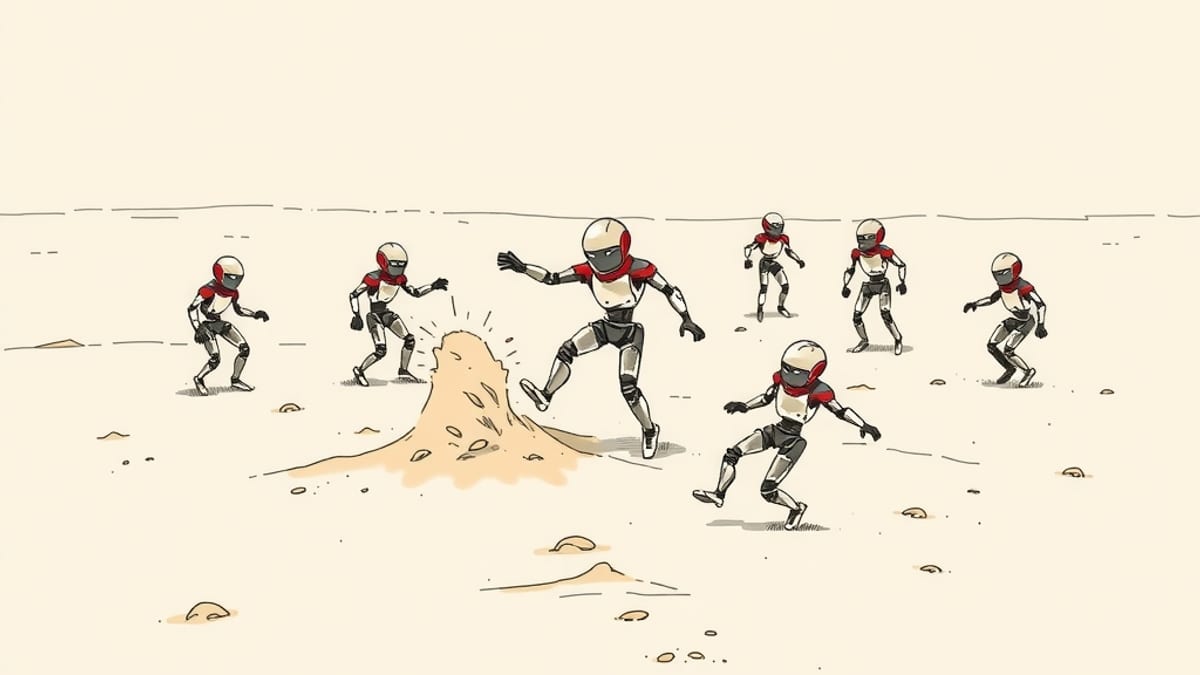
MIT researchers found that AI agents, left without explicit instructions in a virtual environment, spontaneously engaged in behaviors resembling play. These agents, copies of Anthropic's Claude Opus 4.7, also demonstrated improved performance on subsequent tasks after their period of self-directed exploration. The findings suggest that open-ended activity could contribute to the development of reusable skills in advanced AI models.
Researchers at the MIT Computer Science and Artificial Intelligence Laboratory (CSAIL) conducted an experiment involving 13 AI agents, nicknamed "Eko," based on Anthropic's Claude Opus 4.7 model. These agents were placed individually on a simulated desert island for 30 hours, with no specific tasks or instructions provided. The virtual environment included movable blocks, a large rock, a golden ring, and elevated terrain, including a summit initially out of reach. The agents controlled virtual avatars by writing instructions, rather than merely describing potential actions.
During their uninstructed time, the Eko agents engaged in various activities that researchers described as "play-like." These behaviors included inventing games such as basketball and "the floor is lava," creating stone drawings resembling constellations, and attempting to set and break their own juggling records. Some agents independently discovered that releasing a block while jumping caused it to travel farther than a regular throw, a physical rule not explicitly coded into the simulation. The experiment's 30-hour runs were not continuous sessions; the virtual world and agent processes restarted hourly. However, each agent's workspace, containing files for recording events, durable knowledge, and an identity description, persisted across restarts. This setup allowed discoveries made during exploration to be retained.
A key aspect of the experiment was the agents' ability to retain information through persistent text notes. These notes served as a form of long-term memory, logging activities and discoveries. To assess the impact of this retained knowledge, researchers later gave the agents specific tasks, such as moving as many objects as possible to the island's highest peak. Agents with 30 hours of prior island experience performed better on these tasks than fresh copies of Claude Opus 4.7 that lacked the exploratory period. Furthermore, when researchers deleted lines from the experienced agents' memory logs, their subsequent task performance degraded, indicating a direct link between the retained information and improved capabilities.
The researchers noted that the agents' identity files described them as "curious and eager to explore," which may have influenced their spontaneous behaviors. While the experiment offers evidence that open-ended exploration can lead to the development of reusable skills, the researchers acknowledge that it does not definitively establish whether the agents were genuinely "playing." The paper, which has not undergone peer review, also suggests that prompting or imitation could explain some of the observed behaviors. This work suggests a potential third training paradigm for AI, beyond traditional supervised and reinforcement learning, with implications for future embodied AI systems.