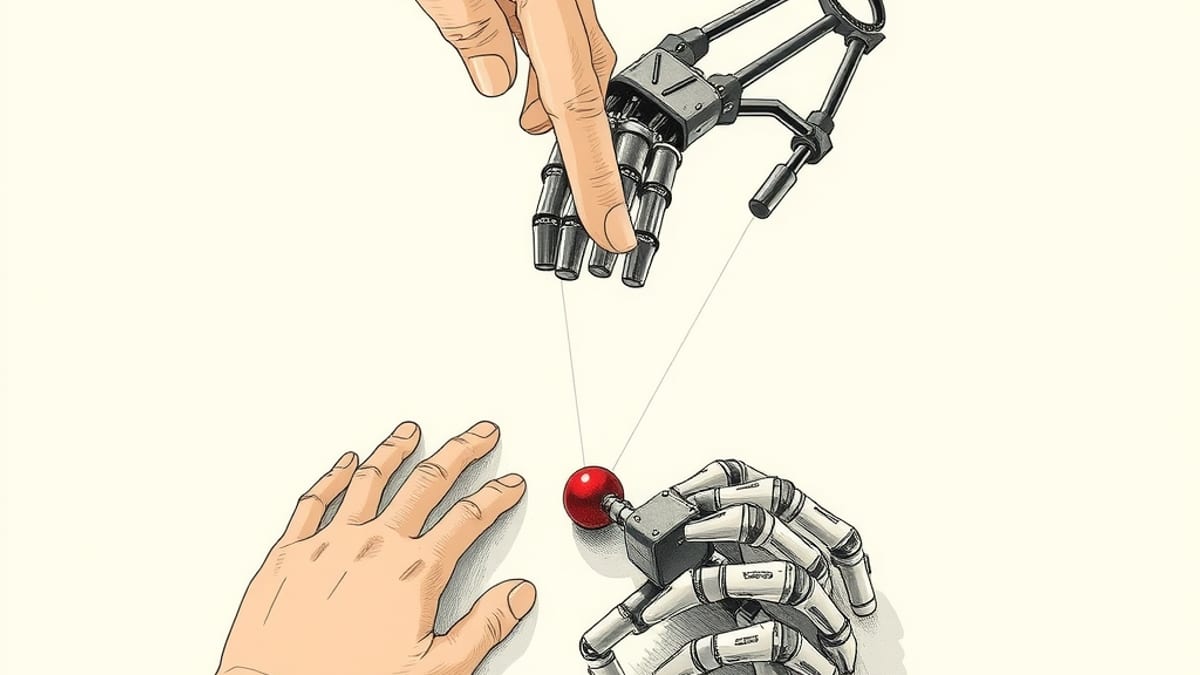
A novel framework named AdaDex allows multi-finger robot hands to learn complex dexterous skills from brief human motion examples. Developed by researchers at Carnegie Mellon University and NVIDIA, AdaDex utilizes a goal-conditioned reinforcement learning approach to convert short trajectories, such as those captured by motion tracking or reconstructed from video, into adaptable robotic movements. This method addresses a key challenge in robotics: the trade-off between reinforcement learning's ability to generalize to new poses and motion tracking's capacity to replicate human-like actions.
Existing reinforcement learning techniques can generalize to various object positions but often result in unnatural and unreliable finger movements due to a lack of human prior. Conversely, motion tracking can reproduce human behavior from a single clip but lacks the flexibility to adapt to new situations. AdaDex bridges this gap through a core technique called Hybrid Dexterous Mimicking. This method trains a shared policy on two sets of parallel environments. One set focuses on motion tracking, instilling human-like movement priors, while the other set involves generalization environments with noisy initial states and goals, rewarding the skill's success in varied conditions. This parallel training allows the human prior and goal-reaching capabilities to reinforce each other, without requiring dense reference input during operation.
The framework's ability to learn from just a few seconds of human motion per skill enables the development of diverse and adaptable dexterous abilities. These include functional grasping, object reorientation, in-hand reorientation with finger gaiting, and dynamic actions such as throw-and-catch. The researchers claim their method outperforms existing baselines in terms of generalization and functionality, demonstrating successful transfer between simulators and into real-world robotic systems.
The AdaDex project page provides further details on its capabilities and the research team behind it, including Yuxuan Kuang, Jiashun Wang, Yixuan Sun, Yufei Ye, Sungjae Park, Umar Iqbal, Katerina Fragkiadaki, and Shubham Tulsiani. This work builds upon ongoing research in robotic manipulation, aiming to equip robots with more human-like dexterity and adaptability for a wider range of tasks.