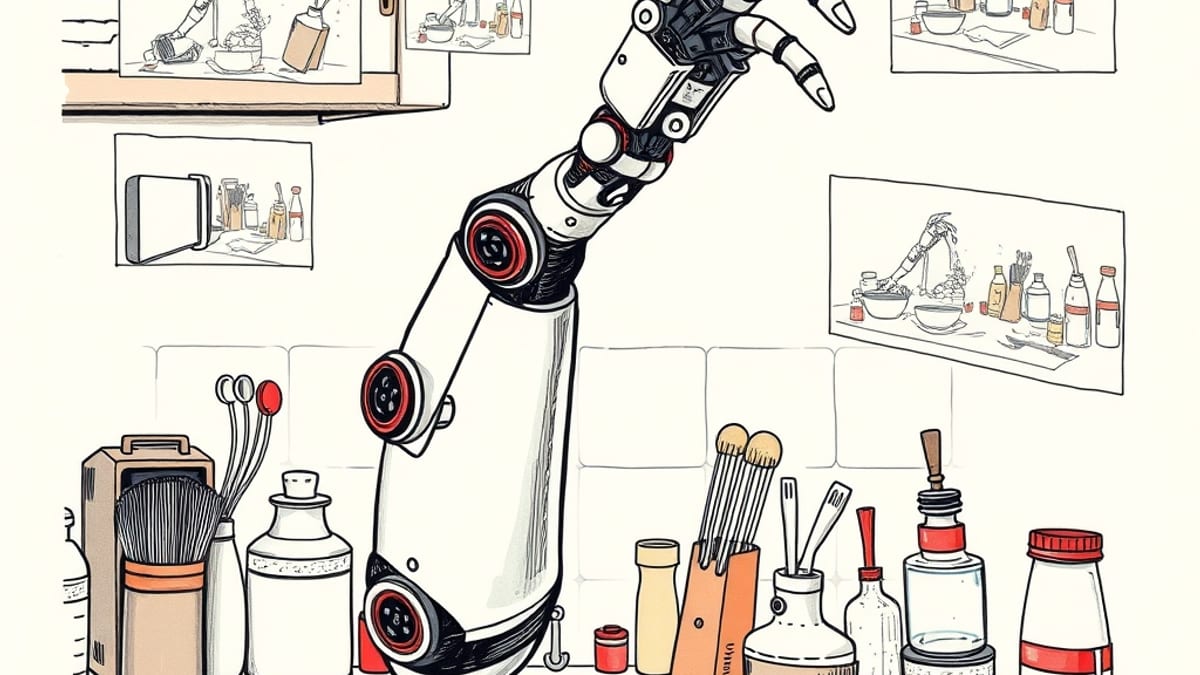
A new research paper published in Nature Machine Intelligence introduces NeuGraspNet, a novel method for 6-degree-of-freedom (6DoF) grasp detection that leverages neural volumetric representations and surface rendering. The work, authored by Snehal Jauhri, Ishikaa Lunawat, and Georgia Chalvatzaki, addresses a significant challenge in robotic manipulation: the ability to grasp objects in cluttered scenes from any single viewpoint without requiring additional scene exploration.
Traditional approaches to robotic grasping often struggle with objects in unstructured, cluttered spaces and under partial observability. Deep learning has advanced the field by training networks with simulation data, but transferring these skills to the real world remains complex. NeuGraspNet aims to enhance the efficiency, versatility, and autonomy of robots operating in everyday environments by providing a more robust grasping solution.
The core of NeuGraspNet lies in its re-interpretation of grasping as a rendering problem. The method encodes the interaction between a robot's end-effector and an object's surface by jointly learning to render the local object surface and learning grasping functions within a shared feature space. This dual learning process allows for effective and fully implicit 6DoF grasp quality prediction, even when scenes are only partially observed.
NeuGraspNet uses global, scene-level features for generating potential grasps and local, grasp-level neural surface features for evaluating the quality of these grasps. This distinction enables the system to predict grasp quality without explicit models of every object. The researchers demonstrated the real-world applicability of NeuGraspNet using a mobile manipulator robot, which successfully performed grasping tasks in open, cluttered spaces.
The system operates effectively from random viewpoints, a common requirement in mobile manipulation scenarios. This capability is crucial for robots that need to interact with their environment dynamically, rather than from a pre-defined, fixed perspective. The paper states that NeuGraspNet outperforms existing implicit and semi-implicit grasping methods in these challenging conditions.
Previous research in robotic manipulation has explored various methods to address grasping in clutter. Some studies have focused on learning pushing and grasping policies in isolation. For example, one approach trained a robot to learn joint planar pushing and 6DoF grasping policies through self-supervision, using two separate deep neural networks to map 3D visual observations to actions. This work highlighted the necessity of both pushing and grasping for effective manipulation in dense clutter, particularly for objects with diverse shapes that cannot be grasped from a top-down perspective.
Another area of research has focused on contact-aware learning, which integrates physical principles, specifically contact mechanics, with robot learning. This approach aims to reduce the reliance on extensive datasets and intensive exploration. One dissertation introduced a contrastive grasp planning module to improve grasp robustness by counteracting camera noise and bridging the simulation-to-reality gap. It also proposed a Maximum Likelihood Grasp Sampling Loss, which significantly reduced training sample requirements.
The development of NeuGraspNet contributes to the ongoing effort to improve robot manipulation capabilities in complex, real-world settings. The ability to accurately predict grasp quality and execute grasps in cluttered, partially observed environments is a foundational step toward more autonomous and versatile robotic systems in various applications, from home assistance to industrial automation.
Future work may build on these contact representation learning methods to enhance robotic dexterity further. The integration of advanced sensing, such as vision-based tactile sensors for reconstructing contact profiles, could provide essential feedback during manipulation tasks, offering another layer of intelligence to robotic systems. The ability to generalize grasping skills to novel objects, as explored in other research, also remains a key area for development. One study showed that training robots on randomly assembled objects composed of simple shape primitives could lead to robust generalization to real-world objects, achieving strong zero-shot performance.