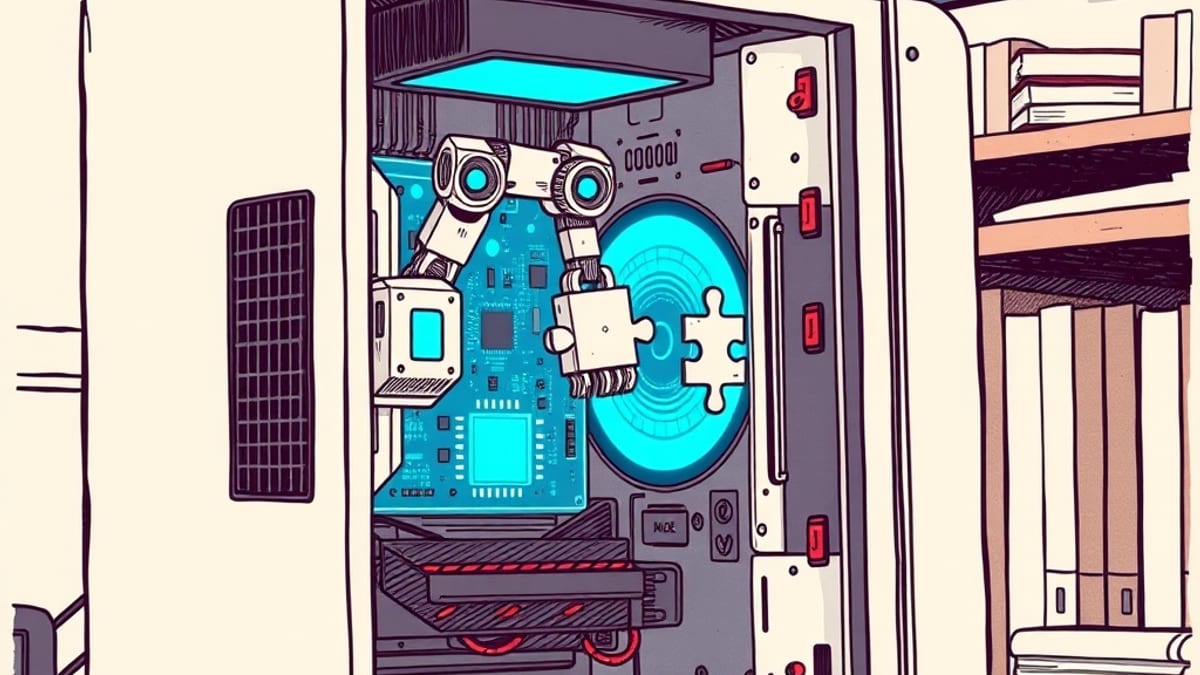
Meta has released Muse Glimmer, a 30-billion-parameter open-weight AI model optimized for running autonomous agents on local consumer hardware. The model, released under the permissive Apache 2.0 license, marks a return to Meta's open-source AI strategy after recent ventures into proprietary models like Muse Spark. This new model is designed to balance capability with the constraints of local computing resources, enabling tasks such as scheduling, file management, and coding to be performed directly on a user's PC or Mac without continuous cloud connectivity.
The development of Muse Glimmer represents a strategic shift for Meta, emphasizing accessibility and user empowerment in the advancement of artificial intelligence. Mark Zuckerberg, Meta's CEO, articulated this philosophy in an essay accompanying the model's release, stating, "Rather than centralizing superintelligence, we should distribute it widely and give every person the ability to direct it." This approach contrasts with some of the industry's leading AI developers who maintain closed-weight models, limiting transparency and user customization. The open-weight nature of Muse Glimmer allows researchers and developers to inspect its operations and adapt it for various applications, a move that proponents argue is essential for broader AI development and security.
Muse Glimmer is a dense, multimodal transformer model that accepts both text and image inputs, producing text outputs. It features a context window of 128,000 tokens by default and supports longer contexts, enabling it to handle complex, multi-step workflows. The model was trained on data from over 100 languages. Meta has also implemented optimizations for faster generation, including a speculative decoding technique using a lightweight "drafter" model, which proposes token blocks for the main model to verify, significantly speeding up text generation without compromising output quality.
The practical implications of Muse Glimmer extend to privacy and security, particularly for agentic tasks that involve sensitive personal data. By running locally, the model can process information such as files, screenshots, and development environments without continuously sending this data to remote servers. This local execution capability is crucial for applications requiring a high degree of privacy and for users seeking to operate AI tools offline.
Meta has collaborated with various hardware and software partners, including AMD, Arm, Dell, Intel, and NVIDIA, to optimize Muse Glimmer's performance across different devices and platforms. Developer documentation and optimized integrations for popular frameworks like llama.cpp and MLX are available, aiming to facilitate a swift transition from download to a functional agent. The model's performance has been benchmarked against leading models in its size category, with Meta reporting strong success rates on tasks such as coding and complex reasoning.
While Muse Glimmer is a powerful tool for developers, it is currently released as a developer tool rather than a direct consumer product. Meta plans to release an open-weight version of its more powerful Muse Spark model soon, further expanding its commitment to open-source AI development. This strategy positions Meta as a proponent of distributed AI access, challenging the trend of increasingly centralized and proprietary AI systems.