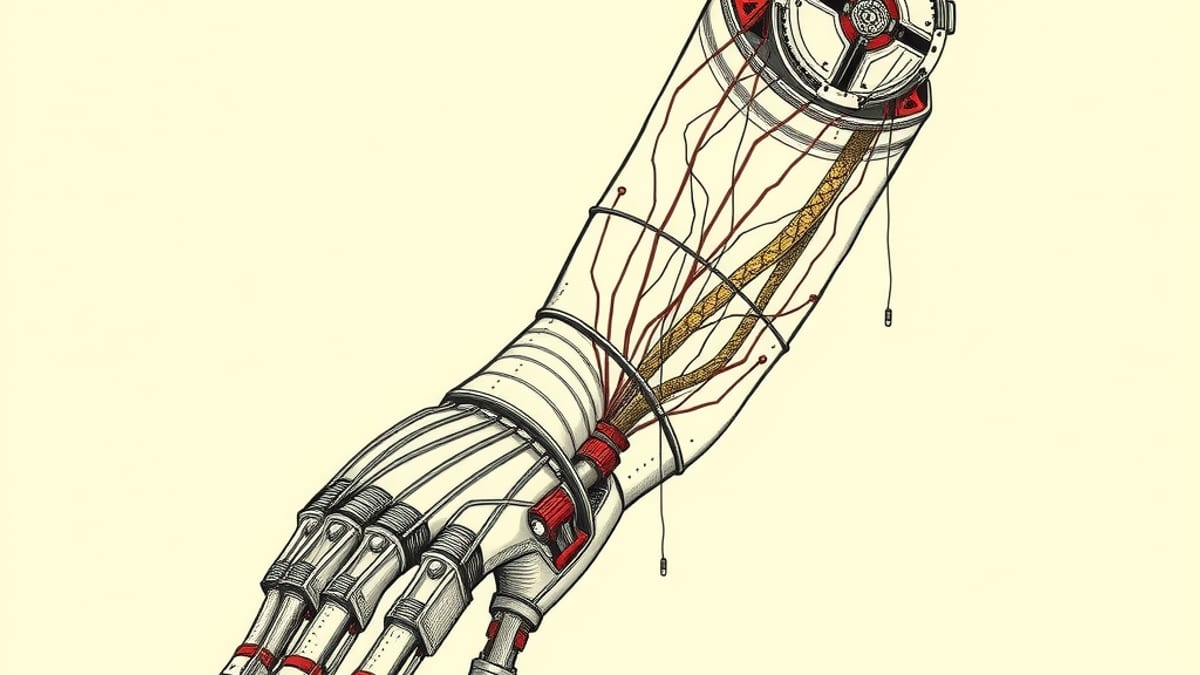
A new type of artificial skin, described in Nature Machine Intelligence, integrates more than 10,000 iontronic sensors with a processing architecture that mirrors the human somatosensory system. This development, led by Chuan Fei Guo of Southern University of Science and Technology and collaborators, aims to provide humanoid robots with a more sophisticated sense of touch.
The iontronic skin, termed NI-skin, achieves a high sensor density of 1,110 units per square centimeter. Unlike conventional robotic skins that can become overwhelmed by data from thousands of sensors, the NI-skin employs a layered processing approach. This mirrors the human nervous system's method of handling tactile input through signal encoding, convergence, and cognitive modeling. This hierarchical structure is critical for managing the vast amount of data generated by a large-scale skin, enabling parallel transmission of tactile information with reduced latency and signal interference.
The iontronic sensors themselves utilize the movement of ions within soft polymer materials to convert pressure into electrical signals, a process analogous to biological mechanotransduction. This ion-based mechanism allows the skin to be both compliant and highly sensitive, capable of detecting fine surface details with a spatial resolution of 800 micrometers and a temporal resolution of 10.6 milliseconds. The system also incorporates a three-stage processing pipeline that compresses data significantly before it reaches a robot's central processor, reducing bandwidth demands by hundreds of times.
This advanced tactile sensing capability enables robots to perform complex tasks, such as intricate manipulation of objects and the perception of potentially harmful mechanical stimuli. The researchers demonstrated that robots equipped with this NI-skin can execute challenging interactions and proactively avoid injury by detecting pain-related stimuli. The project's leaders have made the tactile interaction datasets, visualization code, and training scripts publicly available on GitHub, a move intended to encourage broader adoption within the robotics community. The researchers suggest that this combination of high sensor density, large scale, and efficient processing provides a tactile foundation approaching human-level perception, which is essential for robots to operate safely and effectively alongside people.