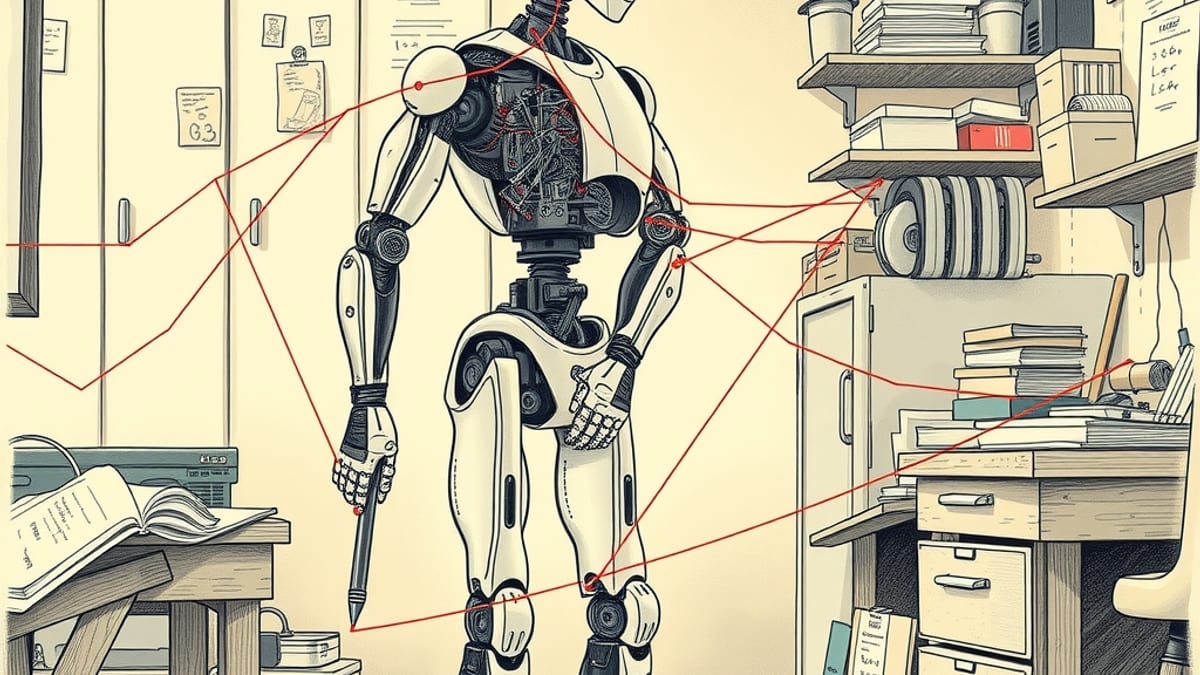
The EgoExplorer dataset provides continuous recordings of human activities, capturing how people coordinate movement, posture, and object interaction. The data includes first-person video, reconstructed whole-body motion, fine-grained finger articulation, and tactile observations. This information is accompanied by step-level descriptions of the tasks performed. The dataset emphasizes professional activities and was collected using a lightweight, portable wearable system.
Traditional datasets often offer only partial views of human coordination, limiting their utility for training advanced humanoid robots. EgoExplorer aims to address this by providing a more complete picture of human loco-manipulation in diverse environments. The system uses sparse body sensing and a "Calibrate-Complete-Constrain" pipeline to achieve its data coverage.
The development of EgoExplorer aligns with a broader trend in robotics research that seeks to leverage egocentric human data for robot learning. Datasets like EgoVerse and EgoHumanoid have also explored using first-person human demonstrations to improve robot performance, particularly in manipulation tasks. EgoVerse, for example, offers over 1,300 hours of human demonstrations across various tasks and scenes. Similarly, the EgoHumanoid framework demonstrated that egocentric human data can significantly enhance a humanoid robot's ability to perform complex movement and manipulation tasks, showing a 51% improvement in generalization compared to robot-only baselines.
The challenge in using human data for robot training often lies in bridging the "embodiment gap" between human and robot bodies. This involves aligning visual perspectives and translating human actions into a format that robots can execute. Researchers for EgoHumanoid developed a systematic alignment pipeline with view alignment to reduce visual discrepancies and action alignment to map human motions into a unified action space for humanoid control.
The EgoExplorer project, developed by researchers from Shanghai AI Lab and Zhejiang University, contributes to the growing collection of multimodal egocentric datasets. These datasets are becoming increasingly important for training advanced AI systems to understand human interaction with the world and for developing more capable humanoid robots.