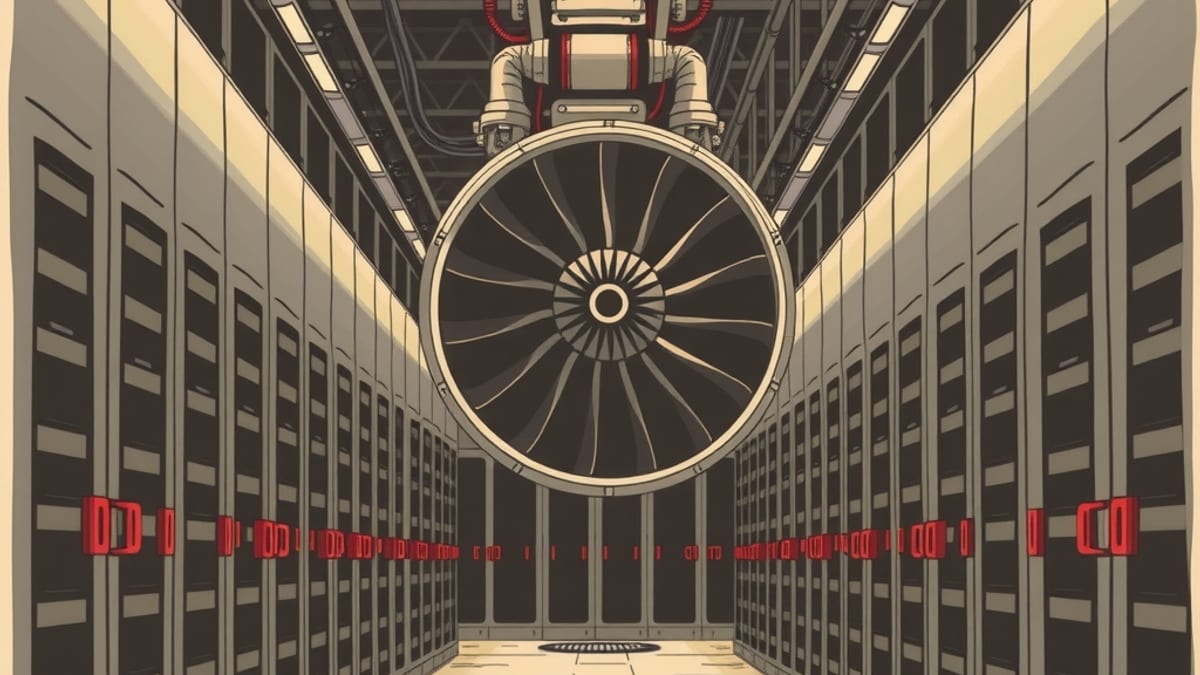
Data center developers are increasingly turning to repurposed jet engines to generate electricity, a measure driven by significant delays in connecting to the electrical grid and acquiring new power turbines. The demand for rapid power deployment, particularly for artificial intelligence (AI) infrastructure, has led companies to seek out these unconventional power sources, despite their lower efficiency and higher emissions compared to conventional power plants.
Companies such as Elon Musk's xAI have installed eight converted jet engine turbines in Mississippi to power their data centers. These engines, often sourced from retired aircraft, are retrofitted by firms like ProEnergy, which converts General Electric turbines commonly found on Boeing aircraft. ProEnergy's repurposed turbines can each produce approximately 50 megawatts of electricity, enough to power about 15,000 homes. Another company, FTAI Aviation, has also launched a division to convert retired Boeing 737 and Airbus A320 engines for data center use.
The appeal of these repurposed jet engines lies in their availability and the speed at which they can be deployed. While traditional grid connections can take years, jet engine power solutions can potentially have a data center operational within 24 months. This speed is critical for companies racing to build out AI capabilities, where power availability is a major bottleneck. The U.S. Energy Information Administration has noted that retired military jet engines alone could represent a significant power capacity, estimating that thousands of aircraft at a single base could generate as much as 40 gigawatts.
However, the use of jet engines comes with considerable drawbacks. These repurposed turbines are generally less efficient and more polluting than engines designed for conventional gas-burning plants. For instance, xAI's generators in Mississippi have permits allowing them to emit carbon monoxide at twice the rate of other turbines on site, with a 25% higher limit for volatile organic compounds. Environmental groups have raised concerns about these emissions, challenging the approvals and highlighting the potential health risks.
The constrained market for new gas turbines, with wait times extending beyond 2029, further exacerbates the situation. This scarcity has driven up demand for repurposed engines as a temporary or bridging power solution. Companies like ProEnergy have reported that demand from data centers now outpaces that from traditional utilities. Some data center projects are expected to use these jet-powered generators for five to seven years before grid interconnection is secured.
While some companies, like Google, have stated they will wait for grid-connected power, others are opting for the immediate, albeit less efficient and more polluting, solution offered by repurposed jet engines. The trend highlights the immense pressure on the data center industry to rapidly scale up power capacity to meet the burgeoning demand from AI and other computing-intensive applications. The long-term viability and environmental impact of these solutions remain subjects of ongoing scrutiny.