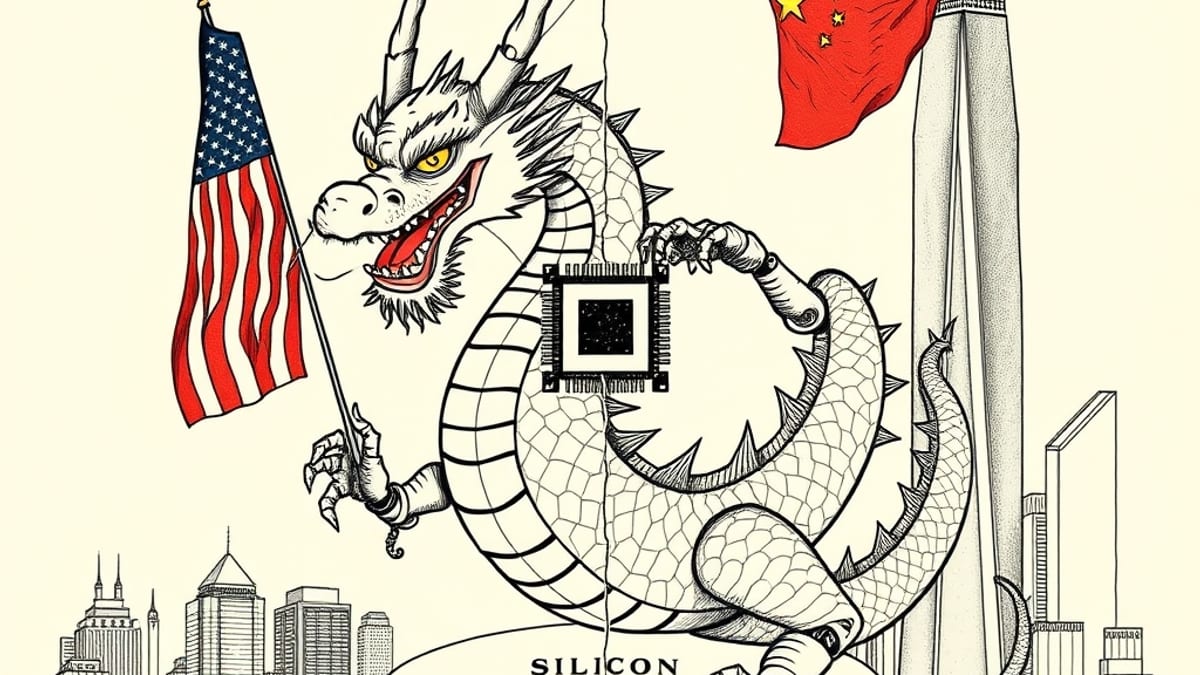
China's recent technological leaps in artificial intelligence, robotics, and semiconductor manufacturing are creating significant disruption, dividing opinion within the US tech sector and prompting government responses. Over the past month, new open-source AI models, advanced robotic systems, and specialized computer chips from China have rattled financial markets and escalated competition with the United States.
The most immediate challenge to the US tech landscape has emerged from Chinese-developed open-source AI models, such as Moonshot AI's Kimi K3. These models are powerful enough to rival proprietary, more expensive offerings from companies like OpenAI and Anthropic, and are available for free download and use. This accessibility has divided Silicon Valley. Chip manufacturers and some tech firms see revenue opportunities and a chance to counter the dominance of OpenAI and Anthropic. Conversely, OpenAI and Anthropic argue that Chinese-made models pose security risks and threaten their business models. This internal debate extends to the US government, with some officials wary of blocking low-cost AI models that American businesses have adopted, while others advocate for stricter measures. Treasury Secretary Scott Bessent has suggested sanctions against Chinese AI firms for alleged intellectual property theft, while other officials have received appeals from tech founders not to restrict access to these open models. A significant number of US tech companies, including Microsoft, Nvidia, Palantir, and Meta, have publicly urged lawmakers against imposing restrictions on open AI models.
In parallel, China's advancements in robotics have drawn direct regulatory action. The Federal Communications Commission (FCC) announced a ban on humanoid robots from China, citing unacceptable national security risks. The FCC alleges these robots could be used for surveillance or to steal data, and pose a threat to US manufacturing and supply chains. This move escalates the technological competition between the two nations. China's robotics sector has seen rapid growth, with quadruped robots developed in China accounting for nearly 70 percent of global sales in the first half of 2026.
The semiconductor industry has also felt the impact. Reports of China commencing mass production of specialized chips crucial for the AI boom triggered a stock sell-off that erased $1 trillion in market value from other chip manufacturers. This development follows China's reported success in mass-producing domestically developed immersion deep ultraviolet (DUV) lithography machines, a critical tool in semiconductor manufacturing. While these Chinese-made machines do not immediately threaten the market dominance of Dutch firm ASML, they represent a significant step towards reducing China's reliance on foreign technology amidst export controls.
The US government's response to China's tech progress is multi-faceted. Beyond the FCC's robot ban, there is ongoing debate within the Trump administration regarding potential controls on Chinese AI models. Lawmakers have been briefed that China poses an "existential threat," with calls to accelerate US technological advancements and counter China's efforts to set global technology standards. Strategies discussed include expanding the "Silicon Shield" beyond semiconductors to other vital technologies and reducing bureaucratic hurdles.
The rapid progress by Chinese companies like Moonshot AI, DeepSeek, and in the robotics sector, alongside advancements in chipmaking equipment, highlights a shift in the global technology dynamic. This intensifying competition is forcing a reassessment of strategies within Silicon Valley and among US policymakers, as China increasingly asserts its capabilities in key technological domains.