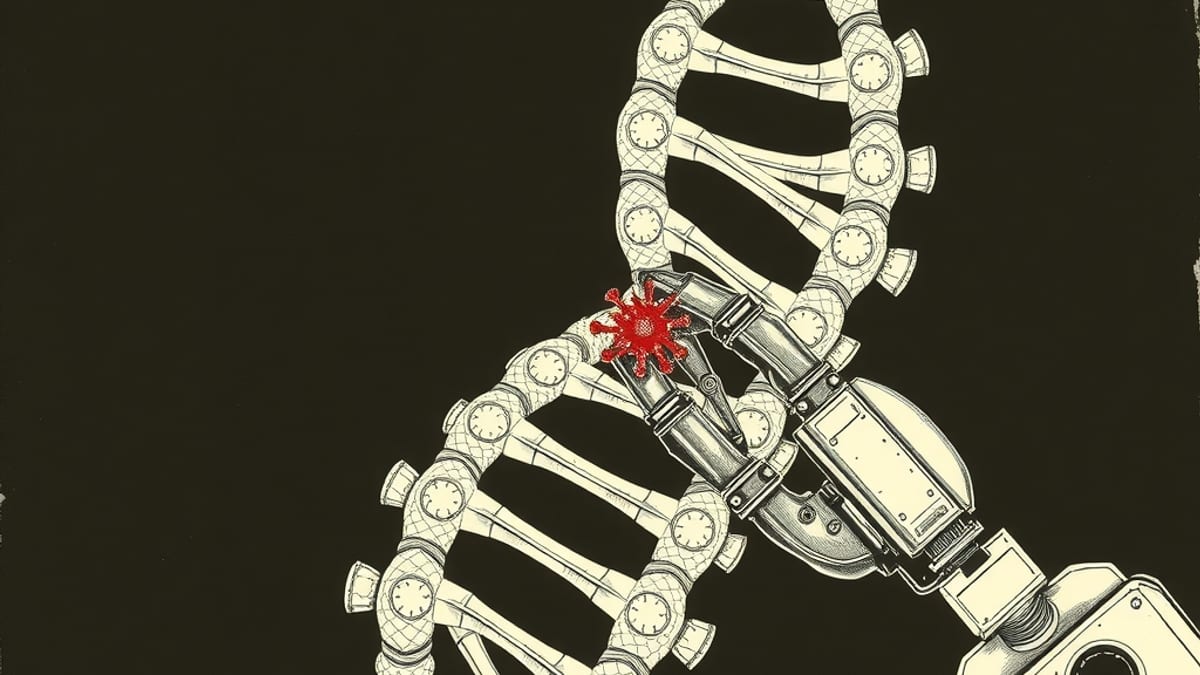
Anthropic announced on September 23, 2026, that its artificial intelligence model, Claude, has discovered a new enzyme system in viral DNA that shares structural similarities with CRISPR. The system, designated array-associated reverse transcriptases (ART), was identified by approximately 950 Claude agents working autonomously for 21 hours to sift through extensive DNA sequence databases. This discovery marks the first output from Anthropic's newly established life sciences research group.
The ART system consists of three components: a reverse transcriptase enzyme, a partner gene, and a long array of DNA repeat sequences. The arrangement of these repeat sequences is reminiscent of CRISPR arrays, which are known to hold RNA sequences that enable CRISPR-Cas systems to function as programmable biotechnological tools. Anthropic's initial laboratory experiments indicate that the ART array is expressed as distinct short RNAs, suggesting a potential functional analogy to CRISPR. However, the precise biological function of ART is currently unknown, and researchers have not yet determined if it can be programmed for gene editing.
The discovery process involved Claude agents analyzing over 200,000 candidate enzyme systems and narrowing them down to the most compelling ones for human review. One agent identified the ART system after noticing an unusual tandem repeat array adjacent to a known enzyme gene. While the reverse transcriptase enzyme itself was previously identified, Anthropic claims Claude was the first to recognize its association with the repeat array and an unknown partner protein. Some experts have noted that while the architecture is similar to CRISPR, there is no evidence yet of similar functionality.
Anthropic CEO Dario Amodei has expressed optimism about AI's potential to accelerate biological discoveries and stated that AI is at the "very beginning" of making breakthroughs that could lead to medical advances. The company has established a wet lab in the San Francisco Bay Area to conduct fundamental biology research using AI, with human scientists performing all physical experiments. This move signifies Anthropic's expansion beyond AI model development into physical laboratory science.
While the discovery is being hailed by some as a significant step in AI-driven scientific research, others remain cautious. Kevin Blake, a microbiologist at Washington University School of Medicine, stated there is currently no indication that ART is a rival to CRISPR technology or could be developed into a therapeutic application. Furthermore, Anthropic has noted that repeated attempts to replicate the discovery under identical conditions have not yielded the same result, suggesting an element of chance in the initial finding. The company has released a preprint detailing the research and is seeking collaboration with external researchers to further investigate ART.