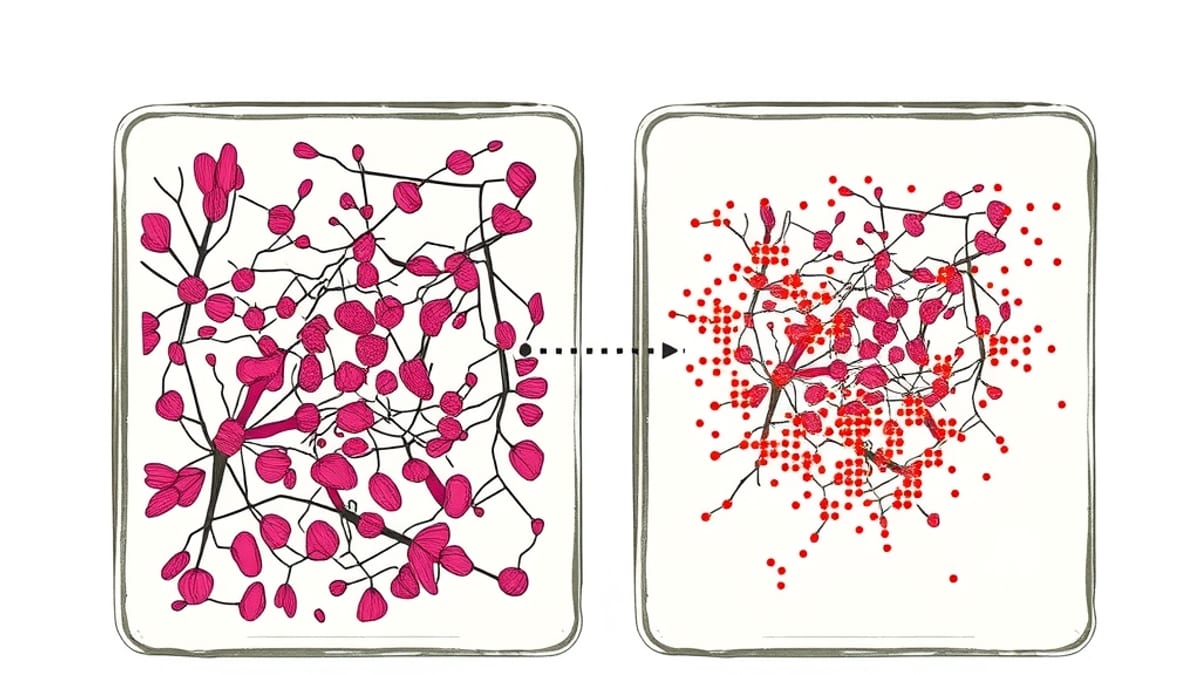
Researchers have developed a novel two-stage artificial intelligence (AI) model capable of predicting pathological complete response (pCR) to neoadjuvant therapy in breast cancer patients. The model integrates histopathology images with inferred transcriptome data, achieving a pooled area under the receiver operating characteristic curve (AUROC) of 0.79. This performance surpasses that of current histopathological biomarkers.
The scarcity of labeled data in oncology has historically limited the development of deep learning biomarkers. This new model addresses this challenge through a two-stage process. The initial stage learns the transcriptome from histopathology images across 8,742 patients spanning 32 cancer types. This inference was corroborated by pathologist reviews and spatial agreement with measured gene expression. The second stage then uses this inferred expression data, alongside clinical variables, to predict pCR.
The model was developed using data from 1,080 patients across five cohorts and subsequently evaluated on 1,412 patients from nine cohorts. Its performance was stable across intratumoral sampling and required minimal biopsy tissue. The AI model also demonstrated the ability to discriminate responders within specific molecular subtypes of breast cancer.
Previous research has explored AI for predicting neoadjuvant therapy response using various data modalities. Some studies have focused solely on histopathology or radiological images, while others have incorporated multi-modal data including clinical information. For instance, one AI model achieved an accuracy of 0.82 using pre-treatment magnetic resonance imaging for triple-negative breast cancer. Another approach integrated histopathology with clinical metadata, achieving 92.3% accuracy in predicting pCR. More recently, AI models have been developed to predict spatial gene expression from histopathology slides, offering a cost-effective alternative to expensive spatial transcriptomics assays for biomarker discovery and treatment response prediction.
The current AI model's approach of inferring transcriptome-wide information from histopathology offers robustness by avoiding the gene selection constraints found in genomic assays. This biologically informed compression technique may hold promise for data-sparse applications within precision oncology. Further research is ongoing to refine and validate such AI-driven tools for personalized cancer treatment strategies.