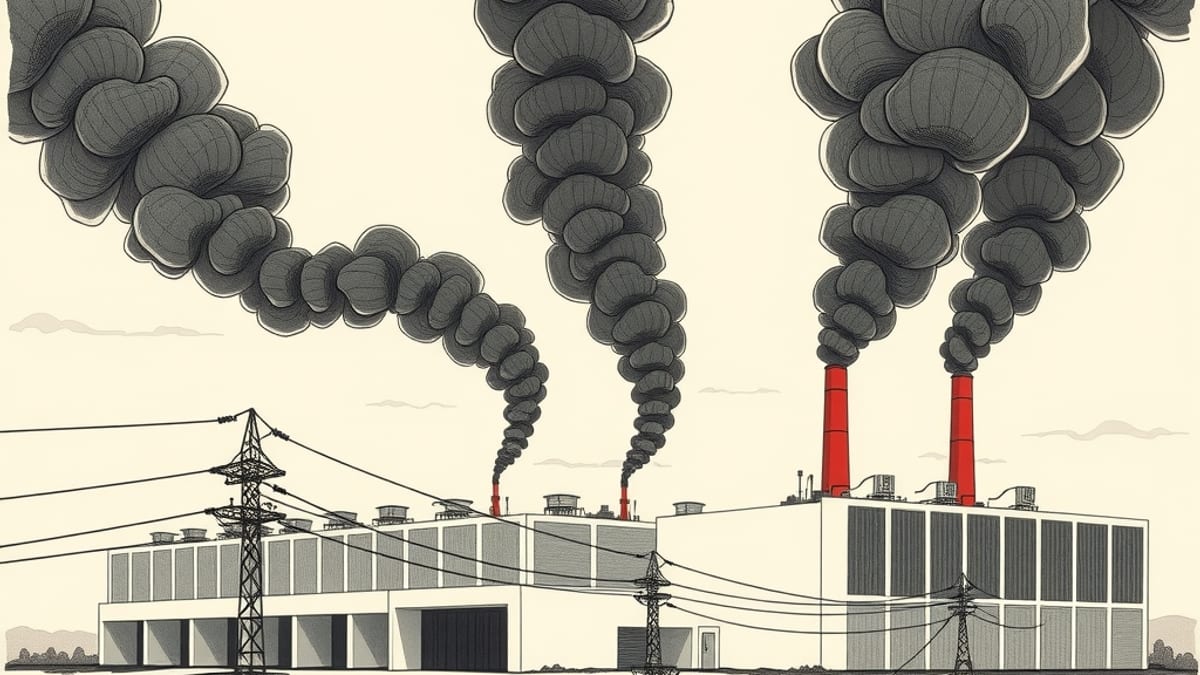
Developers of artificial intelligence data centers are planning to build on-site gas-fired power stations with a combined capacity of 181 gigawatts, according to research. These facilities are proposed for sites in the United States, the United Kingdom, and mainland Europe, primarily to circumvent delays in connecting to existing national electricity grids. If fully realized, this planned gas-fired capacity is nearly four times the total peak electricity demand of Great Britain.
The research, conducted by BloombergNEF, indicates that this strategy, termed "speed to power," could lead to substantial annual carbon dioxide emissions. In the United States alone, where 90% of these on-site gas power stations are planned, the projected emissions are approximately 345 million metric tons of carbon dioxide equivalent per year. This figure is comparable to the annual greenhouse gas emissions of about 72.8 million fossil fuel cars.
Mark Daly, head of data centers and emerging tech at BloombergNEF, noted that the economics driving AI development prioritize rapid deployment. While developers claim these on-site power sources will be temporary solutions until grid connections are secured, there is a risk of long-term fossil fuel dependency. Once operational, the economic incentives might encourage continued use of these gas plants, creating a "fossil-fuel lock-in" effect.
The International Energy Agency (IEA) has projected that global electricity demand from data centers could double to 945 terawatt-hours by 2030, driven by the surge in AI. This would represent almost 3% of total global electricity consumption. The IEA also highlighted that data centers, unlike other energy consumers, tend to be concentrated in specific locations, which can complicate grid integration.
In the United Kingdom, over 100 inquiries were made by planned data centers in 2024-2025 seeking connections to the gas network due to electricity grid access delays. Some specific sites, such as Wapseys Wood in Buckinghamshire and Quest Park in Bedfordshire, are reportedly seeking to build their own on-site gas power stations for this reason.
The reliance on on-site gas power plants also presents other risks. Developers are reportedly encountering mechanical failures with gas turbines due to a lack of in-house operations and maintenance expertise. Furthermore, projects that depend on "behind-the-meter" gas plants are vulnerable to volatile fuel prices and pipeline constraints. Some companies, like Anthropic, have detailed these risks in their IPO filings, especially in the context of global energy market fluctuations.
The trend of building on-site gas power stations for AI data centers is occurring despite a broader global push towards renewable energy. The IEA's "Renewables 2026" report forecasts continued growth in solar and wind power, with these sources projected to account for a significant portion of global electricity generation by 2050. However, the immediate energy demands of AI development appear to be prioritizing speed over cleaner, more sustainable energy solutions in the short term.