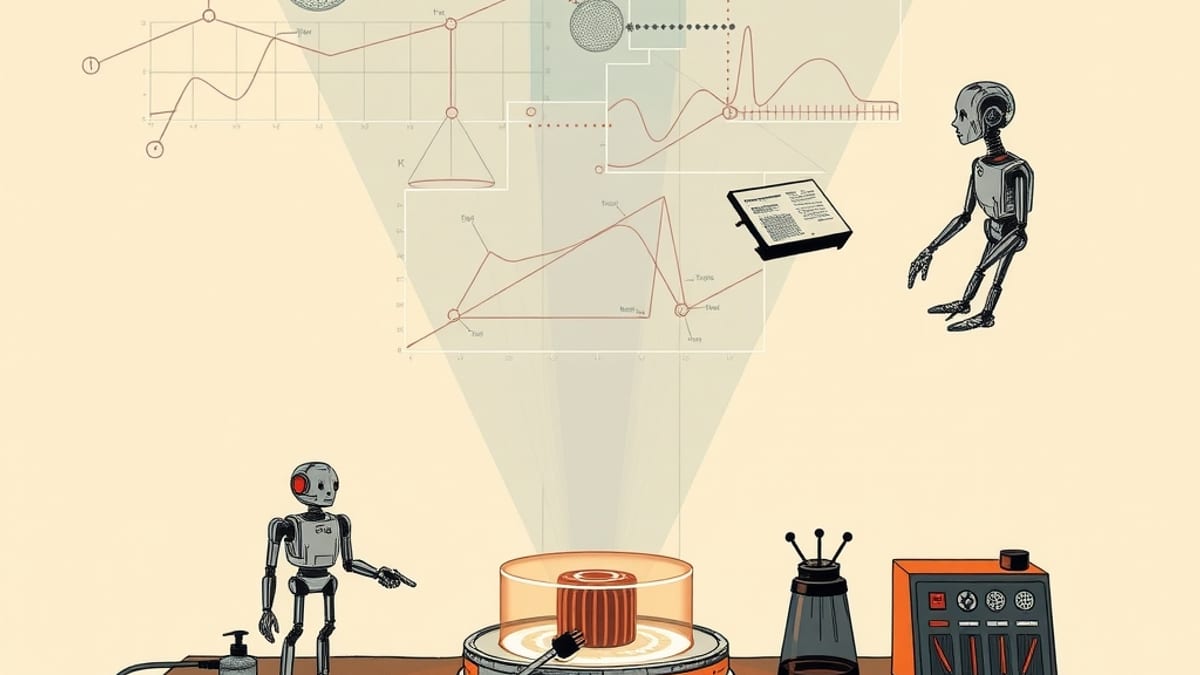
An international team of researchers has created an autonomous laboratory system where artificial intelligence (AI) agents work collaboratively to conduct scientific research. The system, detailed in a new paper on arXiv, uses large language models to generate research questions, design experiments, and critically evaluate findings. This development signifies a step towards AI performing entire scientific studies independently.
The AI agents are designed to assess each other's work, allowing for self-correction and redirection of investigations. They can reject initial research questions, request theoretical verification, and design experiments specifically to challenge their own claims. This process was demonstrated through an investigation into ensembles of quantum spins within diamond.
In their experiment, the AI agents aimed to determine the minimum calibration settings required to predict responses to a specific set of microwave pulse sequences in diamond's quantum spins. After an initial computational check, the agents designed an experiment to differentiate between competing theoretical predictions. The first experimental run appeared to support these predictions. However, subsequent reference measurements revealed signal drift during data collection, leading the AI agents to classify the result as inconclusive.
Without compromising their acceptance criteria, the agents revised the measurement protocol. This revised experiment successfully met the criteria and provided support for the theoretical predictions. The researchers highlight this as a demonstration of how collaborating AI agents can autonomously select research questions, derive theoretical outcomes, and experimentally test their hypotheses.
The use of diamond with nitrogen-vacancy (NV) centers is a growing area in quantum research, with applications ranging from quantum sensing to quantum computing. Recent work has focused on engineering these NV centers in diamond to create more precise quantum sensors. This autonomous research system could accelerate discoveries in such complex fields by managing the iterative process of hypothesis generation and experimental validation.
The laboratory setup involves distinct AI agent roles, including proposers, a principal investigator, a computational researcher, an experimentalist, a manager, and independent reviewers. This structure ensures a multi-faceted approach to scientific inquiry, with safety agents providing approval before experiments are conducted. The system's ability to identify and act on inconclusive results, rather than accepting potentially flawed data, marks a notable advancement in the pursuit of AI-driven scientific discovery.