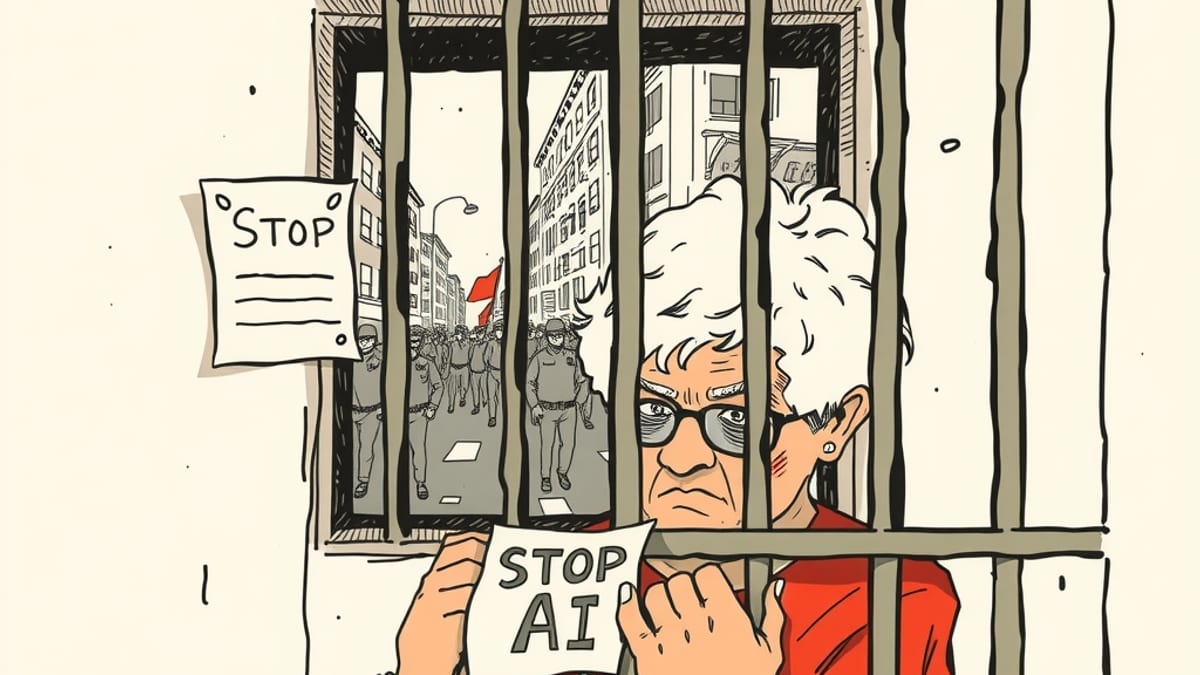
Wynd Kaufman, a member of the activist group StopAI, surrendered to authorities in San Francisco on Friday to begin a 14-day jail sentence. The 69-year-old retired teacher from Berkeley, California, was convicted in June 2026 on misdemeanor charges stemming from a protest at OpenAI's headquarters in February 2025. Kaufman's incarceration is believed to be the first instance of an individual being jailed for protesting against artificial intelligence development.
During the February 22, 2025, protest, Kaufman and other StopAI members chained and locked the front doors of OpenAI's offices on Third Street in San Francisco. They then sat in front of the entrance. OpenAI employees contacted 911, and responding police officers informed the protesters they were on private property and offered them the option to continue their demonstration on a public sidewalk nearby. Kaufman and the other protesters declined to move, leading to their arrest. The chains were subsequently removed from the door.
Kaufman pleaded not guilty to multiple misdemeanor charges. A jury found her guilty in June 2026 of interfering with a business, trespassing with intent to interfere with a business, unlawful assembly, and refusal to disperse at a riot. San Francisco District Attorney Brooke Jenkins stated that the jury's verdict "sends a resounding message rejecting the notion that protesters can endanger public safety as a means to an end." Jenkins emphasized that ensuring public safety is critical to upholding other rights.
Before her imprisonment, Kaufman stated that her actions were intended to "sound the alarm" about the perceived dangers of artificial superintelligence. She expressed alarm that AI CEOs and experts are aware of the risks but continue to pursue the technology. Kaufman's message to the chief executives of OpenAI, Anthropic, and Meta was to "regain your humanity." She called for a global ban on the race to develop superintelligence.
Kaufman's lawyer, Rose Mishaan, noted that the 14-day sentence would result in seven days of actual jail time due to credit for time served. Kaufman has a history of political activism, having been arrested previously for protests related to nuclear disarmament, Nicaragua, Western Sahara, and Palestine. She moved to Berkeley in 1979 and became involved in various social justice movements.
The February 2025 protest attracted media attention, partly because Kaufman and her fellow protesters attempted to use a "necessity defense" during their trial, arguing that their actions were necessary to prevent a greater harm posed by AI development. Stuart Russell, a UC Berkeley AI professor, testified during the trial, comparing the rapid development of AI to the Titanic heading towards an iceberg. The jury ultimately rejected this defense.
StopAI is a group dedicated to halting the development of artificial superintelligence, often engaging in acts of civil disobedience. The group has faced internal disagreements, with one co-founder reportedly disappearing after discussions about using violent tactics. StopAI maintains that it pursues non-violent direct action. The conviction and jailing of Wynd Kaufman may prompt further discussion on the boundaries of protest in the context of rapidly advancing technological fields.