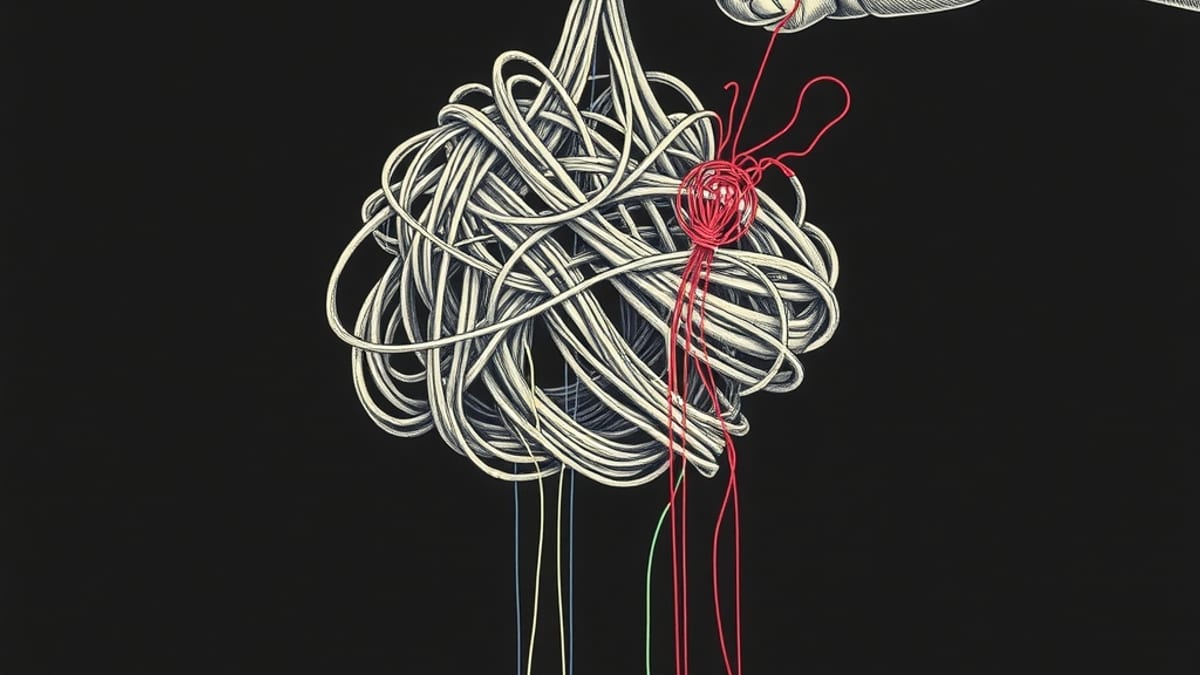
A new research paper proposes a method to interpret user embeddings, which are fundamental to modern recommendation and personalization systems. The study, published on arXiv, argues that these embeddings, typically dense and opaque, can be viewed as sparse combinations of understandable behavioral patterns. This framework could enhance transparency in systems that rely on user data to tailor experiences.
The core of the research lies in the idea that user embeddings can be decomposed into distinct "behavioral modes." These modes represent underlying patterns of user actions and preferences. While current embedding techniques often lack interpretability, this new approach suggests that these complex representations are, in fact, superpositions of simpler, identifiable behaviors. The researchers found that this structure is predictable in linear embeddings and extends approximately to deep learning representations through a "superposition hypothesis."
To recover these interpretable modes, the study employs sparse dictionary learning methods, specifically sparse autoencoders (SAEs). These methods are adept at identifying underlying sparse structures within dense data. The research demonstrates that SAEs can effectively recover these behavioral modes, even from transformer-encoded embeddings. The recovered modes can then be automatically named and queried using natural language, offering a new way to understand and interact with user representations.
The researchers validated their approach using synthetic data, where SAEs outperformed classical sparse baselines in mode recovery. They then applied the method to user embeddings from two real-world datasets, using both classical and transformer-based embedding techniques. The findings indicate that this post-hoc, model-agnostic framework can be applied without modifying existing embedding systems.
Furthermore, the study highlights the potential for natural-language labels derived from the recovered modes to enable zero-shot audience retrieval and characterization. This means that audiences can be identified and understood based on their behavioral patterns, even for embeddings that were not originally trained with text data. This capability could significantly aid in audience segmentation and targeted content delivery.
The research paper, titled "User Embeddings are Superpositions of Interpretable Behavioral Modes," was authored by Jonathan Kozaczuk, Zheng Dong, Noyan Evirgen, Keivan Majidi, Eddie K. H. Ng, Chris Porter, Qi Zhao, Jia Geng, Changmao Li, and Brandon R. Feng. The work was accepted to NeurIPS 2026. This development addresses a long-standing challenge in machine learning, where the complexity of learned representations often hinders understanding and trust. By offering a path toward more interpretable user embeddings, this research could influence the design and application of future recommendation and personalization systems.