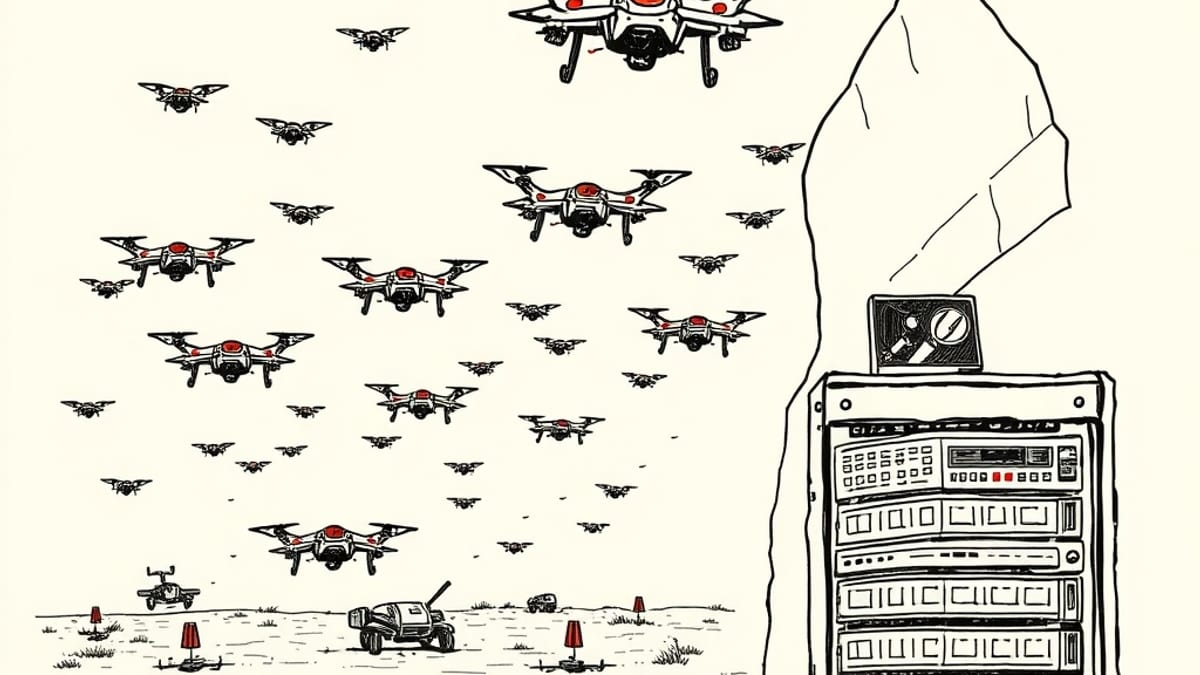
A United States firm has equipped 50,000 Ukrainian drones with artificial intelligence for autonomous target tracking, according to reports. The initiative is part of a $100 million deal designed to upgrade the capabilities of Ukraine's unmanned aerial vehicles. This development signifies a move towards greater autonomy for kamikaze drones, allowing them to identify and pursue targets without continuous human guidance. The AI system enables drones to track designated targets even if navigation or control links are disrupted. This capability is crucial in electronic warfare environments where communication can be compromised. The technology, developed by the US company Auterion and integrated with Ukrainian manufacturer SkyFall's Shrike FPV strike drones, began deliveries in July. The full integration is expected to be completed over the coming months. While the exact financial details and the contracting country have not been publicly confirmed by all parties, Reuters reported that Germany is financing the approximately €90 million (roughly $103 million) order. Auterion CEO Lorenz Meier confirmed the contract value to Reuters. The deal involves fitting Auterion's Skynode S autonomy kits and Strike software onto the drones. This contrasts with a previous $50 million Pentagon-backed commitment to deliver 33,000 conversion kits to Ukraine. Ukraine has become a significant testing ground for drone technology, with its military adopting AI and computer vision into various platforms. The country's defense industry has rapidly expanded, with Ukrainian manufacturers producing a vast majority of the drones procured by its forces. The Ukrainian Ministry of Defence has implemented a new procurement strategy that prioritizes drones based on battlefield data and proven effectiveness. This approach aims to eliminate corruption risks and ensure that only reliable, target-striking UAVs are acquired. The integration of AI into these drones addresses a critical need for enhanced autonomous capabilities on the battlefield. Reports indicate that Ukraine's agility in developing and deploying drone technology has outpaced traditional military development cycles. This has led to a situation where Ukraine is not only a recipient of advanced technology but also a significant contributor to global drone warfare innovation, even influencing NATO's approach to defense strategies. The AI system's ability to maintain target tracking during communication disruptions is particularly important. This capability allows for more persistent engagement and increases the likelihood of mission success in contested airspace. The future development of this technology may include swarm attack capabilities, where one operator could potentially direct multiple drones simultaneously. However, details regarding safeguards and authorization procedures for such operations have not yet been disclosed. Ukraine's extensive use of drones in combat has provided invaluable real-world data, accelerating the development and refinement of AI-driven systems. This battlefield-tested technology has supported over 100,000 combat missions since 2024. The nation's drone industry is now a major force, with estimates suggesting Ukraine could produce millions of drones annually. This production capacity and technological expertise are increasingly being recognized and sought after by international partners, including the United States and European nations. The broader context of this development includes Ukraine's emergence as a "drone superpower," influencing global defense discourse and forcing alliances like NATO to reassess their own strategies and procurement processes. The economic asymmetry between low-cost drones and expensive defense systems remains a significant challenge for traditional military powers. The deployment of AI-enhanced drones represents a continuing evolution in this conflict, aiming to provide Ukraine with a more potent and adaptable aerial capability.
US Company Provides AI for 50,000 Ukrainian Drones in $100 Million Deal
A United States company has supplied artificial intelligence capabilities to 50,000 Ukrainian drones as part of a $100 million agreement. This integration aims to enable the drones to autonomously track targets, enhancing their effectiveness in combat operations.
AI-assisted archive. Original-source fact review is pending. How evidence is checked
Read source-checked investigations