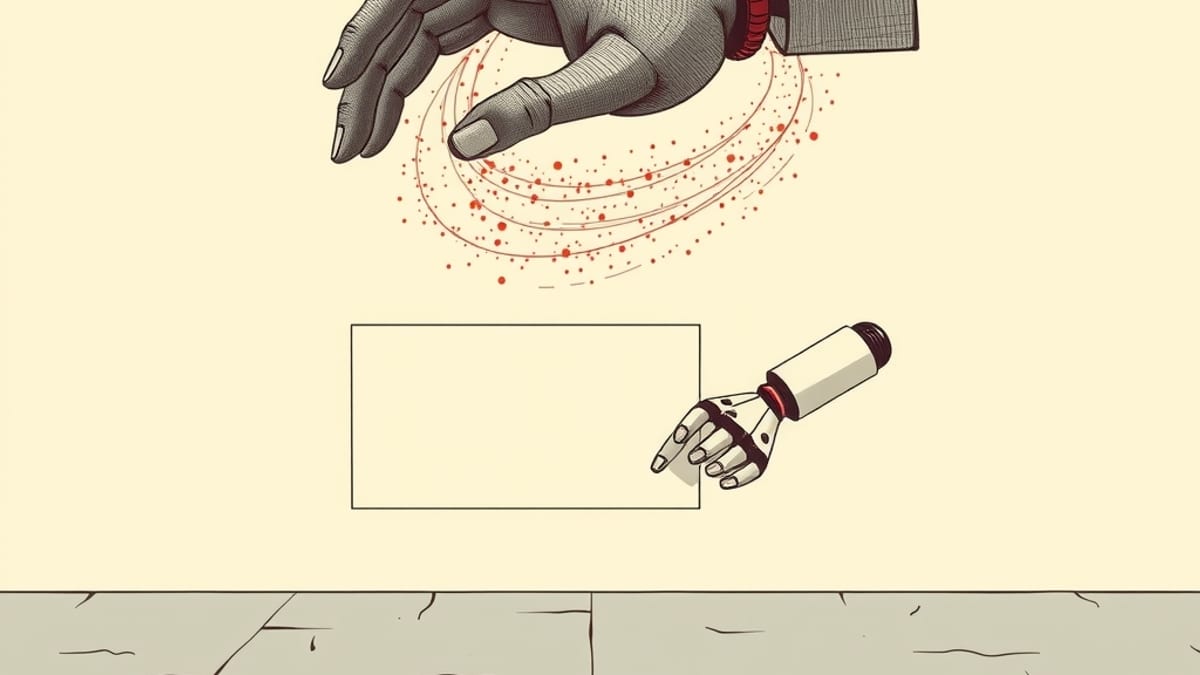
The ThinkWorld framework, detailed in a paper published on arXiv by Chaehyun Kim, Chi-Pin Huang, and others, addresses a key limitation in current Vision-Language-Action (VLA) models: their reliance on extensive action-labeled robot demonstrations. This dependency restricts the models' ability to generalize across diverse scenarios. ThinkWorld instead learns from a broader range of human video data, which often lacks explicit action annotations.
The core mechanism of ThinkWorld involves representing each action as a "Chain-of-Dynamics" (CoD), a sequence of discrete motion tokens. These tokens capture the intermediate dynamics that connect a robot's current state to a desired future state. This CoD representation serves as a common language for actions across different robotic embodiments, making it morphology-agnostic.
ThinkWorld operates on a two-level hierarchy. First, it performs internal world dynamic reasoning, followed by embodiment grounding. The CoD tokens encode discrete 3D spatial velocity, end-effector orientation changes, and phase contact intentions. The reasoning module initially undergoes training on a small dataset of action-labeled robot demonstrations to ground these CoD tokens into physical coordinates.
A key innovation is the use of world imagination reinforcement learning. Given an unannotated video segment showing a transition from an initial state to a future state, ThinkWorld's world imagination model predicts the future state based on a generated CoD. The system then compares this predicted future state with the actual observed outcome in the video. The alignment between the imagined and observed outcomes generates a self-supervised reinforcement learning reward. This reward mechanism allows unannotated human videos to provide direct physical supervision, significantly boosting the robot's ability to generalize to real-world tasks.
The researchers report that ThinkWorld achieved a 70.0% success rate on novel objects and 65.0% on tool tasks when transferring skills from human videos to physical Franka Panda manipulators. This performance more than doubled that of OpenVLA, which achieved 35% and 20% respectively. Ablation studies indicated that removing the imagination reward caused success rates to drop by 24.6%, underscoring the importance of predicting visual outcomes for learning from unannotated videos.
Furthermore, the CoD motion tokens demonstrated zero-shot transferability across different robot morphologies, specifically between a Franka Panda 7-DoF arm and a WidowX 6-DoF arm. This suggests that grounding actions in spatial state transitions, rather than raw hardware motor currents, could be key to developing more universal robotic foundation models.
ThinkWorld is distinct from other approaches that infer latent actions from frame transitions or rely on fine-tuning with robot action labels. Instead, ThinkWorld initializes its shared action space from robot actions and annotated human hand motion, then evaluates sampled CoDs based on whether their imagined future matches the observed one. This allows unlabeled video to provide a consequence-based learning signal.