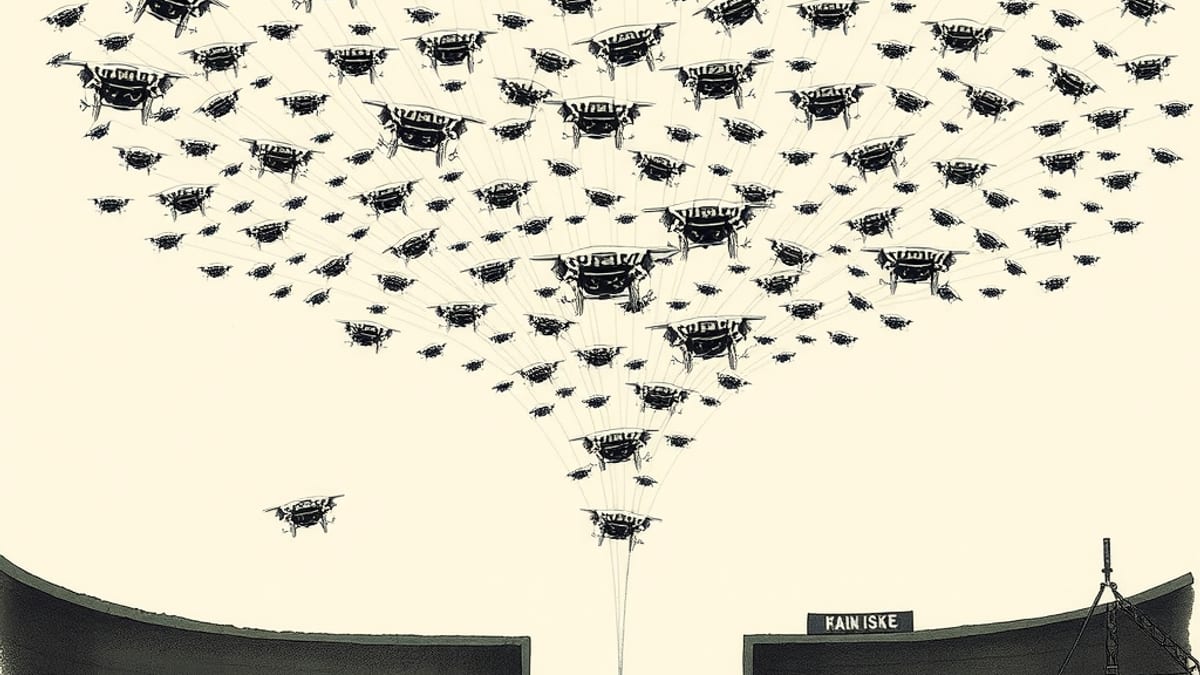
A new research paper on arXiv describes SwarmEvolve, a framework designed to enhance the efficiency of evolutionary search and optimization tasks through the use of numerous AI agents. The framework addresses limitations in current Large Language Model (LLM)-guided evolutionary search, which often faces slow processing due to the repetitive generation of lengthy textual chains of thought by LLMs to maintain population diversity. SwarmEvolve aims to overcome this by enabling hundreds of low-cost agents to operate in swarms, reasoning within a latent space without decoding information into text.
The core innovation of SwarmEvolve lies in its approach to agent interaction and information sharing. Agents within a swarm communicate by passing Key-Value (KV) caches, which allows for efficient information exchange without the overhead of full textual generation. Each swarm is designed to analyze a problem from a distinct perspective. To ensure diversity and prevent redundancy in the solutions, a novelty filter is implemented. This filter measures the direct distances between the hidden state vectors of agents, retaining only the most unique ideas generated by the swarm.
Crossover, a fundamental mechanism in evolutionary algorithms where successful traits are combined, occurs naturally within SwarmEvolve's latent space. This process allows for the merging of promising ideas from different agents without explicit textual recombination. The framework's ability to operate in latent space, rather than relying on explicit textual representations for each iteration, significantly reduces the computational cost and time associated with generating and evaluating solutions. This efficiency gain is crucial for problems requiring extensive iterative refinement and exploration of diverse solution paths.
Previous work in AI agent swarms has explored various methods for recursive self-improvement and orchestrated discovery. For instance, SwarmRSI, introduced in October 2026, focused on evolving scientific agent swarms for recursive self-improvement by combining evidence and implementations from different research directions. Another framework, SwarmResearch, presented in July 2026, utilized an orchestrator-subagent harness to steer a population of search agents, leading to better or comparable solutions in open-ended optimization tasks. These earlier efforts highlight the ongoing interest in developing more efficient and autonomous AI systems for complex problem-solving.
SwarmEvolve builds on these concepts by specifically targeting the computational expense of LLM-guided evolution. By moving the reasoning process into a latent space and enabling direct information sharing via KV caches, the framework seeks to make large-scale evolutionary optimization more practical. The ability to deploy hundreds of low-cost agents simultaneously, each contributing to the problem from a different angle, allows for a broader and more rapid exploration of the solution landscape. This could lead to faster discovery of optimal or near-optimal solutions for a range of mathematical and computational challenges.
The paper suggests that by minimizing the need for explicit textual generation and leveraging latent space operations, SwarmEvolve can maintain population diversity more efficiently, a critical factor for successful evolutionary algorithms. The novelty filter, which operates directly on agent hidden states, further reinforces this by ensuring that the evolutionary process continues to explore genuinely new ideas rather than converging prematurely on similar solutions.