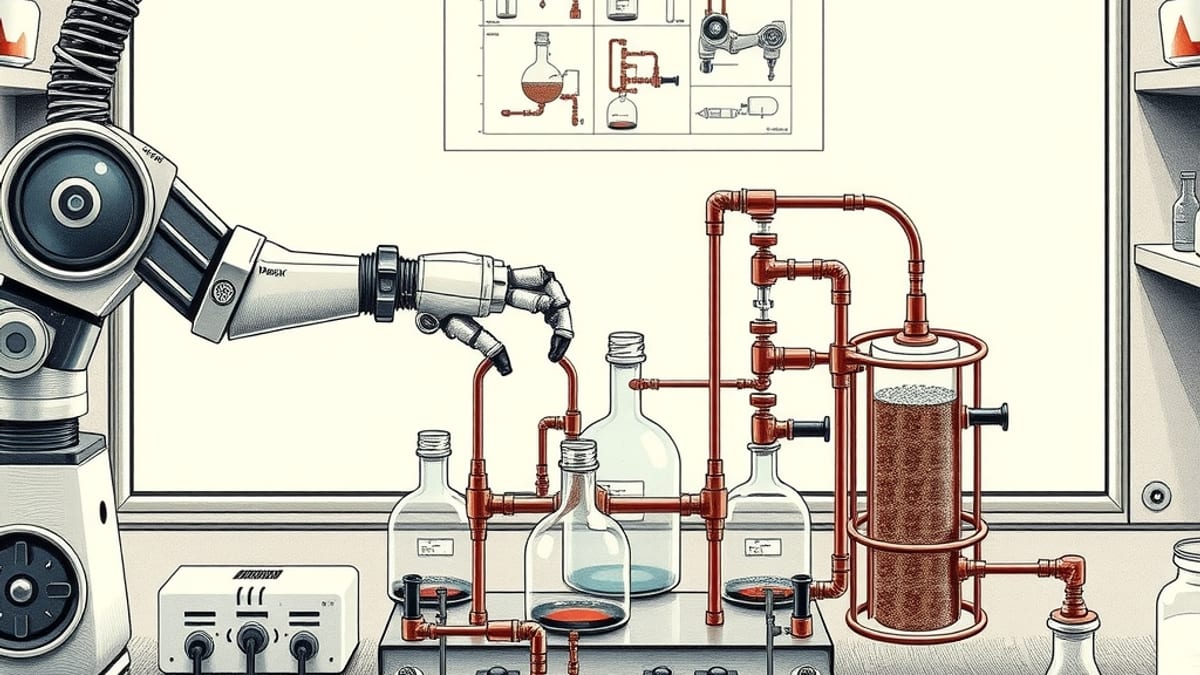
A new research paper published on arXiv describes the development of "self-building laboratories" (SBLs), a system designed to automate the construction and operation of experimental setups. The SBL addresses the bottleneck of laboratory flexibility in scientific discovery, where adapting existing facilities for new experiments often requires extensive manual engineering. The The SBL system begins with an existing laboratory environment, which can range from an empty room to a functional self-driving laboratory (SDL). It then identifies the necessary capabilities to achieve a specified scientific objective. The system proceeds to build the missing components, including the laboratory layout, a digital twin, robot skills, and experimental workflows.
According to the paper, the SBL integrates the identification, development, and validation of operational capabilities into the autonomous scientific process. Researchers define the overarching scientific objectives, and the SBL then identifies any discrepancies between these goals and its current capabilities. It subsequently develops or extends the interfaces, skills, and workflows required to bridge these gaps.
A key component of the SBL is its use of a digital twin. This virtual representation of the laboratory allows the system to develop candidate operations and test them against task constraints before refining and validating them through physical interaction in the real world. The digital twin is constructed from individual device models and the overall laboratory layout, utilizing robot-mounted cameras for additional observations when available.
The system acquires missing skills by using the digital twin and, with user approval, through trial-and-error in the physical environment. This process enables the SBL to progress from a user's scientific goal to the safe execution of the desired workflow with minimal human intervention. For instance, the SBL can learn to interpret sensory feedback, such as visual observations, depth measurements, robot state, and force/torque feedback, to guide its actions during exploration. This allows it to learn complex maneuvers like placing an object into a constrained fixture, which involves visual alignment, guarded descent, contact detection, and lateral adjustments.
The researchers suggest that this approach could lead to a dynamic ecosystem where scientific infrastructure evolves alongside scientific inquiry. The concept holds particular promise for environments where human engineers face limitations, such as remote field stations, hazardous sites, or laboratories in space, which operate under severe constraints on resources, communication, and crew time.
The development of SBLs builds upon existing efforts in laboratory automation, such as self-driving laboratories (SDLs), which focus on automating experimental execution and optimization. However, current SDLs are limited to the procedures they were initially designed for. The SBL aims to overcome this limitation by automating the very process of setting up new experimental capabilities. The ability to rapidly reconfigure laboratory spaces and equipment has been a longstanding goal in lab design, with flexible layouts and modular furniture often cited as strategies to adapt to evolving research needs. The SBL represents a step towards automating this adaptability.