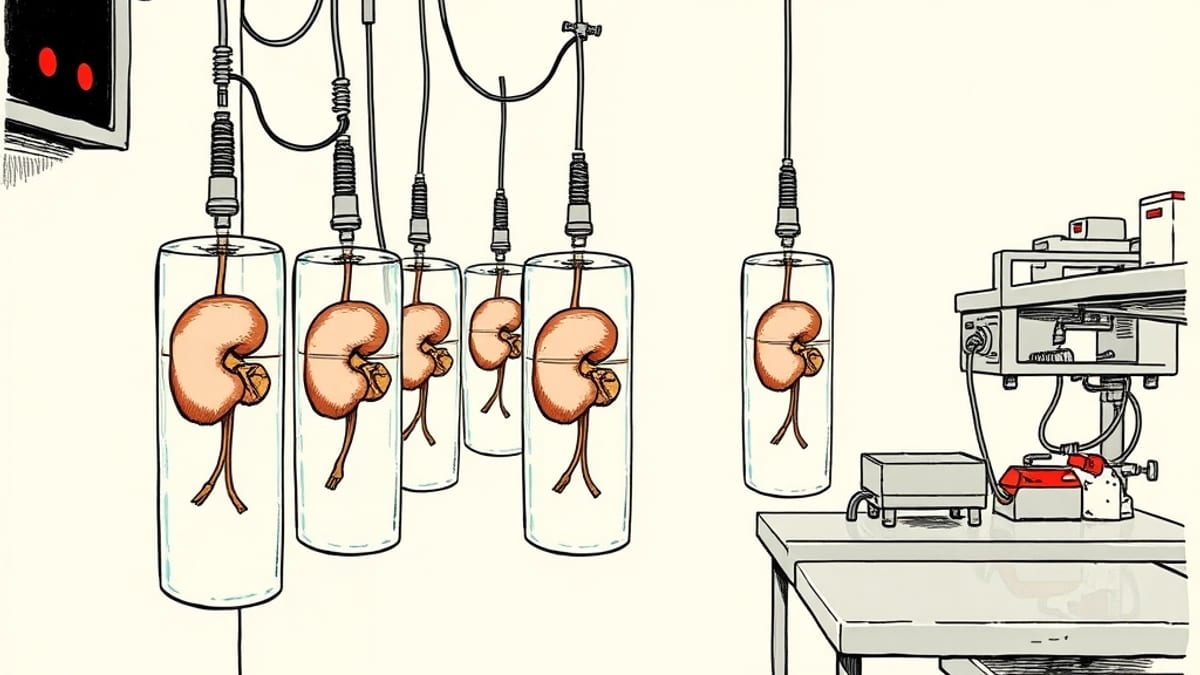
Researchers at Texas A&M University have developed a method to supercool pig kidneys to -4 degrees Celsius (25 degrees Fahrenheit) without ice formation, enabling their preservation for up to 72 hours. This duration is triple the 24-hour limit typically imposed by current organ storage methods. In experimental transplants, these supercooled kidneys demonstrated faster recovery and maintained health for over 30 days, outperforming kidneys stored on ice for 24 hours.
The procedure utilizes a pressure-controlled device that prevents ice crystals from forming, a common cause of damage in traditional organ preservation. Unlike some other experimental methods, this technique does not require cryoprotectant chemicals, which can complicate regulatory approval processes. The researchers anticipate this could accelerate their path toward human trials and potential Food and Drug Administration (FDA) approval.
Currently, a significant number of donated kidneys are discarded annually because they degrade before they can be transplanted. In the United States alone, over 104,000 individuals are on waiting lists for organ transplants, with many succumbing to their conditions before a suitable organ becomes available. Extending the viability of donor organs could address this critical shortage and improve transplant outcomes.
The Texas A&M team plans to establish a company to commercialize this technology. Preliminary findings suggest that storage times of up to 120 hours may be achievable with further refinement of the process.
This work builds upon previous advancements in organ preservation and xenotransplantation. In March 2024, Massachusetts General Hospital performed the first transplant of a genetically edited pig kidney into a living human recipient. That kidney, provided by eGenesis, had undergone 69 genomic edits to enhance compatibility and reduce the risk of rejection. The recipient in that case, Richard Slayman, has since recovered well, with the transplanted kidney functioning normally.
Other research has focused on cryopreservation, where organs are frozen for long-term storage. In May 2025, researchers at the University of Minnesota Twin Cities, part of the NSF ATP-Bio center, successfully transplanted a cryopreserved pig kidney that had been stored for 10 days. That effort involved complex rewarming techniques to prevent damage.
Scientists have also made progress in overcoming the immune rejection that often occurs in xenotransplantation. In November 2025, researchers at NYU Langone Transplant Institute reported reversing rejection events in a pig kidney transplanted into a brain-dead human donor. This demonstrated that existing medications could manage the immune response, offering another avenue for improving the success of cross-species transplants.
The ability to store organs for longer periods, whether through supercooling or cryopreservation, addresses a fundamental logistical challenge in transplantation. The current 24-hour window for kidney preservation is often insufficient for complex matching processes, long-distance transport, or unexpected surgical delays. Extending this time frame could allow for more thorough organ evaluation, better recipient matching, and a more efficient allocation system, ultimately saving more lives.