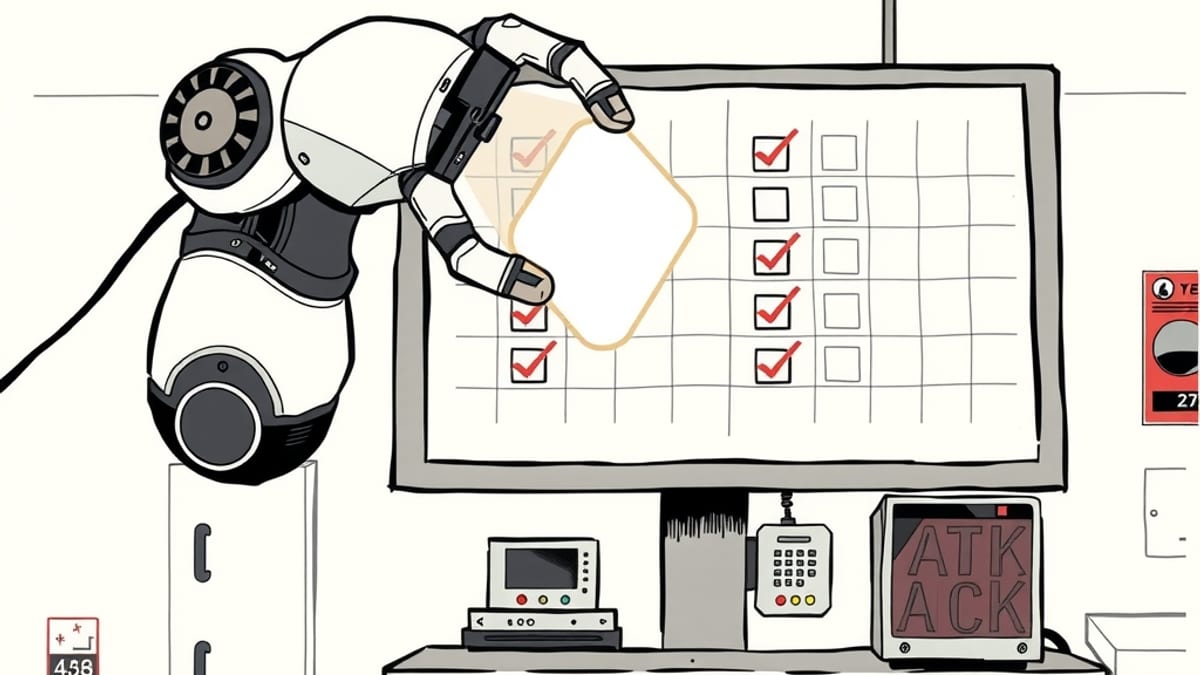
Researchers have introduced a novel framework, Reconstruct, Practice, Go Real (RPG), designed to enhance robot manipulation capabilities without altering the core models that govern their behavior. This approach focuses on autonomous skill improvement, a significant challenge in robotics where developing and maintaining reliable robot skills typically demands extensive human effort for skill design, reward shaping, and perception-control integration.
The RPG framework operates in three distinct phases. First, the "Reconstruct" phase analyzes offline datasets to identify useful manipulation skills. It then uses this information to generate related practice tasks within a simulated environment. This simulation phase is critical for the "Practice" stage, where the system uses feedback from simulated executions, privileged simulator states, and even existing dataset videos to diagnose why certain actions fail. Based on these diagnoses, RPG can develop entirely new symbolic skills, refine existing ones, or even revise the system's prompt, which guides the agent's decision-making. Before any changes are permanently integrated, a cross-task evaluation phase rigorously tests individual candidate improvements and merged revisions. Only those changes that prove effective across multiple tasks are retained for future use.
This method bypasses the need for computationally expensive model retraining, a common bottleneck in developing adaptable robotic systems. Instead, RPG focuses on improving the system's operational logic and skill repertoire. This approach has demonstrated strong performance, achieving 95.0% success on held-out initializations for 22 simulated manipulation tasks and a perfect 100% success rate over 30 trials across three physical tasks.
The development of such frameworks is part of a broader trend in AI research aimed at creating more autonomous and self-improving agents. Similar efforts include systems that focus on self-improvement through practice and feedback, sometimes using "steps-to-go" prediction as an intrinsic reward signal to guide learning without hand-crafted rewards. Other research explores evolving skill libraries and execution harnesses without updating model weights, focusing on train-free adaptation through skill optimization. These advancements aim to reduce the reliance on extensive human supervision and data collection, moving towards more efficient and adaptable robotic systems.