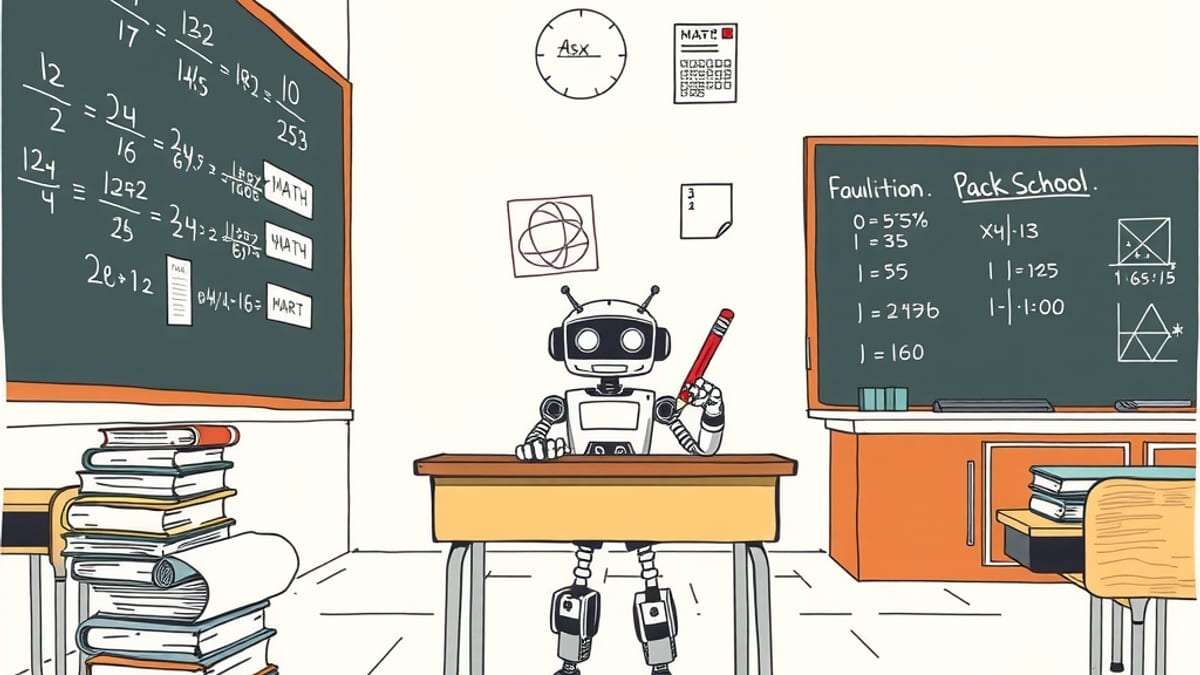
A team of researchers has introduced a new framework for studying knowledge acquisition in large language models (LLMs) by strictly controlling their training data. The effort centers on LITTLECURRICULUM, an 88-billion-token dataset curated from U.S. elementary school materials, and LITTLELEARNER, a 5-billion-parameter LLM trained from scratch on this specific curriculum. This approach aims to create a "developmentally restricted sandbox" where researchers can observe how models learn within explicit knowledge and capability boundaries.
Traditional LLMs are trained on vast, heterogeneous web-scale text corpora, making it challenging to isolate and understand how specific knowledge and skills are acquired. The creators of LITTLECURRICULUM addressed this by explicitly excluding concepts, facts, and vocabulary taught above Grade 5. This precise filtering allows for a clear mapping of LITTLELEARNER's capabilities to interpretable curriculum guidelines.
The research, detailed in a paper titled "LittleLearner: Language Models Under Pedagogically Controlled Knowledge Exposure," was published on arXiv. The authors include Fanfei Li, Jana Zeller, Manuel Prada-Corral, Thaddäus Wiedemer, Prasanna Mayilvahanan, Ryan Cotterell, and Wieland Brendel, affiliated with institutions such as the MPI for Intelligent Systems, ELLIS Institute Tübingen, and ETH Zürich.
LITTLELEARNER, despite its constrained training data, demonstrates sufficient language competence for open-ended evaluation. Initial experiments conducted by the researchers explored whether post-training and in-context learning could push the model beyond its pre-defined knowledge scope. The findings indicate that while these methods improve LITTLELEARNER's ability to utilize its existing, in-scope knowledge, they do not enable the model to acquire or demonstrate capabilities outside of the elementary school curriculum. This suggests a hard boundary imposed by the training data.
The LITTLECURRICULUM dataset was distilled from FineWeb-Edu through a five-stage filtering pipeline aligned with Common Core standards for Kindergarten through Grade 5. This meticulous curation ensures that the content strictly adheres to the pedagogical constraints. The researchers also trained LITTLELEARNER at smaller scales (0.6B and 1.3B parameters) and provided "Unfiltered control" models with the same architecture, tokens, and training recipe, but without the curriculum restrictions, for comparative analysis.
The release of both the LITTLECURRICULUM corpus and the LITTLELEARNER model as a public sandbox is intended to facilitate further research into AI safety and interpretability. This controlled environment may reduce the costs associated with studying knowledge boundaries and offer a reference for developing domain-specific models with precisely controlled knowledge scopes.
Industry observers have noted the potential for this work to influence how organizations evaluate model knowledge boundaries and curate training data. The project could lead to new benchmarks for capability boundaries and inform the design of more transparent and controllable language models. Follow-up studies are anticipated to explore scaling the curriculum or applying similar controlled corpora to larger models.
The research also touched upon various interventions, such as scaling model size, post-training, and in-context learning. Scaling model size improved performance within the controlled knowledge exposure and extended modestly to problems along similar learning trajectories. However, it yielded little improvement on problems requiring more advanced capabilities outside the exposure. Post-training, even with out-of-scope data, significantly boosted in-scope K-5 capabilities but failed to recover beyond-K-5 capabilities. Similarly, in-context learning amplified in-scope ability without meaningfully improving out-of-scope performance.
This work offers a method to systematically test knowledge acquisition mechanisms, curriculum learning strategies, and safety interventions in LLMs. The ability to precisely define and measure a model's knowledge boundaries could be valuable for developing AI systems with predictable and auditable knowledge scopes.