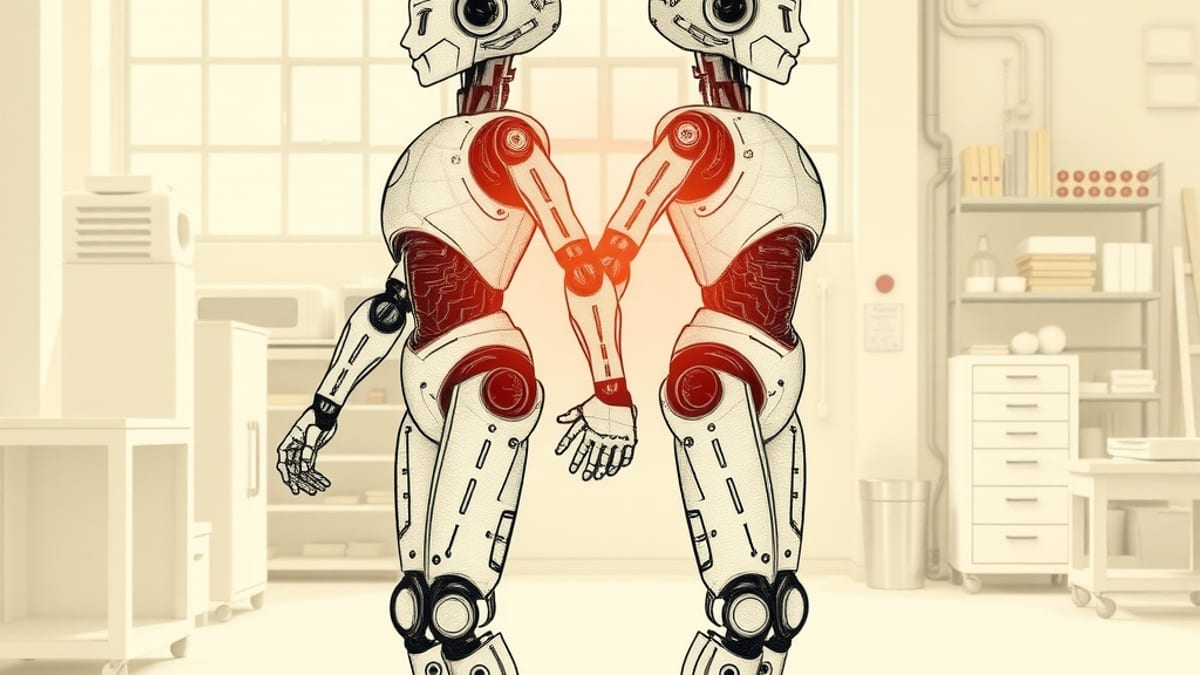
A new hierarchical system named "Social Humanoid" allows humanoid robots to coordinate physically with human partners, generating and executing socially responsive whole-body motion. This development addresses a gap where most humanoid robots are trained as solitary agents, lacking the ability to naturally interact and adjust with human collaborators.
The system operates by modeling human and humanoid motion through a shared tokenized representation. This allows for flexible sequence modeling, enabling the generation of reactive humanoid movements. A key feature is its ability to anticipate a human partner's motion even when they are occluded from view. A low-level whole-body tracking controller then executes the generated motion on the robot.
To train "Social Humanoid," researchers introduced a two-phase adaptive retargeting procedure. This process retargets one interaction partner to the robot while morphing the other to maintain contact dynamics, reachability, and relative body scale. This procedure was applied across five motion-capture datasets, creating a new benchmark of 260 hours of human-humanoid interactions. The researchers report that "Social Humanoid" produces coordinated and human-aligned behavior in both simulation and real-world tests.
The system is demonstrated on a 29-degree-of-freedom Unitree G1 humanoid robot. The Unitree G1, launched in August 2024, is known for its affordability and versatility, with configurations ranging from 23 to 43 degrees of freedom. It features advanced sensors such as LiDAR and depth cameras, making it suitable for various research and development tasks.
The development of "Social Humanoid" aims to move beyond training robots as isolated entities. By enabling robots to synchronize their movements and anticipate human actions, the system opens possibilities for collaborative physical tasks between humans and robots. The researchers highlight that the system can perform interactions such as hugs, greetings, and posing for photos, all executed with low latency.