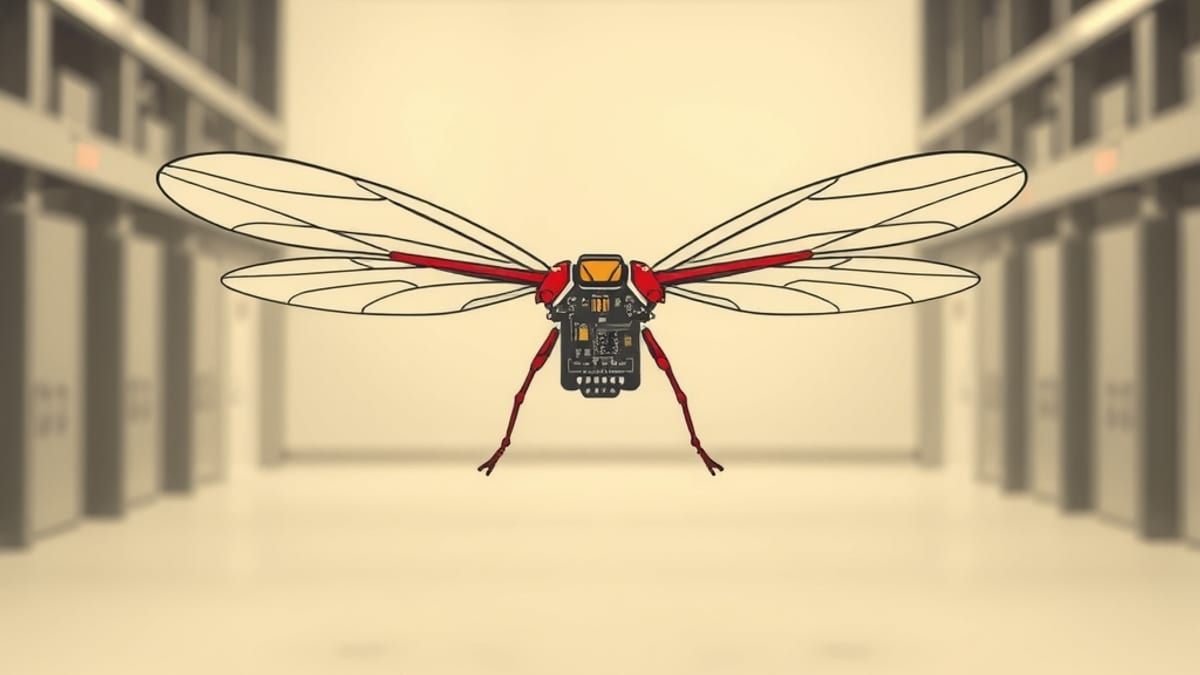
A new microrobot developed by MIT researchers can fly and navigate using only its onboard sensors and computer, a departure from earlier versions that required an external motion-capture system. The robot, which weighs 1.29 grams, roughly the weight of a paperclip, can hover and follow trajectories with centimeter-scale positional accuracy. This development, detailed in the journal Science Robotics, marks a step toward autonomous microrobots for tasks in environments where larger drones cannot operate.To enable the robot to carry the additional weight of its electronics, the research team enlarged its soft artificial muscles, which power its four wings. By tuning the radius and length of these actuators, they increased their size by 50 percent, boosting the net lift force by 46 percent. This allowed the robot to achieve a lift-to-weight ratio of 1.9.The onboard electronics package weighs 244 milligrams and includes an inertial measurement unit for attitude, an optical flow sensor for lateral speed and position, and a time-of-flight sensor for height. A microcontroller runs the control code. The team also developed a simplified sensing algorithm to quickly estimate the robot's orientation, angular velocity, and position, which helps reduce computational cost and drift.In tests, the microrobot maintained positional errors within a few centimeters during hovering and point-to-point flights. Researchers guided the robot using a joystick to send high-level position commands, successfully maneuvering it around several plants and landing it on a sunflower. This demonstrates a hierarchical control system, where a human operator provides broad directions and the robot's onboard systems manage the fine-tuned flight control.Kevin Chen, an associate professor in MIT's Department of Electrical Engineering and Computer Science and head of the Soft and Micro Robotics Laboratory, stated that this is the first demonstration of an aerial microrobot with sensory and computational autonomy. While the robot's perception and control are now onboard, it still receives power from an offboard source. The electronics consume about 6 percent of the total power, with the remainder driving the artificial muscles and wings.The researchers plan to integrate power electronics and batteries for fully untethered outdoor flight in the future. They also intend to add a miniature camera to enable autonomous object recognition and obstacle avoidance. Such microrobots could be deployed for tasks like pollinating crops in areas with declining natural pollinator populations, monitoring plants for pests, or conducting industrial surveillance in confined spaces.
MIT Microrobot Flies Without External System, Carries Onboard Sensors and Computer
Researchers at the Massachusetts Institute of Technology have developed a flapping-wing microrobot that navigates using its own onboard sensors and microcontroller, eliminating the need for an external motion-capture system. This advancement moves the insect-scale robot closer to practical applications such as agricultural monitoring and industrial inspection.