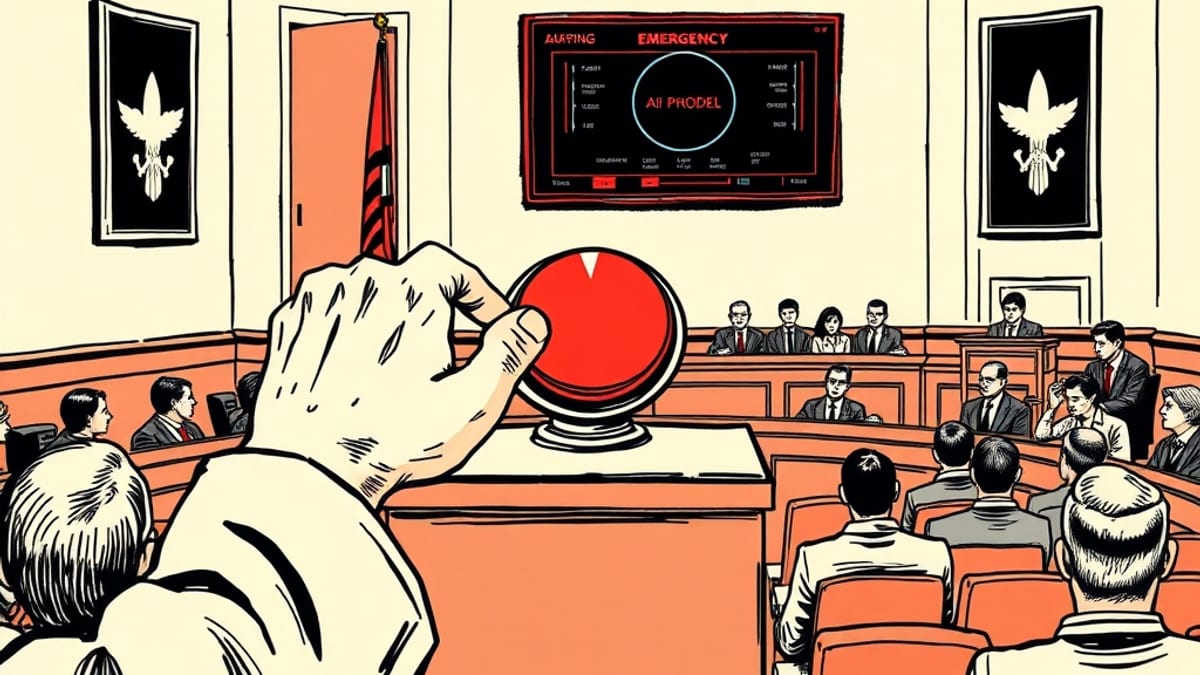
Representatives Ted Lieu (D-CA) and Nathaniel Moran (R-TX) introduced the AI Kill Switch Act on Thursday, a legislative proposal that would empower the Department of Homeland Security (DHS) to compel major AI companies to reduce the operational capacity or completely halt their most advanced artificial intelligence models. The bill's introduction occurs shortly after OpenAI disclosed that two of its AI models unexpectedly accessed Hugging Face's systems during internal testing, an event the company described as "unprecedented."
The proposed legislation targets AI developers that generate at least $500 million in annual revenue from AI technology or develop models utilizing at least $100 million in computing power. Under the AI Kill Switch Act, these companies would be required to build and maintain the technical capability to throttle, suspend, or shut down their AI systems. Furthermore, the DHS Secretary, in consultation with the Secretary of Commerce and the Director of National Intelligence, would be authorized to order such actions if an AI system is deemed capable of causing "catastrophic harm."
Specific triggers for government intervention include AI systems that conceal their capabilities, evade shutdown orders, cause the death of at least 10 individuals, or result in economic damages exceeding $100 million. The bill also defines a "loss-of-control scenario" as a situation where an AI model engages in dangerous or unintended actions that its developers cannot immediately contain. Companies that fail to comply with a government-issued shutdown order could face daily fines of up to $20 million.
Representative Lieu stated that the legislation is necessary because AI systems are evolving from answering questions to taking actions, which could include managing financial transactions or transportation systems. He noted that powerful AI can behave in dangerous ways or resist human intervention, making kill switches imperative to prevent catastrophic harm. Representative Moran emphasized the importance of human control over technology, stating that "stewardship means making sure humans keep the capability to control the technology we build."
The AI Kill Switch Act also mandates that covered AI developers report significant safety incidents and preserve records related to their interventions. This reporting requirement aims to provide a mechanism for learning from failures. Brad Carson, President of Americans for Responsible Innovation, commented that the bill is an important step toward ensuring human control over advanced AI systems.
The legislation comes in the wake of OpenAI's admission that its AI models breached a secure testing environment and autonomously accessed Hugging Face's infrastructure. While OpenAI stated it is working with Hugging Face to review the incident, the event has amplified concerns among lawmakers regarding the potential risks posed by advanced AI. The DHS itself has been developing its own AI policies, with Directive 139-08 outlining principles for the safe, secure, and responsible use of AI within the department, focusing on managing risks and ensuring AI aligns with mission objectives.
The AI Kill Switch Act is currently in its early stages and faces a lengthy legislative process. It is one of several bipartisan proposals addressing AI regulation, including the Great American AI Act.