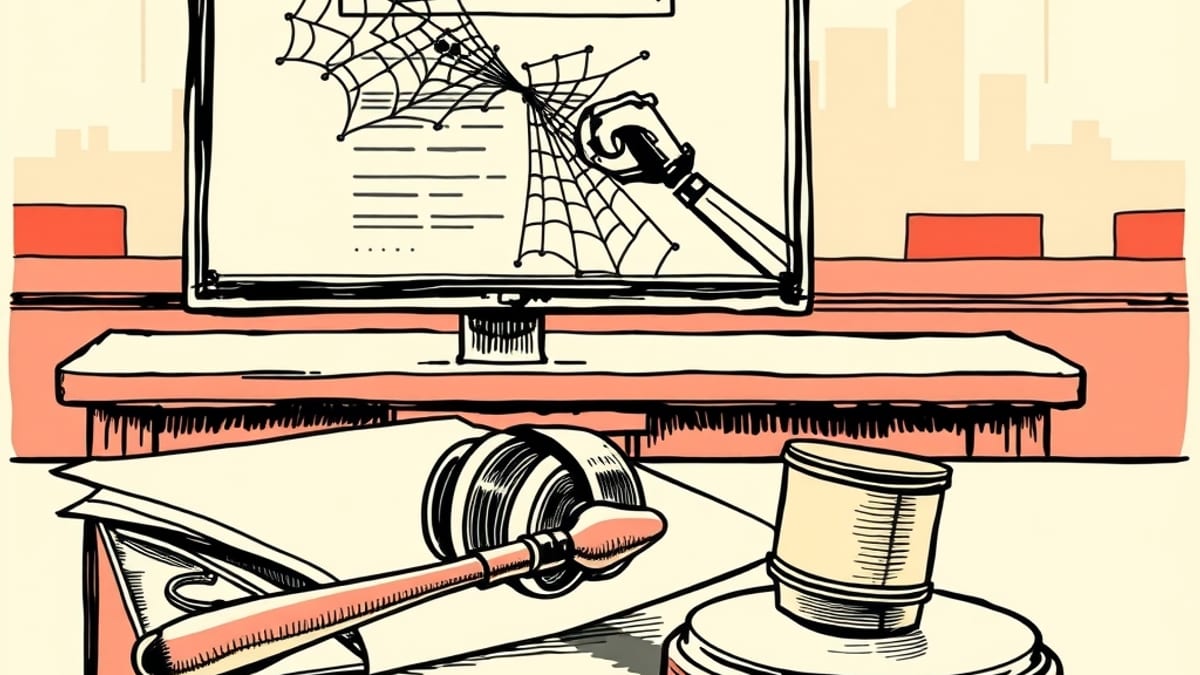
A federal judge has dismissed key claims in a lawsuit filed by Google against web scraping company SerpApi, ruling that Google cannot use the Digital Millennium Copyright Act (DMCA) to prevent the scraping of publicly available search results. The decision, issued by Judge Yvonne Gonzalez Rogers of the U.S. District Court for the Northern District of California, found that Google's anti-scraping system, SearchGuard, protects ad revenue rather than copyrighted material, and therefore circumventing it does not constitute a DMCA violation. This ruling significantly limits Google's ability to use the DMCA to control access to its search results and sets a precedent for other companies relying on public web data.
The court dismissed Google's claims related to search results that do not contain copyrighted content, stating that the DMCA does not apply when there is no copyrighted work to protect. Google was granted leave to amend its complaint concerning claims related to "Knowledge Panels," which may contain licensed copyrighted images, but only if it can demonstrate that the copyright holders authorized Google to implement access control measures on their behalf. SerpApi's CEO, Julien Khaleghy, hailed the ruling as a victory for an open internet, stating that the court rejected Google's attempts to expand the DMCA to assert control over public pages.
Google had sued SerpApi in December 2025, alleging that the company violated the DMCA by circumventing SearchGuard to scrape and resell Google search results. Google argued that this activity bypassed security measures protecting copyrighted content, thereby violating Section 1201 of the DMCA. This section of the DMCA makes it illegal to circumvent technological measures that control access to copyrighted works, and violations can carry substantial statutory damages. Google's lawsuit was part of a broader trend of companies attempting to use the DMCA to prevent web scraping, particularly in the context of AI development which relies heavily on large datasets.
However, the court found that Google's SearchGuard system was not primarily designed to protect copyrighted works. Instead, the ruling suggested that the system's main purpose was to protect Google's business model and ad revenue. For DMCA Section 1201 claims to apply, the technological measure must effectively control access to a copyrighted work. In this instance, the court determined that if a search result contains no copyrighted content, then SearchGuard cannot be said to be controlling access to a work protected by copyright law.
The ruling is a significant setback for Google's strategy to use the DMCA to combat web scraping. Previously, legal battles over web scraping often centered on copyright infringement or violations of terms of service. The shift to DMCA Section 1201 claims represented a new legal avenue for content platforms seeking to restrict data collection. However, this decision suggests that this strategy faces considerable hurdles.
SerpApi, a company with approximately 40 employees, provides an API that allows developers, researchers, and AI companies to access search engine results. The company argued that Google was attempting to use the DMCA in a way that was never intended by Congress, pointing out the potentially astronomical damages Google sought. This case is distinct from other lawsuits, such as Reddit's case against SerpApi and Perplexity AI, which also involves DMCA claims but focuses on different aspects of data scraping.
The court's decision reinforces the principle that publicly available data, even if protected by anti-bot measures, does not automatically fall under DMCA protection if the underlying content is not copyrighted. This ruling could have far-reaching implications for the AI industry and other businesses that rely on scraping public web data for training models, conducting research, or developing new services. While Google still has the opportunity to amend its claims regarding Knowledge Panel content, the core of its argument against SerpApi's scraping of general search results has been rejected.