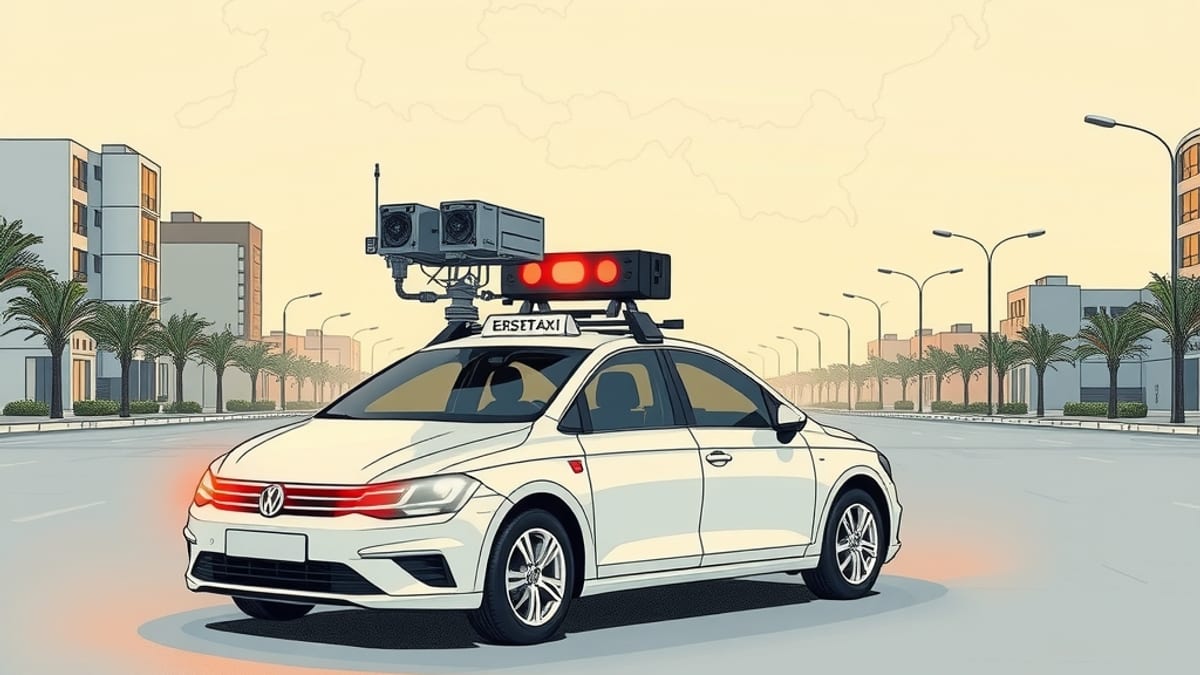
inDrive, a global mobility platform, announced a collaboration with Pony.ai and Nvidia to assess the viability of autonomous ride-hailing in Kazakhstan. The three companies plan to explore deploying Pony.ai's seventh-generation robotaxis in Astana, with initial tests anticipated in the first half of 2027. This initiative marks Pony.ai's first expansion into Central Asia.
Under the terms of the memorandum of understanding, Pony.ai will supply its Gen-7 robotaxis, which feature multi-sensor fusion and system-level redundancy for driverless operations. inDrive will manage the ride-hailing service through its existing platform, which has over 400 million downloads globally. Nvidia will provide the necessary AI infrastructure, including its Hyperion reference sensor and compute platform for Level 4 autonomous vehicles, and its Halos safety system.
Kazakhstan was selected as the initial test market due to its recent establishment of a legal framework for driverless transport, which is part of a broader national push towards digitalization and artificial intelligence. Astana, with a population of approximately 1.7 million, offers a suitable urban environment for testing these services alongside existing transportation options. inDrive Founder and Chief Executive Arsen Tomsky noted that Astana's status as the world's second-coldest capital will provide a challenging environment for autonomous technology, particularly in snow and ice conditions.
The collaboration will initially focus on evaluating the technical, operational, regulatory, and commercial feasibility of integrating Level 4 autonomous vehicles into the inDrive app. Initial trials in Astana are expected to include a safety operator, with the long-term goal of transitioning to fully driverless operations.
Pony.ai has experience with fully driverless commercial operations in major Chinese cities and has deployed its technology in other international markets, including Europe, the Middle East, and Asia. The company aims to expand its robotaxi fleet to over 3,500 vehicles across more than 20 cities by the end of 2026. For Nvidia, this project represents another deployment of its autonomous vehicle platform. Rishi Dhall, Vice President of Automotive at Nvidia, stated that the company's platforms are designed to reduce robotaxi development costs, which could be a factor in emerging markets with lower fare structures.
Should the Astana pilot prove successful, the partners plan to explore opportunities for expansion into other Kazakh cities and additional international markets where inDrive operates.