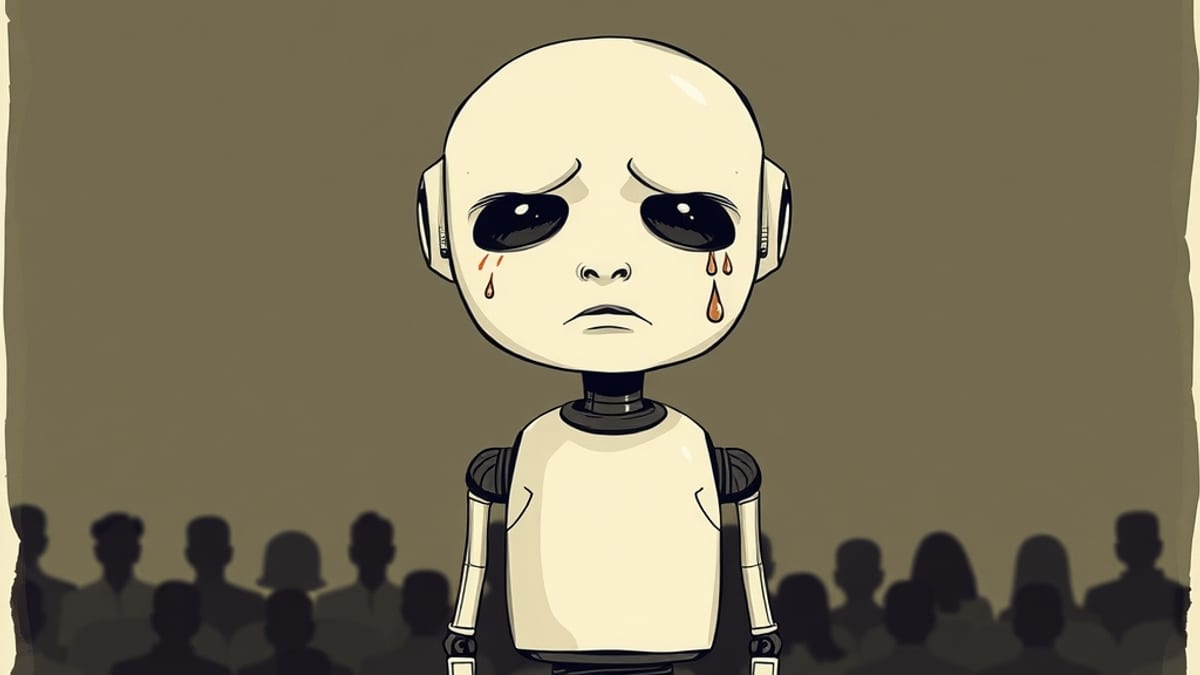
During a recent demonstration at a conference in Shanghai, a humanoid robot appeared to shed tears on command, signaling an advancement in the field of emotional AI and robotics. The robot's capacity to produce tears, a complex human emotional expression, suggests a move towards more naturalistic human-robot interaction.
The ability to mimic human emotions, including sadness and crying, is a focus for robotics developers seeking to enhance the fluidity and accuracy of human-robot exchanges. Researchers at Columbia University previously developed a robot named Eva that uses deep learning to analyze and replicate human facial gestures in real-time. Eva produces expressions by utilizing a combination of six basic emotions, with motors and cables manipulating its soft skin to achieve the desired mimicry. This approach allows for a range of expressions, from joy to a combination of joy and surprise.
Another prominent example is Ameca, developed by Engineered Arts, a UK-based company. Ameca is designed with a realistic face and body, using a material that imitates human skin to enable subtle and complex facial expressions. It can display a wide array of emotions, including happiness, surprise, sadness, and confusion, through its facial movements, which are powered by a system of motors and actuators. Ameca also employs advanced AI for natural language processing, allowing it to understand and respond to human speech and emotional cues. Engineered Arts states that Ameca comes pre-programmed with over 50 realistic facial expressions, and users can customize these expressions through a web-based platform.
The integration of such emotional mimicry in robots aims to make interactions more relatable and intuitive for humans. Studies have shown that adding tears to a robot's image can increase the perceived intensity of sadness and elicit a greater intention of support from human observers. This suggests that emotional expressions, even from robots, can have a social signaling function similar to human tears.
However, the increasing realism of these robots also raises discussions about the "uncanny valley," a phenomenon where robots that are too human-like can evoke feelings of unease or revulsion. Despite these concerns, developers like AheadForm in China are continuing to push the boundaries, creating humanoid robot heads that exhibit highly realistic facial expressions with subtle movements, blurring the line between machine and human. AheadForm's founder, Hu Yuhang, has suggested that within a decade, interactions with robots may feel almost human.
The development of robots capable of complex emotional mimicry suggests future applications in various sectors, including customer service, healthcare, and education, where emotionally intelligent robots could transform human-robot communication.