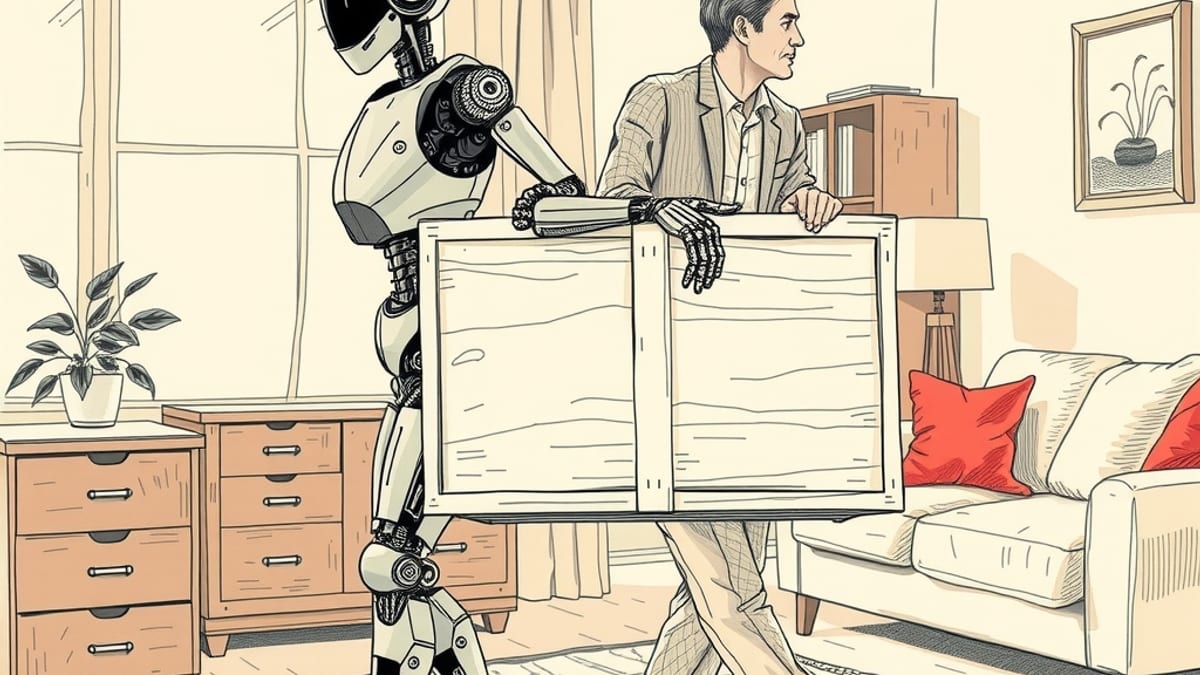
The HALO research project, developed by researchers at the University of Texas at Arlington and Carnegie Mellon University, focuses on improving human-robot collaboration in physically coupled tasks. The system addresses the challenge of coordinating humanoid robot movements with human partners during activities such as shared pushing and carrying.
HALO employs a novel pipeline to generate vision-language-motion data within a thousand procedurally generated home environments. This method allows the system to scale skill acquisition based on computational resources rather than relying on time-intensive human teleoperation or wearable capture devices. Typically, producing one hour of data through human interaction requires at least an hour of human input.
The core difficulty in human-robot collaboration lies in independent learning agents optimizing their own strategies, which can hinder overall coordination. HALO addresses this by adjusting learning updates to reduce disagreement with a shared objective. The system utilizes Heterogeneous-Agent Lyapunov policy Optimization (HALO) to establish formal stability directly in the policy-parameter space, ensuring a per-step Lyapunov decrease condition on a parameter-space disagreement metric. This approach stabilizes decentralized policy learning, distinguishing it from methods that primarily constrain physical trajectories for safety.
Experiments with HALO have demonstrated its ability to perform cooperative tasks, including pushing with precise orientation, navigating through narrow spaces, and handling long objects. The system also shows coordination when a human partner is obstructed or changes height, which are critical tests for shared objects that make each participant's movements immediately consequential.
The researchers report improved generalization and robustness in both simulations and real-world humanoid robot experiments. The demonstrations involved a Unitree G1 humanoid robot jointly carrying a tire with a human partner through an obstacle course. While promising, the real-robot results were obtained using motion capture and a limited number of trials.
The project's findings suggest that HALO's certified stability can improve generalization and robustness in collaborative scenarios, particularly in "corner cases" where complex physical coupling and human-induced perturbations occur. This research aims to enable humanoids to coordinate with people during physically coupled tasks, including transport through confined spaces, and represents a step toward more generalist humanoid autonomy.