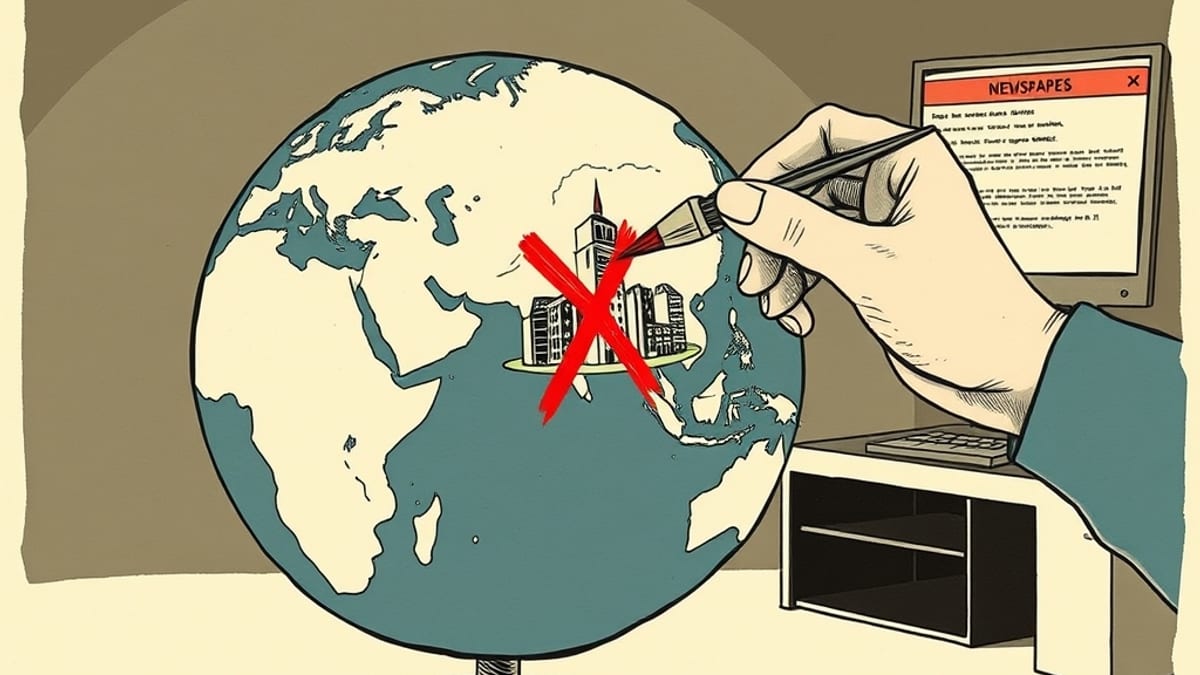
Google has withdrawn a newly introduced artificial intelligence image generation tool from its Google Earth platform, citing policy violations and the potential for misinformation. The feature, which allowed users to create photorealistic images overlaid on real-world satellite, aerial, and 3D mapping data through text prompts, was available for less than a day.
The tool, powered by Google's Nano Banana 2 image-generation technology, was launched on Thursday. However, by Friday, Google announced its rollback, stating, "We've seen people sharing screenshots of generated imagery that appear to violate our policies. So we're rolling back this feature in Google Earth while we work on implementing stronger guardrails." The company indicated that the generated images did not appear within the main Google Earth experience but were shared as screenshots elsewhere online.
Critics raised concerns that the feature could be easily misused to fabricate satellite imagery of real locations, potentially spreading disinformation. Researchers demonstrated the tool's capacity to generate misleading images, including scenarios like refugee camps near the Mexican border, bomb craters near hospitals, or nuclear facilities in Iran. Concerns were also raised about the potential for the tool to create fake images of sensitive events or locations, impacting public trust in genuine geospatial information.
Google initially defended the feature, stating that all images created with Nano Banana in Google Earth included a SynthID digital watermark. This technology embeds an invisible watermark directly into AI-generated content, designed to be detectable by specific software. Google suggested that users could verify an image's authenticity by using the Gemini app or Google Lens in Search. However, some experts argued that SynthID's effectiveness was limited, with one report suggesting it only watermarked a fraction of the generated image and that verification often required using Google's own products. Critics also pointed out that many users do not take the time to verify image authenticity, placing the burden on the consumer to discern real from fake.
The company acknowledged that while geospatial professionals had found uses for the feature, "people sharing screenshots of generated imagery that appear to violate our policies" prompted the rollback. Google did not specify which types of images violated its policies. This incident follows a similar situation in February 2024, when Google paused Gemini's image generation capabilities after the tool produced historically inaccurate depictions of people.
Google has not provided a timeline for when, or in what revised form, the Google Earth image generation tool might return. The company has emphasized its commitment to integrating AI into its mapping technologies, with ongoing efforts in areas like advanced geospatial AI and natural language querying of satellite imagery.